
Do filler words hurt your YouTube videos? What 923,593 transcripts show
Videos with under 3 filler words per 1,000 reach 2x their channel's usual views 22.1% of the time, against 18.9% at 15 or more. The effect is real but small, and it is about breakouts, not the typical video.

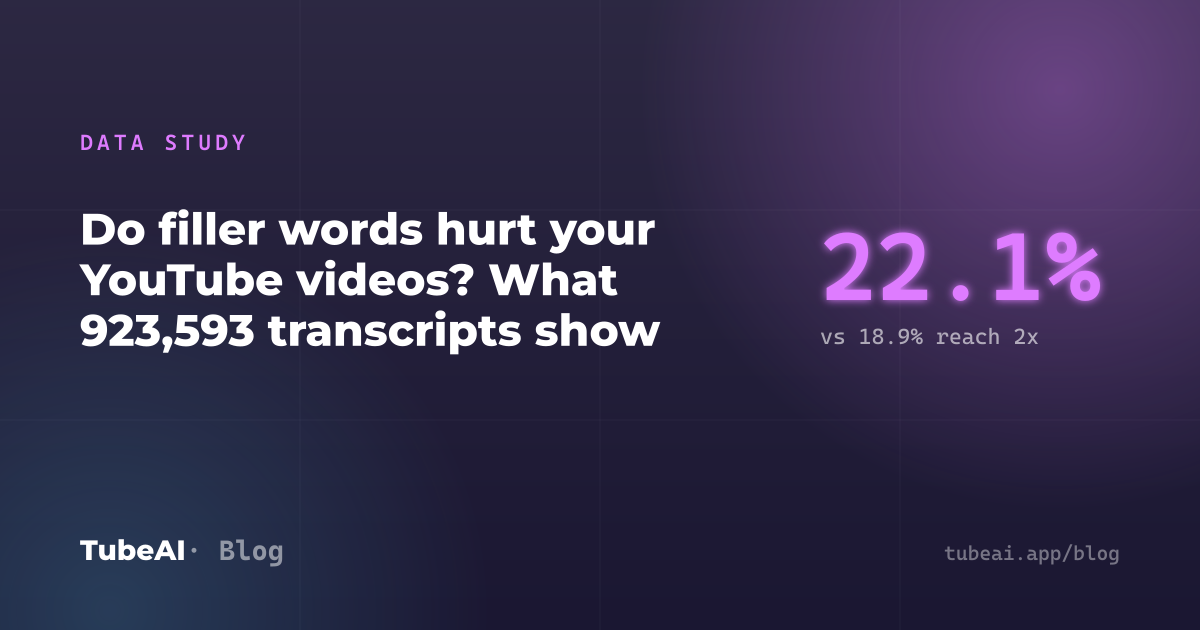
Yes, but only a little. In 923,593 English YouTube videos from 58,586 creator channels, videos with under 3 filler words per 1,000 spoken words reached twice their channel's usual views 22.1% of the time. Videos with 15 or more reached it 18.9% of the time. The typical video performs about the same at every filler rate. What changes is how often a video breaks out.
I measured fillers straight from the transcripts: "um", "uh" and "erm", plus verbal padding such as "you know", "basically", "literally", "actually", "kind of", "sort of" and "I mean". The measure does not count "like", because most of the time "like" is a real word.
- 923,593English long-form transcripts analyzed58,586 creator channels
- 10.8Median filler words per 1,000 spoken words
- 22.1%Videos reaching 2x with under 3 fillers per 1,000
- 18.9%Videos reaching 2x with 15+ fillers per 1,000
How many filler words do YouTubers use?
The median video in the sample has 10.8 filler words per 1,000 spoken words. That is roughly one every 90 words, or about 15 a minute at a typical speaking pace. Very clean delivery is rare: 11.5% of videos stay under 3 per 1,000. At the other end, 11.0% reach 25 or more, about one filler every 40 words.
Longer videos carry more fillers. The median rate is 8.6 per 1,000 for 3-10 minute videos and 13.4 for videos over 40 minutes, which fits what long videos usually are: more conversation, more unscripted talk, fewer retakes.
Do filler words hurt views?
To compare channels of very different sizes, I used the outlier multiplier: a video's views divided by its channel's typical views. A video at 2x got twice what that channel usually gets. Across the sample, 19.8% of videos reached 2x.
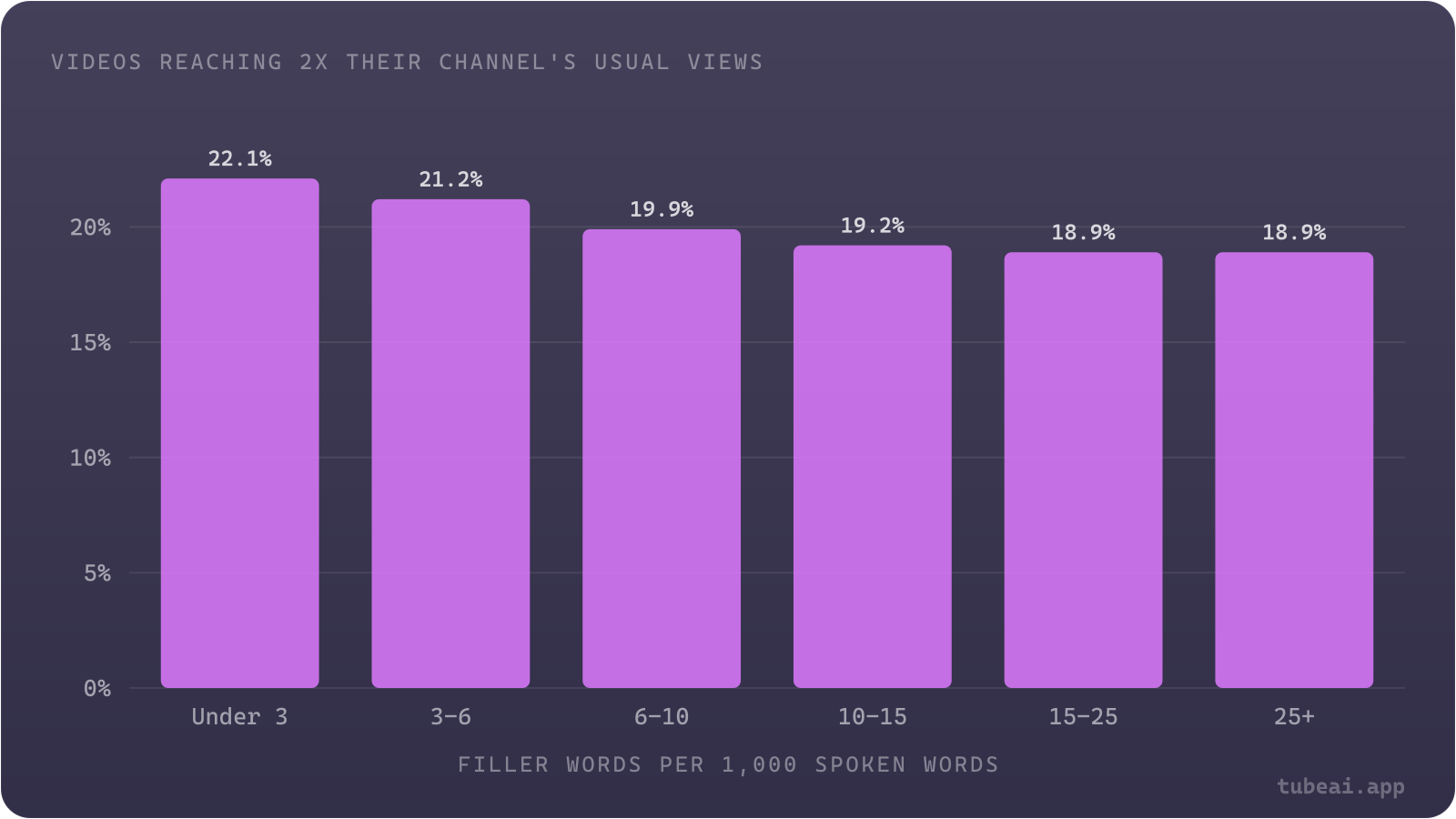
Chart data
| Filler words per 1,000 spoken words | Videos reaching 2x their channel's usual views (%) |
|---|---|
| Under 3 | 22.1 |
| 3-6 | 21.2 |
| 6-10 | 19.9 |
| 10-15 | 19.2 |
| 15-25 | 18.9 |
| 25+ | 18.9 |
The share falls steadily from 22.1% to 18.9% as fillers rise, then flattens: 25 or more per 1,000 does no worse than 15-25. The median multiplier barely moves, though. It sits between 0.99x and 1.06x in every band. So filler words do not drag the typical video down. They lower the odds of the big video, the one that travels past your usual audience.
| Filler words per 1,000 | Videos | Channels | Reached 2x | Median multiplier |
|---|---|---|---|---|
| Under 3 | 106,340 | 21,867 | 22.1% | 1.02x |
| 3-6 | 122,908 | 29,517 | 21.2% | 1.06x |
| 6-10 | 192,572 | 36,285 | 19.9% | 1.03x |
| 10-15 | 203,431 | 34,439 | 19.2% | 1.04x |
| 15-25 | 196,478 | 28,357 | 18.9% | 1.02x |
| 25+ | 101,864 | 14,643 | 18.9% | 0.99x |
Is it just that longer videos have more fillers?
That was the first thing to rule out, since long videos carry more fillers and behave differently. So I split the sample by length. Low-filler videos come out ahead in every band, by 2.5 to 4.2 points, with the widest gap in 20-40 minute videos.
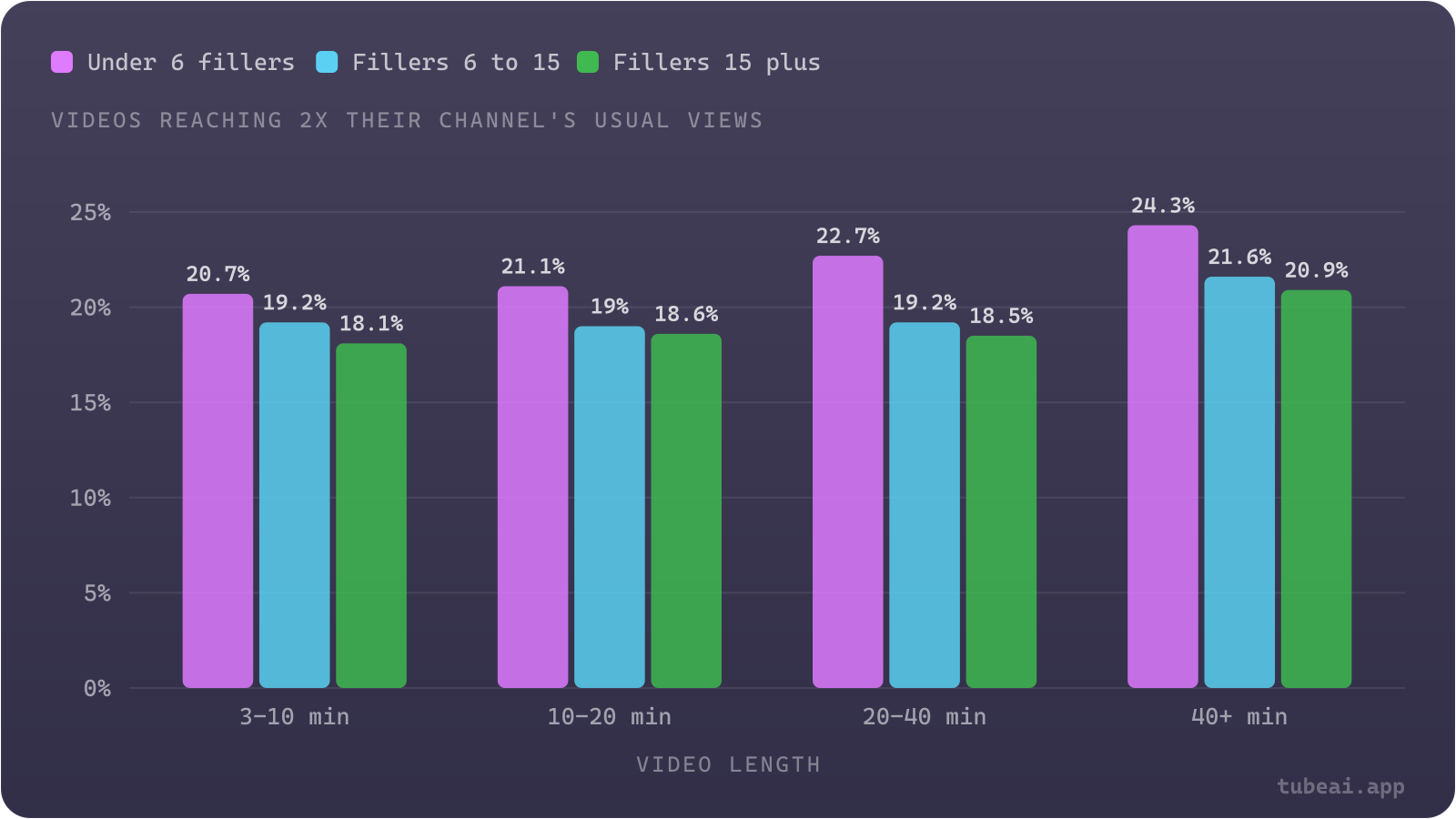
Chart data
| Video length | under_6_fillers (%) | fillers_6_to_15 (%) | fillers_15_plus (%) |
|---|---|---|---|
| 3-10 min | 20.7 | 19.2 | 18.1 |
| 10-20 min | 21.1 | 19 | 18.6 |
| 20-40 min | 22.7 | 19.2 | 18.5 |
| 40+ min | 24.3 | 21.6 | 20.9 |
Does cutting fillers help your own channel?
Comparing different channels can mislead: a tightly scripted explainer channel and a chatty podcast differ in far more than filler words. The fairer test is to compare a channel with itself. For 16,811 channels with at least 10 videos in the sample, I took each channel's usual (median) filler rate and sorted every video by how far it sat from that norm.
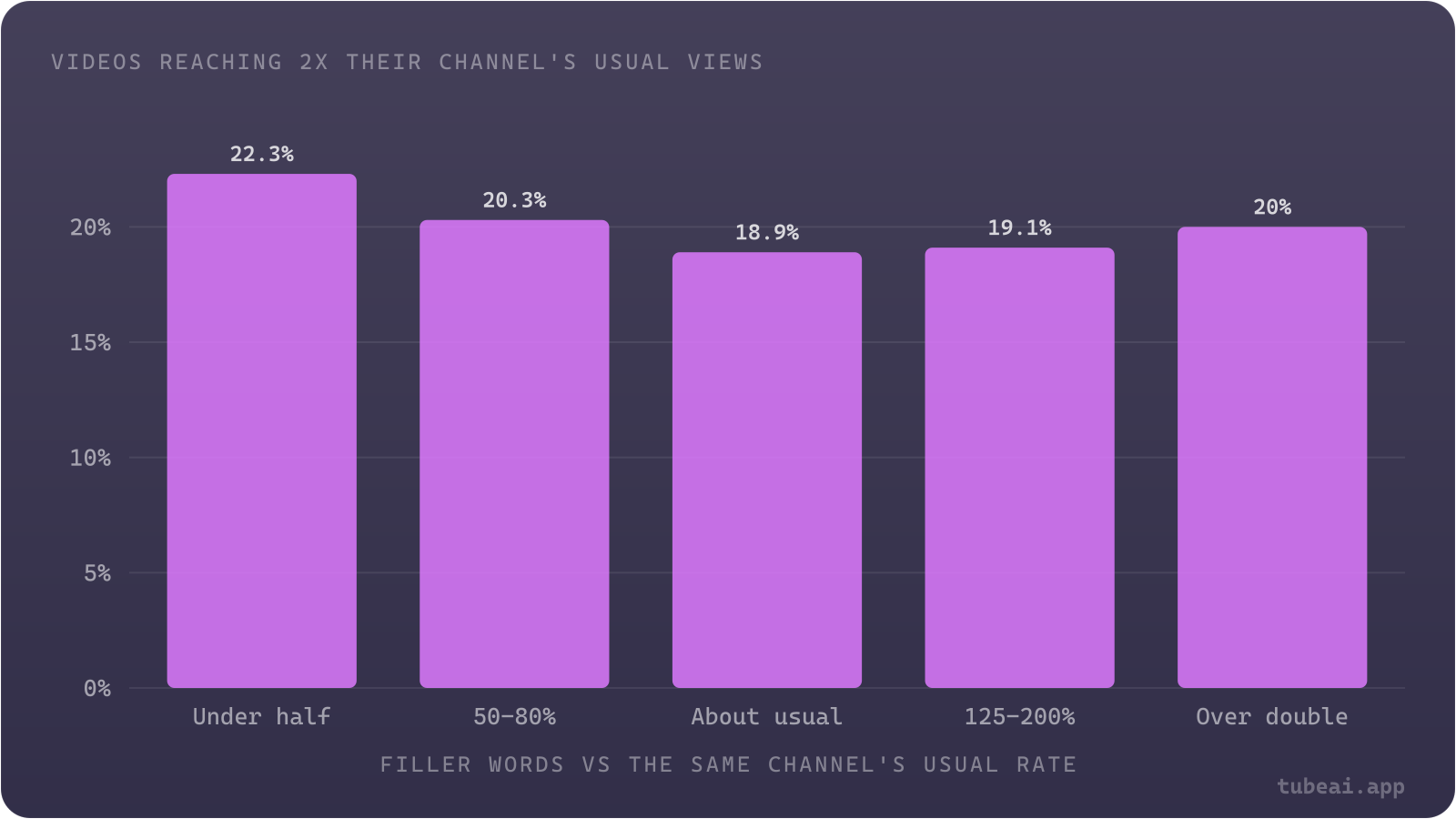
Chart data
| Filler words vs the same channel's usual rate | Videos reaching 2x their channel's usual views (%) |
|---|---|
| Under half | 22.3 |
| 50-80% | 20.3 |
| About usual | 18.9 |
| 125-200% | 19.1 |
| Over double | 20 |
When a channel's video had under half its usual fillers, 22.3% of those videos reached 2x, against 18.9% at the channel's usual rate. Going above the norm did not lower the breakout rate (19.1% and 20.0%), but videos at over double the usual rate had the lowest median multiplier in the comparison, 0.95x.
That points to a real but modest effect. It also hints at why: a video with far fewer fillers than usual is often a more prepared video, with a tighter script, more retakes or a sharper edit. Fewer fillers is partly a sign of that extra work, not only a cause of the result.
Which niches are hurt most by filler words?
The gap depends on the niche. In niches where viewers come for information, such as markets, cooking, travel and cars, low-filler videos break out 4-5 points more often. In niches built on personality and conversation, such as reactions, commentary, politics and entertainment, the gap disappears or reverses. There, a loose, natural delivery is part of the format.
| Niche | Median fillers per 1,000 | Under 6 fillers | 15+ fillers | Gap (points) |
|---|---|---|---|---|
| Financial Markets | 12.6 | 17.7% | 12.5% | +5.2 |
| Food | 8.7 | 22.7% | 17.7% | +5.0 |
| Travel & Adventure | 11.1 | 21.4% | 16.6% | +4.8 |
| Automotive | 13.0 | 22.5% | 18.5% | +4.0 |
| Gaming | 11.3 | 21.0% | 17.7% | +3.3 |
| Health & Fitness | 7.1 | 22.7% | 19.8% | +2.9 |
| Lifestyle & Personal | 11.4 | 17.3% | 14.5% | +2.8 |
| Tech | 9.6 | 24.3% | 21.8% | +2.5 |
| Relationships & Family | 10.7 | 20.3% | 19.9% | +0.4 |
| Commentary & Analysis | 11.8 | 20.3% | 20.1% | +0.2 |
| Politics & Government | 13.6 | 24.1% | 24.7% | -0.6 |
| Reaction Videos | 11.6 | 21.8% | 22.7% | -0.9 |
| Entertainment | 10.7 | 19.8% | 22.1% | -2.3 |
Do small channels need to care more?
Yes. The gap shrinks as channels grow. Under 10,000 subscribers, low-filler videos reach 2x 6.4 points more often. At 1M+ it is 0.7 points. An established audience forgives a loose delivery; viewers who do not know you yet are quicker to leave. The under-10K group is the smallest in the sample, so treat its number as a direction rather than a precise figure.
| Subscribers | Videos | Channels | Under 6 fillers | 15+ fillers | Gap (points) |
|---|---|---|---|---|---|
| Under 10K | 16,216 | 3,521 | 25.9% | 19.5% | +6.4 |
| 10K-100K | 183,726 | 14,509 | 24.1% | 20.3% | +3.8 |
| 100K-1M | 583,427 | 34,498 | 21.3% | 18.8% | +2.5 |
| 1M+ | 140,224 | 6,107 | 18.3% | 17.6% | +0.7 |
How to cut filler words without sounding scripted
The goal is not zero fillers. Videos at 3-6 per 1,000 do almost as well as videos under 3, and in conversational niches fillers do not matter at all. The goal is to stop fillers from padding the parts that carry information.
Script the parts that carry information
Write out your opening and your key explanations, even if you talk freely between them. Fillers cluster where you are thinking on camera.
Pause instead of filling
A one-second silence reads as confidence on video. Practice stopping at the end of a thought instead of bridging it with "um" or "so, basically".
Cut them in the edit
Most fillers sit at the start of a sentence, so they cut cleanly. Prioritize the first minute, where viewers decide whether to stay.
Measure your own rate
Count fillers in one transcript and divide by the word count. If you are above about 15 per 1,000 in an information niche, that is where to start.
Keep your natural voice
Do not over-polish a conversational format. In reaction, commentary and entertainment videos, a loose delivery is part of what viewers come for.
Delivery is one part of a script that holds attention. Speaking pace matters too: see how fast you should talk on YouTube. The first seconds matter most, so read how to start a YouTube video. For pacing a whole script, see the best YouTube video length and what sponsor reads do to performance.
Questions about filler words on YouTube
Do filler words hurt YouTube videos?
A little. In 923,593 English videos, those with under 3 filler words per 1,000 spoken words reached twice their channel's usual views 22.1% of the time, against 18.9% for videos with 15 or more. The typical video performs about the same at any filler rate; fillers mainly lower the odds of a breakout.
How many filler words is normal in a YouTube video?
The median is 10.8 filler words per 1,000 spoken words, about one every 90 words. Only 11.5% of videos stay under 3 per 1,000, and 11.0% reach 25 or more.
Which words count as filler words?
This analysis counted um, uh and erm, plus you know, basically, literally, actually, kind of, sort of and I mean. It did not count like, because most of the time like is a real word in the sentence.
Should I remove every um from my videos?
No. Videos with 3-6 fillers per 1,000 words do almost as well as videos with under 3. Focus on cutting fillers from the opening and from explanations, especially in information niches. In reaction, commentary and entertainment videos, fillers made no measurable difference.
Do filler words matter more for small channels?
Yes. Under 10,000 subscribers, low-filler videos reached 2x 6.4 points more often than high-filler ones. For channels with 1M+ subscribers the gap was 0.7 points.