
How fast should you talk on YouTube? Words per minute vs views
I measured the speaking pace of 119,654 long-form videos. The typical video runs at 162 words per minute, and talking faster or slower barely moves views.

Talk at whatever pace sounds natural for your niche, usually somewhere between 150 and 190 words per minute. I measured the speaking pace of 119,654 long-form YouTube videos published in June 2026, and the median video runs at 162 words per minute across its whole runtime. Faster and slower videos break out at almost exactly the same rate: between 18.2% and 20.9% of videos in every pace band reached twice their channel's typical views. When I compared each channel only with itself, its faster videos beat its slower ones by 2%, a coin flip.
So pace is not a growth lever on its own. It is a fit question: match the pace your niche and your audience expect, and spend your effort on the hook, the structure and the packaging instead.
- 162 wpmMedian speaking paceover the whole video, June 2026
- 36%Videos at 150-189 wpmthe most common range
- 1.02xFaster vs slower, same channelmedian outlier ratio
- 51.1%Channels where faster wonof 15,087 channels
How I measured speaking pace
I took every long-form video (3 to 60 minutes) published in June 2026 by the creator channels the TubeAI database serves, kept the ones with an English transcript, and divided the transcript's word count by the video's length. That gave 119,654 videos from 56,939 channels.
Two things to keep in mind when you read the numbers:
- It is a whole-video average. Intros, music, B-roll and pauses all count as time, so the pace while someone is actually talking is higher than the figure shown. A video averaging 162 words per minute might be spoken at 175-185 when the narrator is on.
- Under 100 words per minute usually means little speech. Gameplay, ASMR, cooking without narration and music-heavy vlogs land there. 14.6% of videos do.
To measure performance I used the outlier score: a video's views divided by its channel's typical views. 1x is a normal video for that channel, 2x is a breakout. It compares each video only with its own channel, so a big channel's numbers don't drown out a small one's.
Does talking faster get more views?
No. The share of videos that reached 2x their channel's typical views barely moves across the whole range of speaking pace, and neither does the median video.
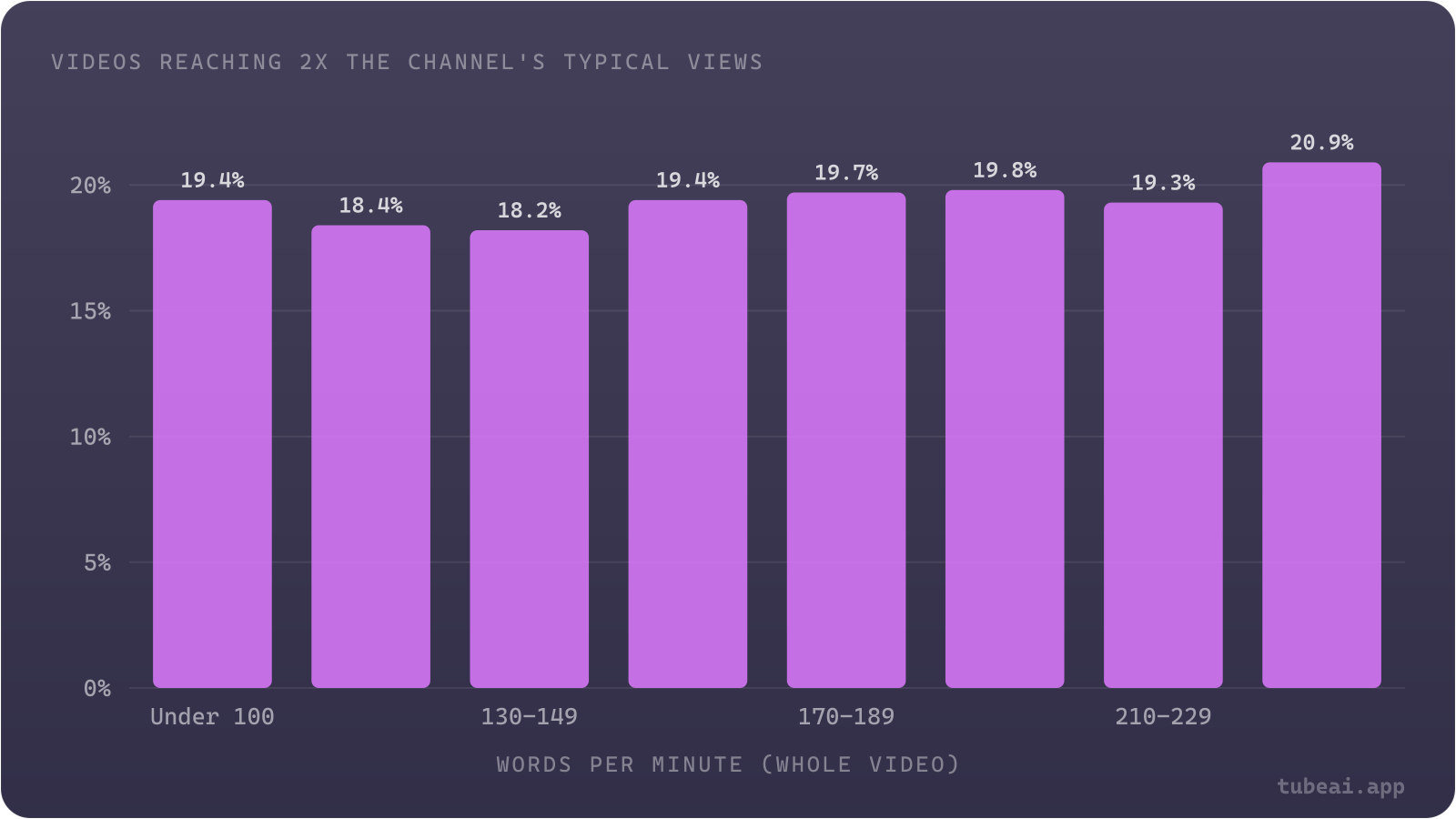
Chart data
| Words per minute (whole video) | Videos reaching 2x the channel's typical views (%) |
|---|---|
| Under 100 | 19.4 |
| 100-129 | 18.4 |
| 130-149 | 18.2 |
| 150-169 | 19.4 |
| 170-189 | 19.7 |
| 190-209 | 19.8 |
| 210-229 | 19.3 |
| 230+ | 20.9 |
| Words per minute | Share of videos | Median outlier | Reached 2x | Under half of typical |
|---|---|---|---|---|
| Under 100 | 14.6% | 0.98x | 19.4% | 18.1% |
| 100-129 | 12.0% | 0.97x | 18.4% | 17.1% |
| 130-149 | 12.9% | 0.94x | 18.2% | 18.5% |
| 150-169 | 17.4% | 0.96x | 19.4% | 18.8% |
| 170-189 | 18.7% | 0.97x | 19.7% | 19.5% |
| 190-209 | 14.0% | 0.97x | 19.8% | 19.2% |
| 210-229 | 7.1% | 0.96x | 19.3% | 20.0% |
| 230+ | 3.4% | 0.98x | 20.9% | 19.7% |
The gap between the slowest-performing band (130-149, 18.2% at 2x) and the best (230+, 20.9%) is under 3 points, and the median video sits between 0.94x and 0.98x in every band. The very fastest band edges ahead, but it is only 3.4% of videos, and it also has one of the higher shares of videos that land under half their channel's usual views. Fast talkers swing a little wider in both directions.
The same channel, talking faster vs slower
Comparing different videos mixes in everything else that differs between them: niche, format, channel size. So I also compared each channel with itself. For 15,087 channels with at least six talking videos (100+ words per minute) published April to June 2026, I took the channel's own median pace and split its videos into faster (10%+ above it) and slower (10%+ below it).
The faster videos got a median 1.02x the outlier score of the slower ones, and came out ahead on 51.1% of channels. 52,810 faster videos against 59,047 slower ones, and the result is a tie. Speeding up your own delivery is not, by itself, going to change your numbers.
Pace by channel size
There is one place pace shows a pattern: channel size. On channels under 10K subscribers, the 2x rate climbs from about 20% at 100-169 words per minute to 24.4% at 210-229. On channels with 1M+ subscribers, it goes the other way: talking videos reach 2x only 14-16% of the time at every pace, and the fastest bands are among the weakest.
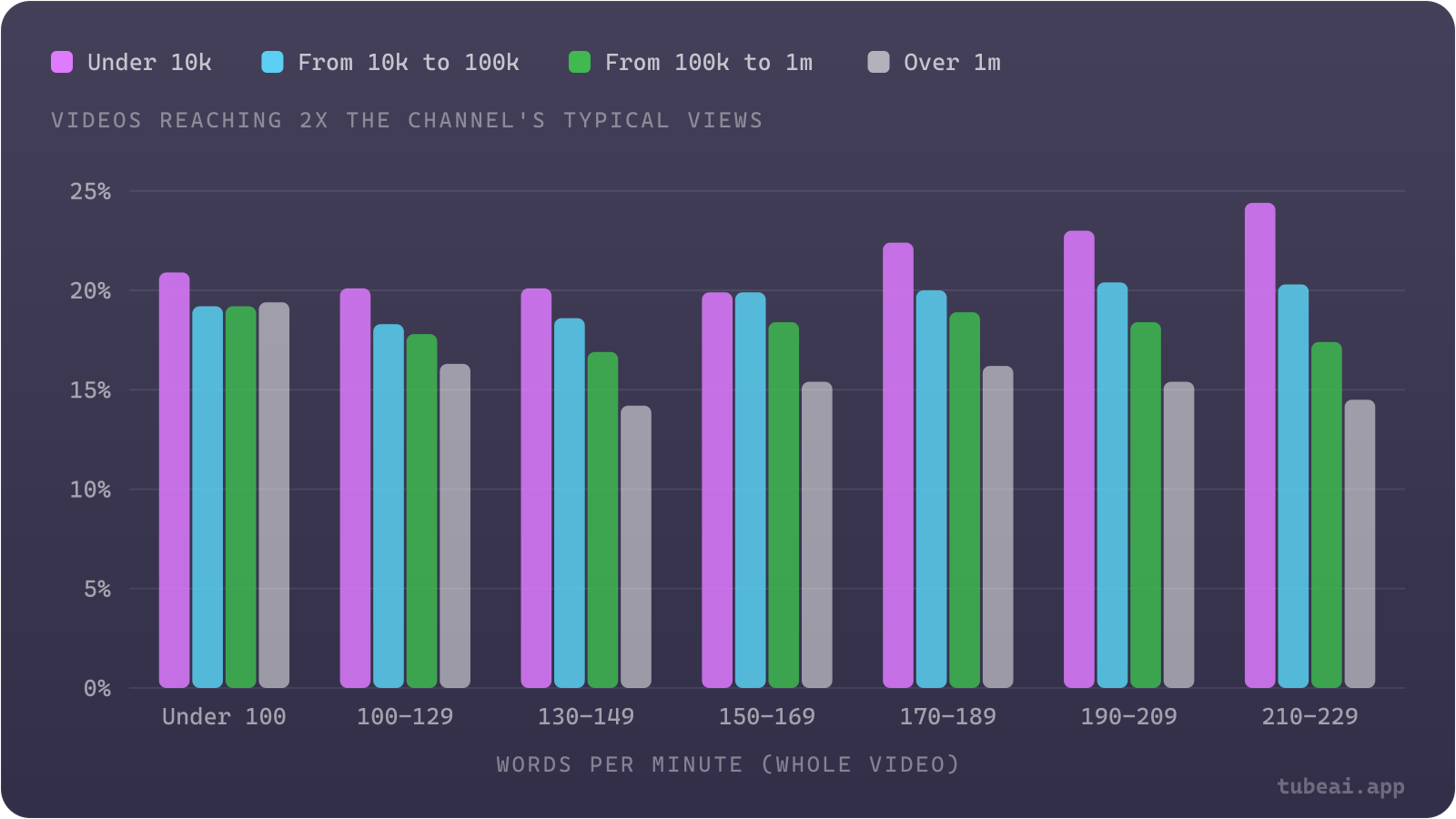
Chart data
| Words per minute (whole video) | under_10k (%) | from_10k_to_100k (%) | from_100k_to_1m (%) | over_1m (%) |
|---|---|---|---|---|
| Under 100 | 20.9 | 19.2 | 19.2 | 19.4 |
| 100-129 | 20.1 | 18.3 | 17.8 | 16.3 |
| 130-149 | 20.1 | 18.6 | 16.9 | 14.2 |
| 150-169 | 19.9 | 19.9 | 18.4 | 15.4 |
| 170-189 | 22.4 | 20 | 18.9 | 16.2 |
| 190-209 | 23 | 20.4 | 18.4 | 15.4 |
| 210-229 | 24.4 | 20.3 | 17.4 | 14.5 |
The small-channel groups are the smallest in the study (663 videos in the 210-229 band), so read this as a lean, not a rule. A plausible reading: a small channel is competing for a stranger's first click, and an energetic delivery helps a new viewer stay. A large channel's audience already knows the host and comes back for them at whatever pace they speak.
Typical speaking pace by niche
Where pace really varies is between niches. Explainer-heavy niches run fast, and hands-on or atmospheric ones run slow, partly because their videos contain long stretches without speech.
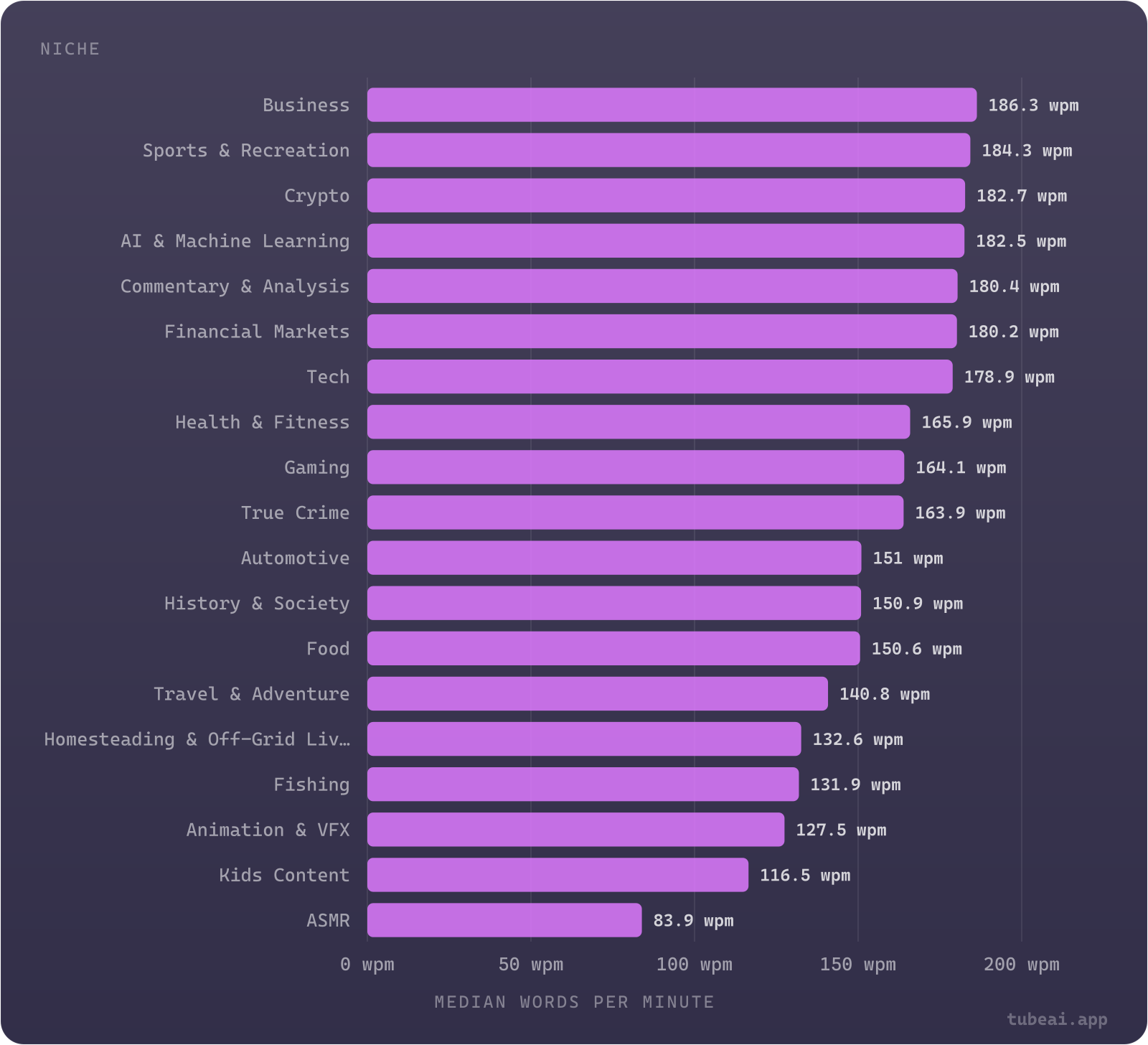
Chart data
| Niche | Median words per minute (wpm) |
|---|---|
| Business | 186.3 |
| Sports & Recreation | 184.3 |
| Crypto | 182.7 |
| AI & Machine Learning | 182.5 |
| Commentary & Analysis | 180.4 |
| Financial Markets | 180.2 |
| Tech | 178.9 |
| Health & Fitness | 165.9 |
| Gaming | 164.1 |
| True Crime | 163.9 |
| Automotive | 151 |
| History & Society | 150.9 |
| Food | 150.6 |
| Travel & Adventure | 140.8 |
| Homesteading & Off-Grid Living | 132.6 |
| Fishing | 131.9 |
| Animation & VFX | 127.5 |
| Kids Content | 116.5 |
| ASMR | 83.9 |
If your niche's median is 180 and you deliver at 130, you will sound slow to viewers used to that niche, even though 130 is perfectly normal in fishing or travel. Use your niche's median as the reference point, not a universal number.
Does pace change with video length?
Very little. Short and long videos are spoken at almost the same pace, so you don't need to slow down for a long video or rush a short one.
| Video length | Videos | Median words per minute | Median outlier | Reached 2x |
|---|---|---|---|---|
| 3-8 min | 20,429 | 158.8 | 0.85x | 19.3% |
| 8-15 min | 38,852 | 165.9 | 0.93x | 19.0% |
| 15-30 min | 39,112 | 161.5 | 1.00x | 19.6% |
| 30-60 min | 21,261 | 160.4 | 1.04x | 19.2% |
Turning pace into a script length
The most practical use of a words-per-minute figure is sizing a script. At the 162 median, a 10-minute video is about 1,600 words and a 20-minute video about 3,200. Because the median is a whole-video average, these word counts already leave room for B-roll and pauses. If you talk faster than your niche's median, write more words for the same runtime; if you deliver slowly, write fewer.
For how long the video itself should be, see our study of YouTube video length and script word counts.
How to set your speaking pace
Find your current pace
Take the word count of a recent script or transcript and divide it by the video's length in minutes.
Compare it with your niche
Use the niche chart above. Within about 20 words per minute of the median is normal for your audience.
Cut words, don't speed up
If a video feels slow, remove filler and repeated points from the script rather than reading the same script faster.
Spend the effort on the opening
The first seconds decide whether a viewer stays at all. Our study of how to start a YouTube video covers what works.
Size the next script from your pace
Multiply your words per minute by the length you want, and write to that word count.
Pace is one part of a script among many. For the parts that do move the numbers, see how to start a YouTube video, how to end one, and whether sponsor reads hurt your videos.
Limits of this data
- The pace is a whole-video average, so it mixes speaking speed with how much of the video has speech at all.
- Only videos with an English transcript in our database are included, from one month (June 2026) for the main figures and three months (April to June 2026) for the same-channel test.
- The outlier score measures views. It doesn't show watch time or how well viewers followed along.
Frequently asked questions
What is a good speaking pace for YouTube?
Most long-form YouTube videos run between 150 and 190 words per minute over their full length, with a median of 162. Any pace in that range is normal; what matters more is matching what viewers expect in your niche.
Does talking faster on YouTube get more views?
Not by itself. Across 119,654 videos, every pace band reached 2x the channel's typical views 18-21% of the time, and within the same channel faster videos beat slower ones on only 51.1% of channels.
How many words is a 10-minute YouTube video?
At the median pace of 162 words per minute measured over the whole video, a 10-minute video is about 1,600 words. That figure already includes time for B-roll and pauses.
Which YouTube niches talk the fastest?
Business, sports, crypto, AI, commentary and financial markets videos run at 180-186 words per minute. Fishing, homesteading and animation run around 128-133, and ASMR at about 84.
Should small channels talk faster?
Slightly. On channels under 10K subscribers, videos at 210-229 words per minute reached 2x 24.4% of the time against about 20% at slower paces. On 1M+ channels faster talking showed no benefit.