
When to ask viewers to subscribe: what 180,553 video scripts show
Most creators never ask. The ones who do mostly ask at the end, and that is where the ask lines up with the strongest videos, especially when it is repeated from the opening.

Ask viewers to subscribe at the end of the video, after the value has landed, and if you want to ask early too, repeat it at the close. In 180,553 long-form English scripts I pulled from the TubeAI research database, videos that asked only at the end did 1.18x better than the same channel's videos with no ask, and videos that asked at the opening and again at the end did 1.30x better. An ask that appeared only at the opening, or only in the middle, made almost no difference.
Most creators skip the question entirely: 62.4% of the scripts never say "subscribe" at all.
- 62.4%of scripts never ask112,614 of 180,553 videos
- 7.6%ask in the openingfirst 10% of the script
- 1.18xend-only askvs the same channel's no-ask videos
- 1.30xopening + endvs the same channel's no-ask videos
Where creators actually put the subscribe ask
I read each transcript and located every time the creator said the word "subscribe". Then I sorted videos by where the first ask landed: the opening (the first 10% of the script, about the first minute and a half of a 15-minute video), the middle, or the end (the last 15%). Videos that asked in the opening and again at the end get their own group.
The end is by far the most common place to ask. The early ask many creators think of as standard is actually rare.
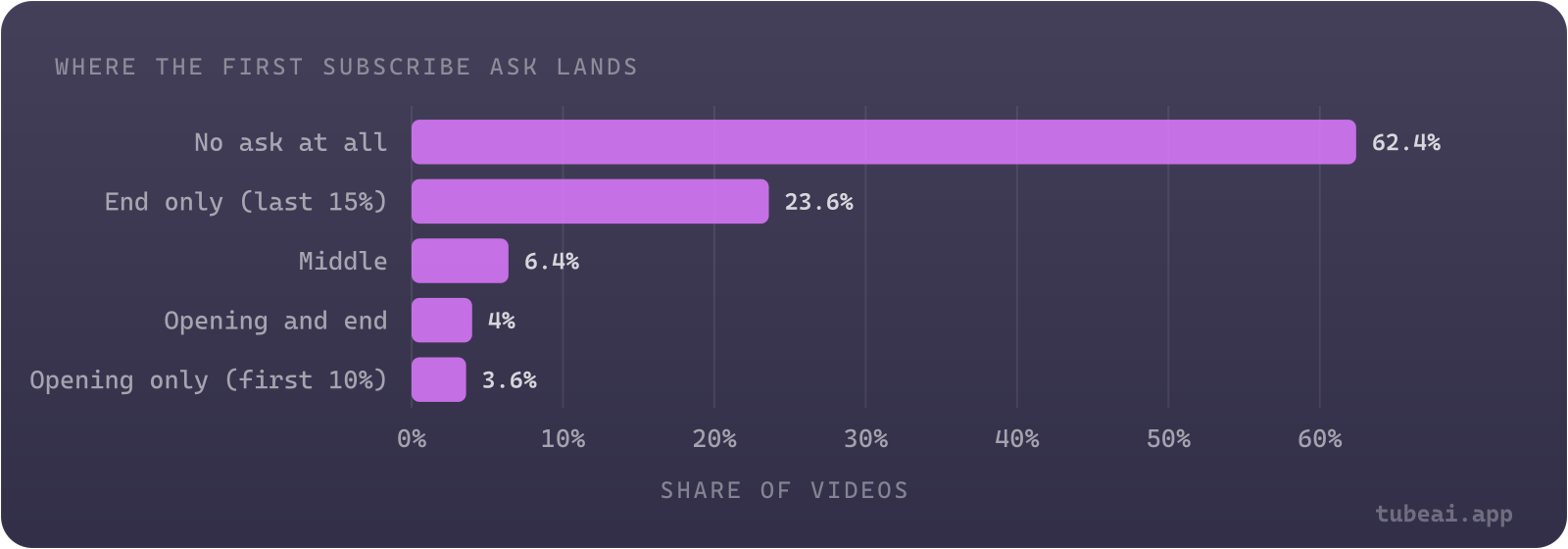
Chart data
| Where the first subscribe ask lands | Share of videos (%) |
|---|---|
| No ask at all | 62.4 |
| End only (last 15%) | 23.6 |
| Middle | 6.4 |
| Opening and end | 4 |
| Opening only (first 10%) | 3.6 |
Which placement lines up with better videos
Comparing channels against each other is misleading here. Some channel styles ask all the time and others never do, so I compared each channel with itself instead. For every channel that had both no-ask videos and videos with an ask in a given position, I took the median outlier multiplier of each group (views relative to that channel's typical video) and divided one by the other.
Across 21,402 of those channel-level comparisons, the end of the video is where the ask pays off:
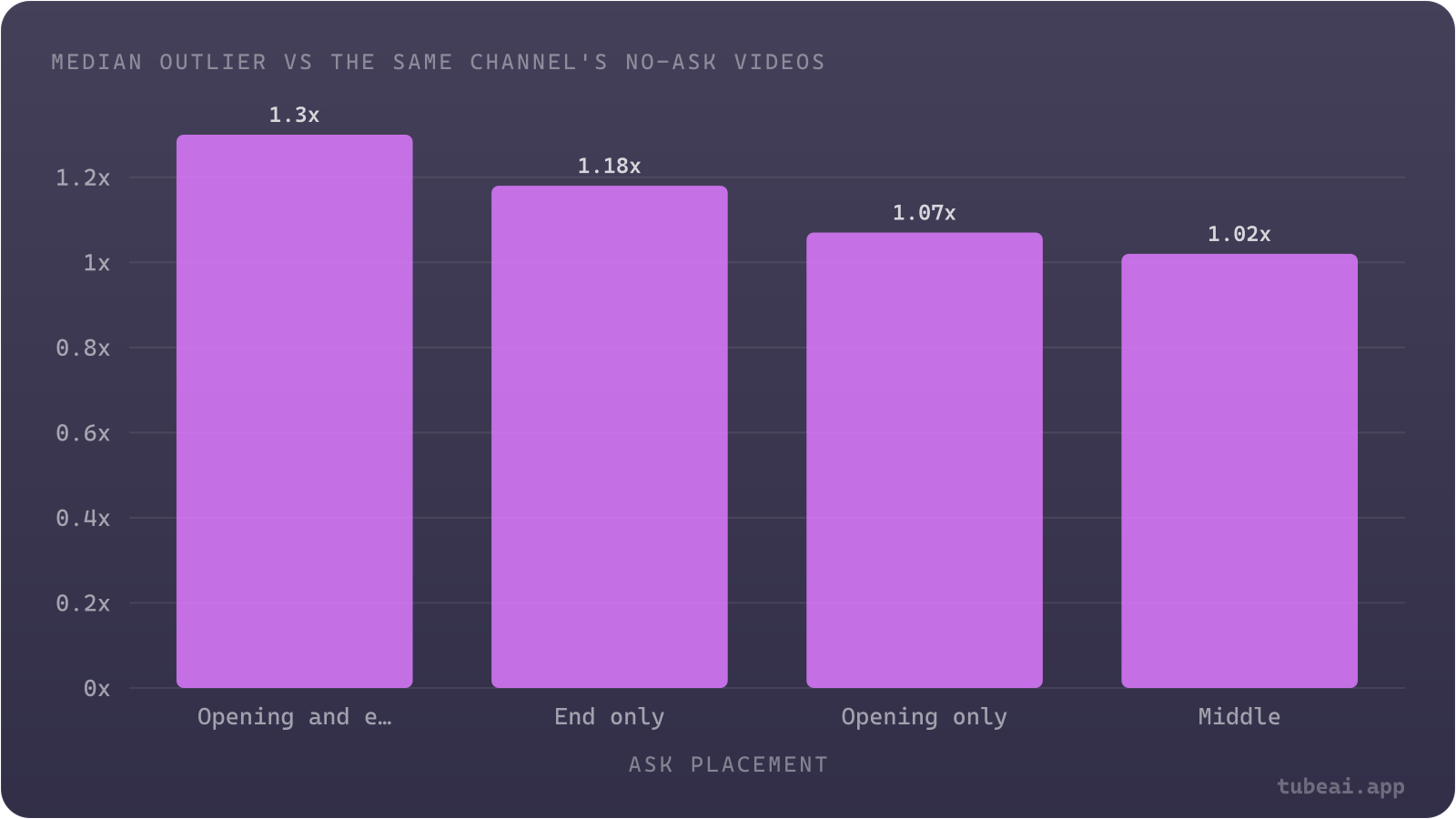
Chart data
| Ask placement | Median outlier vs the same channel's no-ask videos (x) |
|---|---|
| Opening and end | 1.3 |
| End only | 1.18 |
| Opening only | 1.07 |
| Middle | 1.02 |
| Placement | Channels compared | Videos with the ask | Median vs own no-ask videos | Channels where it beat no-ask |
|---|---|---|---|---|
| Opening and end | 1,929 | 2,355 | 1.30x | 57.8% |
| End only | 12,455 | 19,053 | 1.18x | 54.7% |
| Opening only | 2,471 | 3,244 | 1.07x | 52.1% |
| Middle only | 4,547 | 5,550 | 1.02x | 50.9% |
Two things stand out. First, the gains are real but modest: even the best placement beats the channel's own no-ask videos on only 57.8% of channels. Second, asking early is not the problem, but asking only early is. Openings that ask and then come back to it at the close show the strongest result of any group.
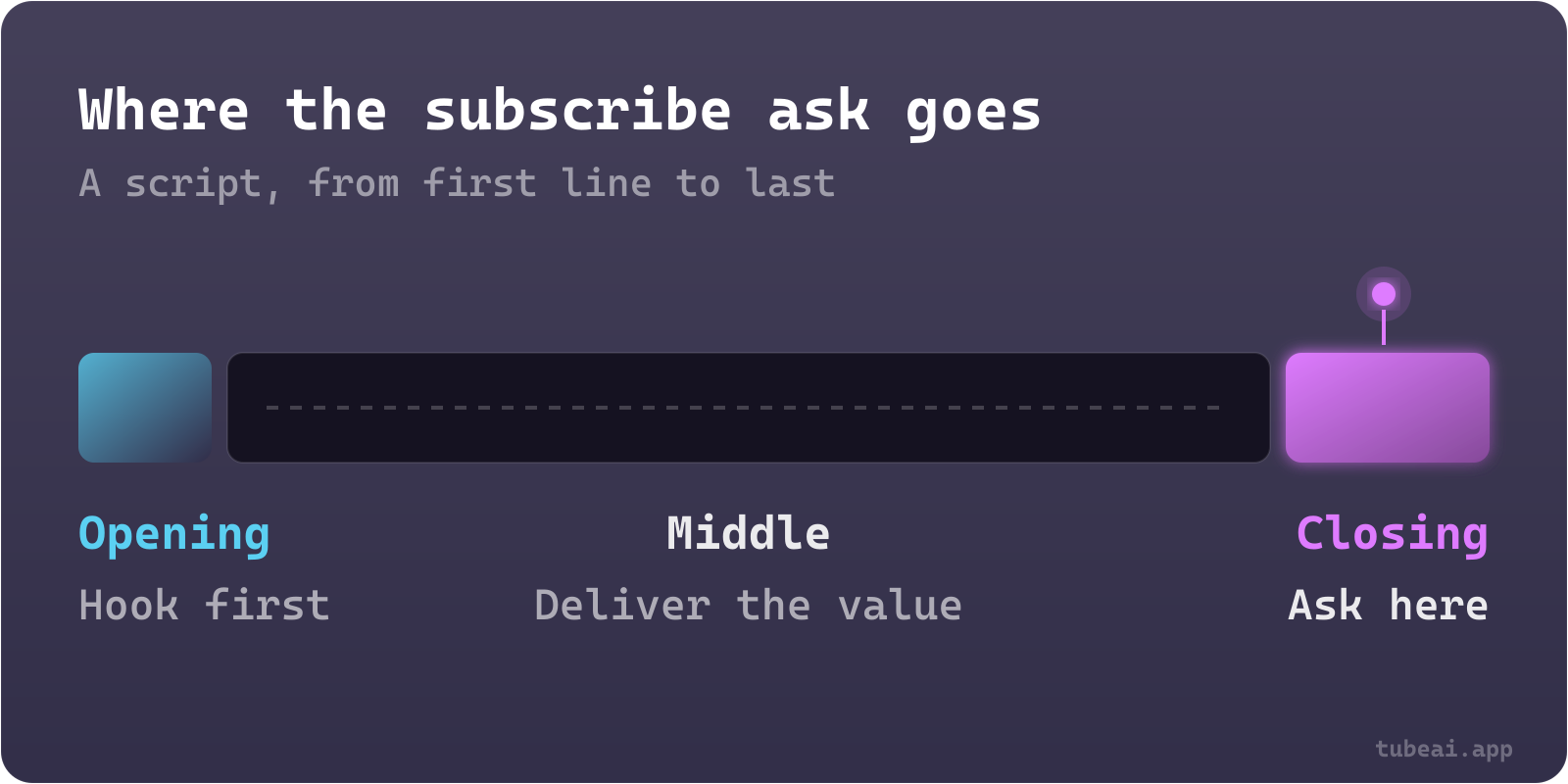
My read: the close is where a viewer has just gotten what they came for, so an ask there lands on someone who already has a reason to say yes. An ask in the first 90 seconds comes before the video has earned anything.
Does asking more than once help?
Across channels, videos that ask more often do perform better, but the curve flattens fast. One ask is a clear step up from none; after two, more asks add nothing.
| Asks in the script | Videos | Median outlier multiplier |
|---|---|---|
| None | 112,614 | 1.51x |
| 1 | 49,367 | 1.75x |
| 2 | 13,430 | 1.83x |
| 3 or more | 5,142 | 1.83x |
This table pools every channel together, so it carries the channel-style effect the same-channel comparison removes. Read it as "a second ask does not hurt", not "asking three times makes videos better".
Does channel size change the answer?
No. In every size band, videos with an ask sit above videos without one, and the early-versus-later split is small. The one band where an early first ask edges ahead is 1M+ subscriber channels, whose audiences may already know the channel well.
| Channel size | No ask | First ask in the opening | First ask later |
|---|---|---|---|
| Under 10K | 1.39x | 1.66x | 1.72x |
| 10K-100K | 1.58x | 1.94x | 1.93x |
| 100K-1M | 1.50x | 1.70x | 1.70x |
| 1M+ | 1.37x | 1.70x | 1.58x |
How to script the subscribe ask
Open with the hook, not the ask
Spend the opening on why the viewer should keep watching. If you want an early mention, make it one short line, not a request that delays the payoff.
Put the main ask right after the payoff
Place it where the video's promise has just been delivered, near the end but before the outro, when viewers have the most reason to say yes.
Give a reason tied to the channel
Say what they get by subscribing: the next video in the series, the topic you cover every week. A reason gives the viewer something concrete to agree to.
Two asks is plenty
If you ask early, come back to it at the close. The data shows no gain beyond two asks.
The ask is one part of the script. For how long that script should run, see how long a YouTube video should be. For the packaging that gets viewers into the video in the first place, see the best YouTube title formats, ranked by data. And for how consistency fits in, see how often you should upload.
How I measured it
I took English transcripts from the TubeAI research database for videos whose YouTube ID starts with A or B (about 1 in 32 IDs, effectively a random sample), on channels that pass TubeAI's creator curation. I kept long-form videos between 3 minutes and 3 hours with at least 1,500 characters of transcript, published at least 30 days before the query so view counts had time to settle. That left 180,553 videos from 82,153 channels, with transcripts collected between Dec 24 2025 and Sep 27 2026.
An ask is the whole word "subscribe" (so "subscribers" does not count), located by its character position in the transcript. Performance is the outlier multiplier: a video's views divided by the typical views of the channel's neighboring uploads.
Frequently asked questions
When is the best time to ask viewers to subscribe?
At the end of the video, after the main payoff. In 180,553 scripts, end-only asks lined up with 1.18x the performance of the same channel's no-ask videos.
Should I ask viewers to subscribe at the start of my video?
Only as a short line, and only if you repeat it at the close. An opening-only ask was close to no difference (1.07x), while opening plus end was the strongest placement at 1.30x.
How many times should I ask viewers to subscribe?
Once or twice. Videos with two asks did slightly better than videos with one, and three or more added nothing.
Do most YouTubers ask viewers to subscribe?
No. 62.4% of the long-form English scripts I checked never say the word subscribe at all.
Does asking viewers to subscribe cause more views?
This data cannot prove cause. It shows that videos with a well-placed ask tend to outperform the same channel's other videos, not that the ask alone produces the views.