
Does YouTube favor big channels? What 5.2 million videos show
Big channels own the million-view videos, but small channels break past their own normal far more often. Here is what 5.2 million videos say about who YouTube actually rewards.

YouTube does not hand big channels more breakouts. Measured against each channel's own usual views, small channels break out far more often: 3.1% of videos from channels with 5k-10k subscribers reached 10x their channel's normal, against 1.2% for channels above 5 million. What big channels do own is the absolute numbers. They posted 5% of the videos in this study and took 68.8% of the videos that reached a million views.
I pulled 5,205,099 long-form videos from 154,854 creator channels in the TubeAI database, published between January and June 2026, and split them by channel size. Here is what the numbers say, and what they mean if you run a small channel.
- 2.6xMore 10x breakouts5k-10k channels vs 5M+ channels
- 68.8%Of million-view videoscame from channels above 1M subscribers
- 6.6%Of million-view videoscame from channels under 100k subscribers
- 24 of 27Nicheswhere smaller channels break out more often
How I measured "favoring"
There are two fair ways to ask whether YouTube favors big channels, and they give opposite answers, so I ran both.
- Relative to the channel's own normal. Every video in the database has an outlier score: its views divided by the channel's usual views around that upload. A score of 10x means the video did ten times what that channel normally gets. If YouTube pushed big channels harder, their videos would beat their own baseline more often.
- In absolute views. Which channels produce the videos that reach 100k or 1 million views?
All videos are long-form (longer than 60 seconds), from channels with at least 5,000 subscribers. The database tracks very few channels below that, so I left them out rather than report a skewed sample.
Small channels break out more often
The share of videos that reach 10x the channel's usual views drops at almost every step up in size. Channels with 5k-10k subscribers hit 10x on 3.1% of uploads. Channels with 100k-500k hit it on 1.9%. Above 5 million subscribers, it is 1.2%.
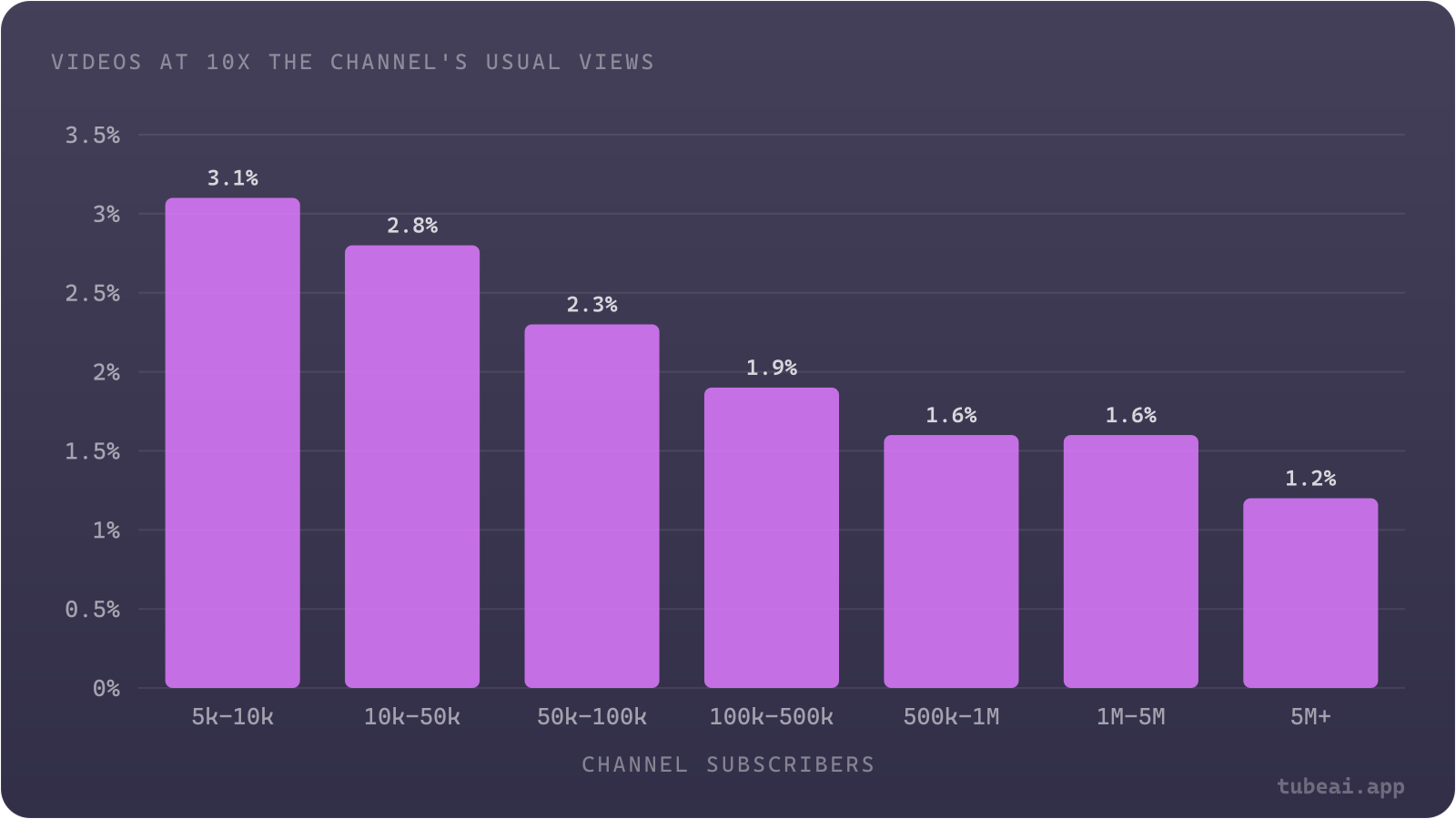
Chart data
| Channel subscribers | Videos at 10x the channel's usual views (%) |
|---|---|
| 5k-10k | 3.1 |
| 10k-50k | 2.8 |
| 50k-100k | 2.3 |
| 100k-500k | 1.9 |
| 500k-1M | 1.6 |
| 1M-5M | 1.6 |
| 5M+ | 1.2 |
The pattern is the same at lower thresholds, just flatter. 20.1% of videos from 5k-10k channels doubled their channel's normal, against 17.2% at 5M+. The full breakdown is below.
| Channel size | Videos | Channels | 2x or more | 10x or more | Under 0.5x | Median views |
|---|---|---|---|---|---|---|
| 5k-10k | 890,710 | 31,643 | 20.1% | 3.1% | 17.7% | 751 |
| 10k-50k | 2,021,944 | 60,854 | 19.3% | 2.8% | 17.0% | 2,100 |
| 50k-100k | 662,225 | 19,096 | 18.3% | 2.3% | 16.1% | 5,200 |
| 100k-500k | 1,138,190 | 30,839 | 17.8% | 1.9% | 15.6% | 11,000 |
| 500k-1M | 231,373 | 5,982 | 17.1% | 1.6% | 14.7% | 33,000 |
| 1M-5M | 222,519 | 5,579 | 17.9% | 1.6% | 15.6% | 66,000 |
| 5M+ | 38,138 | 861 | 17.2% | 1.2% | 15.2% | 202,000 |
Look at the "Under 0.5x" column too. Small channels also flop a little more often: 17.7% of their videos got less than half their usual views, against 15.2% at 5M+. Small channels swing harder in both directions. Big channels have a large, steady audience that sets a floor under every upload, and that same audience makes a 10x jump much harder to pull off.
The edge holds in almost every niche
A size gap could come from niche mix, since small channels cluster in different niches than big ones. So I compared channels with 10k-100k subscribers against channels above 1 million inside the same niche. In 24 of the 27 niches with at least 2,000 videos in each group, the smaller channels broke out more often.
| Niche | 10k-100k channels | 1M+ channels |
|---|---|---|
| True Crime | 3.7% | 0.4% |
| Challenge & Stunt Entertainment | 3.8% | 1.3% |
| Reaction Videos | 3.4% | 1.4% |
| Automotive | 2.9% | 0.9% |
| Politics & Government | 2.7% | 0.8% |
| Gaming | 2.3% | 0.9% |
| Beauty & Makeup (exception) | 2.5% | 2.6% |
| Sports & Recreation (exception) | 1.6% | 2.1% |
| Crafts & Handmade (exception) | 2.0% | 3.6% |
The three exceptions are close or small: Beauty is a tie, and Sports and Crafts lean the other way. Everywhere else, from Gaming to Food to Business, the smaller channels hit 10x more often.
But big channels own the big numbers
Now flip the question to absolute views. Of the 22,783 videos in this window that reached 1 million views, channels above 1 million subscribers posted 68.8%, while making only 5% of all uploads. Channels under 100k subscribers posted 68.7% of the videos and got 6.6% of the million-view hits.
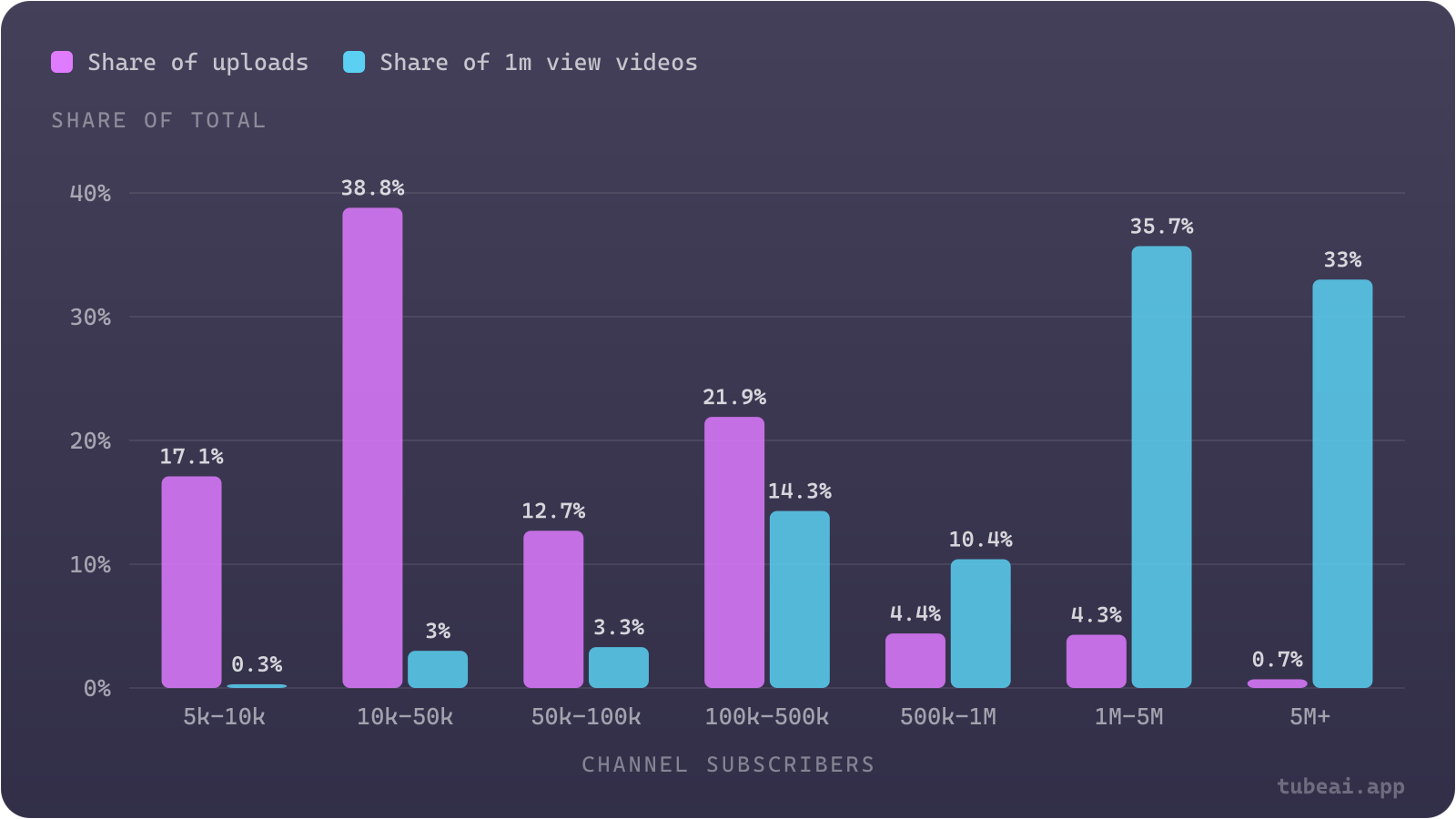
Chart data
| Channel subscribers | share_of_uploads (%) | share_of_1m_view_videos (%) |
|---|---|---|
| 5k-10k | 17.1 | 0.3 |
| 10k-50k | 38.8 | 3 |
| 50k-100k | 12.7 | 3.3 |
| 100k-500k | 21.9 | 14.3 |
| 500k-1M | 4.4 | 10.4 |
| 1M-5M | 4.3 | 35.7 |
| 5M+ | 0.7 | 33 |
That is not the algorithm picking favorites. It is arithmetic. A channel whose typical video gets 202,000 views only needs a 5x video to cross a million. A channel whose typical video gets 751 views needs a 1,300x video to get there.
Small channels reach big numbers only by breaking out
The clearest sign of how this works: of the 3,763 videos from 5k-10k channels that reached 100,000 views, 2,703 (72%) were 10x outliers against their own channel. For channels above 5 million subscribers, only 348 of 23,912 such videos (1.5%) were. Big channels reach 100k views on a normal day. Small channels reach it when one video breaks well past their usual audience, which means YouTube showed it to people who had never seen the channel.
That is the opposite of a system that only rewards size. A video from a 7,000-subscriber channel cannot reach 100,000 views on subscribers alone. When it does, it is because recommendations carried it. For what happens to a channel after a hit like that, see does one viral video grow a YouTube channel.
What this means if you run a small channel
- You are not locked out. Small channels get proportionally more breakouts than big ones, in almost every niche. The idea that YouTube only pushes established channels does not hold up against the data.
- Big numbers come in jumps, not steps. Your average video will not reach 100k views. A breakout can, so the goal is to give more videos a chance to break out: strong topics, clear packaging, consistent output. Our study on low-competition YouTube niches shows where small channels currently get the most views.
- Expect more swing. Small channels flop more often too. A run of weak videos is normal at this size and does not mean you have been suppressed.
- It is not too late. If the size of established channels is what is holding you back from starting, see is it too late to start a YouTube channel.
Limits of this data
- Outlier scores compare a video to its own channel. A 10x video on a small channel is still a small number of views in absolute terms, and that is easier to reach from a low baseline.
- View counts are cumulative at the latest observation, so older videos in the window had more time to collect views. Channel size groups use current subscriber counts.
- We can see views, not impressions, so this shows outcomes rather than how often YouTube recommended each video.
- The data covers creator channels in the TubeAI database with 5,000+ subscribers, not all of YouTube.
Frequently asked questions
Does YouTube favor big channels?
Not relative to their own audience. In 5.2 million videos, channels with 5k-10k subscribers reached 10x their usual views on 3.1% of uploads, against 1.2% for channels above 5 million. Big channels do get far more total views, because their baseline audience is much larger.
Can a small YouTube channel go viral?
Yes. Small channels break out more often than big ones relative to their normal views. Of the videos from 5k-10k subscriber channels that reached 100,000 views, 72% were 10x outliers, meaning recommendations carried them well past the channel's existing audience.
Why do big YouTube channels get so many more views?
Their starting point is higher. A channel whose typical video gets 202,000 views needs a 5x video to reach a million; a channel whose typical video gets 751 views needs about 1,300x. Channels above 1 million subscribers posted 5% of uploads but 68.8% of million-view videos.
Is the YouTube algorithm biased against small creators?
The data does not show it. Smaller channels broke out more often than 1M+ channels in 24 of 27 niches when compared inside the same niche. Small channels also flop slightly more often, so their results swing more from video to video.
What counts as a good video for a small channel?
Compare it to your own recent median, not to bigger channels. About 20% of videos from 5k-10k channels reach 2x their channel's normal, and about 3% reach 10x.