
Does taking a break hurt your YouTube channel? What 5.9 million videos show
Comeback videos don't flop on average. After a 1-3 month break they do slightly better than the channel's usual videos. The real risk is what happens after the comeback.

No, a break of up to a few months does not hurt the video you come back with. I measured 5,924,283 long-form videos published April to September 2026 against how long the channel had been quiet before each one. The first video after a 1-3 month break did slightly better than the same channel's regular uploads: a median 1.09x on the same channel. Comebacks after 6 months or more land at about par, with a much higher chance of flopping. The bigger risk is not the comeback video. It is that half of channels returning from a 3-month-plus break don't post again within 30 days.
- 5.9Mlong-form videos measuredApr-Sep 2026
- 1.09xcomeback vs regular uploadsame channel, 30-89 day break
- 0.92xmedian after 6-12 months offvs the channel's typical video
- 53%posted again within 30 daysafter a 3-month-plus break
How I measured it
For every long-form video (over 3 minutes) published by a served creator channel between April 1 and September 30, 2026, I found the channel's previous long-form upload, looking back as far as April 2025. The number of days in between is the break. Gaps longer than 365 days, and videos with no earlier upload in that window, are left out.
Performance is the outlier score: a video's views divided by the channel's typical views for videos published around the same time. 1.0x is a normal video for that channel, 2x is a breakout, and under 0.5x is a flop. Because the score is relative to the channel itself, a big channel and a small one can be compared fairly.
Shorts are not counted, so a "break" here means a break from long-form. Some of these channels kept posting Shorts in the meantime.
Comeback videos don't flop on average
The median video scores almost exactly 1.0x whether it came 3 days or 3 months after the previous one. What changes with the length of the break is the spread. The longer a channel was quiet, the more often the comeback broke out, and the more often it flopped.
| Gap before the video | Videos | Median outlier | Reached 2x | Under half |
|---|---|---|---|---|
| Under 7 days | 4,654,005 | 1.00x | 18.3% | 15.7% |
| 7-13 days | 723,950 | 1.01x | 20.0% | 16.1% |
| 14-29 days | 299,748 | 1.03x | 22.9% | 18.2% |
| 30-59 days | 169,466 | 1.01x | 23.0% | 18.8% |
| 60-89 days | 31,314 | 1.03x | 26.9% | 22.4% |
| 90-179 days | 30,468 | 1.00x | 26.6% | 24.8% |
| 180-365 days | 15,332 | 0.92x | 25.8% | 29.9% |
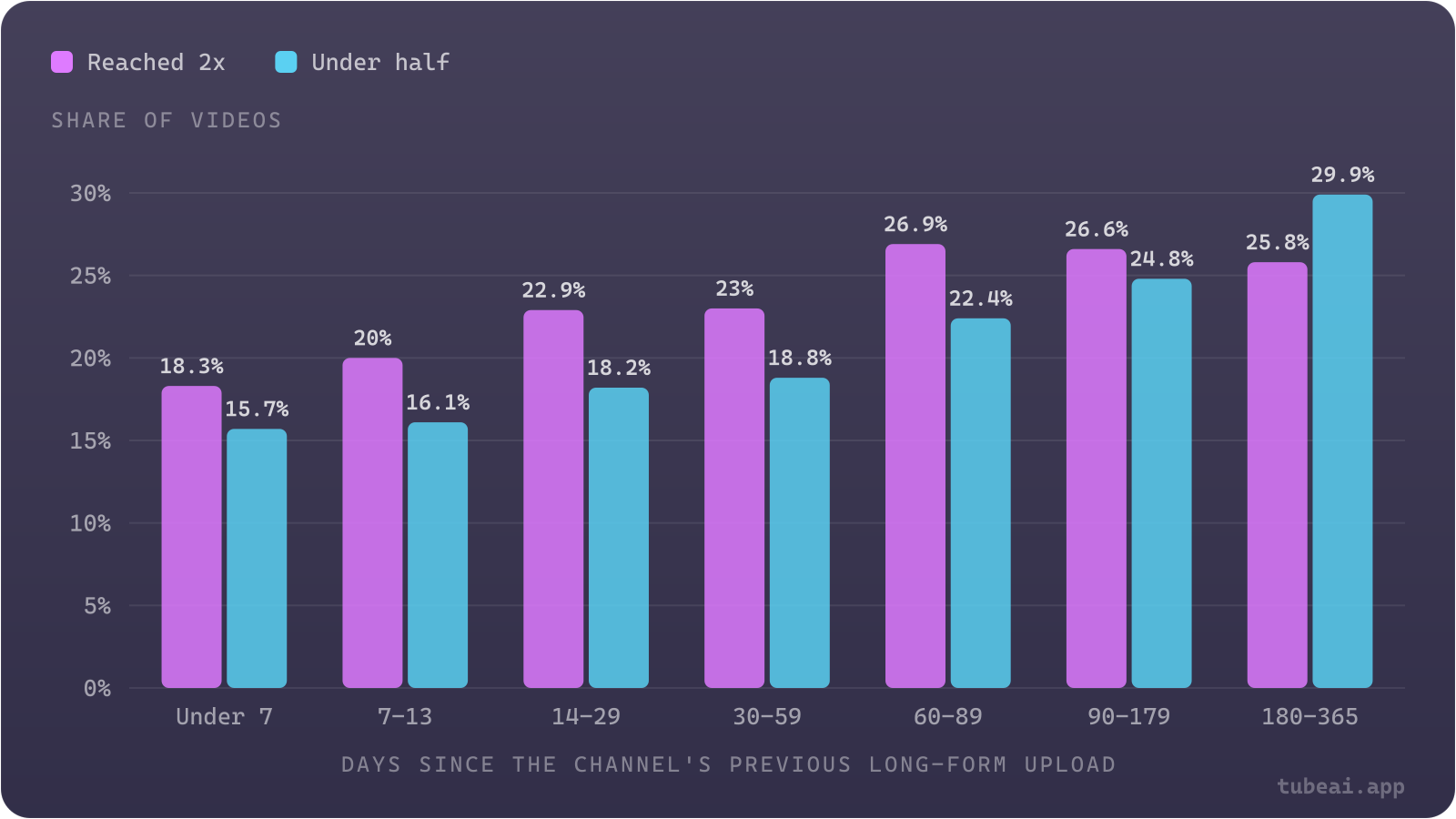
Chart data
| Days since the channel's previous long-form upload | reached_2x (%) | under_half (%) |
|---|---|---|
| Under 7 | 18.3 | 15.7 |
| 7-13 | 20 | 16.1 |
| 14-29 | 22.9 | 18.2 |
| 30-59 | 23 | 18.8 |
| 60-89 | 26.9 | 22.4 |
| 90-179 | 26.6 | 24.8 |
| 180-365 | 25.8 | 29.9 |
Up to about 3 months, the gain in breakouts is larger than the gain in flops, so a comeback is, if anything, a slightly better bet than a routine upload. Past 6 months the balance tips: 29.9% of comebacks got under half the channel's usual views, against 15.7% for videos posted within a week of the last one. A plausible reading is that after a long absence, part of the audience has moved on, so the comeback either reaches the people who missed you or lands in front of nobody.
The same-channel test
Channels that take breaks may be different from channels that don't. To take that out of the picture, I compared each channel with itself: the median score of its comeback videos against the median score of its regular videos (the ones posted less than 14 days after the previous upload). Only channels with at least 3 regular videos and at least one comeback in the window count.
| Break before the comeback | Channels | Comeback vs regular (median) | Comeback ahead |
|---|---|---|---|
| 30-89 days | 82,282 | 1.09x | 55.4% of channels |
| 90-179 days | 9,878 | 1.04x | 52.0% of channels |
| 180-365 days | 4,475 | 1.00x | 49.9% of channels |
On the same channel, a 1-3 month break comes with a modest lift: the comeback beat the channel's regular uploads on 55.4% of channels, with a median of 1.09x. The lift shrinks as the break gets longer and disappears at 6-12 months, where it is a coin flip. Note that this test only includes channels that went on to post regularly again, so it describes the channels that made a real comeback.
Does channel size change it?
The pattern holds at every size. Small channels get the biggest breakout bump from a comeback, and every size band sees more flops after a break of 3 months or more.
| Channel size | Gap | Median outlier | Reached 2x | Under half |
|---|---|---|---|---|
| Under 10K | Under 14 days | 1.01x | 20.4% | 17.6% |
| Under 10K | 30-89 days | 1.03x | 27.2% | 21.2% |
| Under 10K | 90-365 days | 0.99x | 29.2% | 27.4% |
| 10K-100K | Under 14 days | 1.00x | 18.7% | 15.9% |
| 10K-100K | 30-89 days | 1.03x | 23.8% | 19.6% |
| 10K-100K | 90-365 days | 0.94x | 26.1% | 26.1% |
| 100K-1M | Under 14 days | 1.00x | 17.3% | 14.4% |
| 100K-1M | 30-89 days | 1.02x | 20.9% | 17.8% |
| 100K-1M | 90-365 days | 0.95x | 24.3% | 26.4% |
| 1M+ | Under 14 days | 1.00x | 17.3% | 14.6% |
| 1M+ | 30-89 days | 1.02x | 19.7% | 15.1% |
| 1M+ | 90-365 days | 0.92x | 20.7% | 26.9% |
Channels with 1M+ subscribers show the clearest downside: after a 3-month-plus break, their comebacks barely break out more often (20.7% vs 17.3%) but flop far more often (26.9% vs 14.6%). Big channels have the most to lose from a long absence, because much of their reach comes from a habit that a long gap interrupts.
The real risk: the second video
The comeback video itself is rarely the problem. What happens next is. I took every long-form video published April to June 2026 and checked whether the channel posted another long-form video within 30 and 90 days.
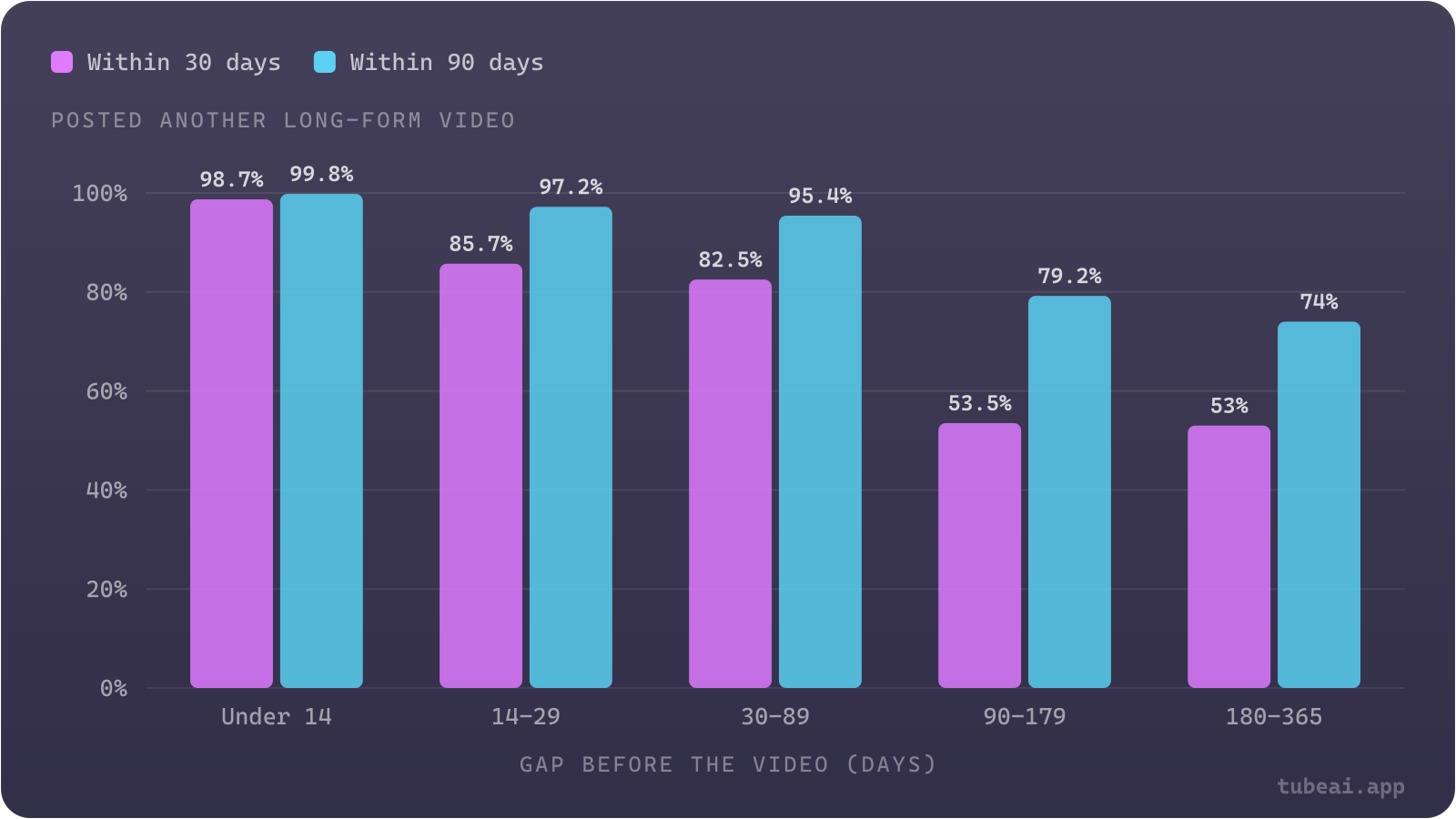
Chart data
| Gap before the video (days) | within_30_days (%) | within_90_days (%) |
|---|---|---|
| Under 14 | 98.7 | 99.8 |
| 14-29 | 85.7 | 97.2 |
| 30-89 | 82.5 | 95.4 |
| 90-179 | 53.5 | 79.2 |
| 180-365 | 53 | 74 |
| Gap before the video | Next video within 30 days | Next video within 90 days | Next video, median outlier | Next video reached 2x |
|---|---|---|---|---|
| Under 14 days | 98.7% | 99.8% | 1.00x | 18.2% |
| 14-29 days | 85.7% | 97.2% | 0.96x | 20.1% |
| 30-89 days | 82.5% | 95.4% | 0.96x | 20.0% |
| 90-179 days | 53.5% | 79.2% | 0.92x | 23.0% |
| 180-365 days | 53.0% | 74.0% | 0.85x | 22.0% |
After a break of 3 months or more, only about half of channels posted again within a month, and a quarter had not posted again 90 days later. When they did, the video after the comeback scored a median of 0.92x after a 3-6 month break and 0.85x after 6-12 months: the comeback spends the attention, and the follow-up feels the gap. Shorter breaks recover almost fully, at 0.96x.
Breaks also show up in subscriber counts: in our study of how fast YouTube channels grow, about a third of 10K-100K channels quiet for 180+ days lost subscribers, against under 5% of channels still uploading. For the cadence side of the picture, see why YouTube views drop and how often to upload.
How to take a break without losing momentum
Keep it under 3 months if you can
Breaks of 1-3 months showed no penalty on the comeback video. Past 6 months, flops nearly doubled.
Make the comeback a strong video
Comebacks swing both ways. Put your best idea and packaging on the first video back, not a filler upload.
Have the next two videos ready
Half of channels returning from a 3-month-plus break didn't post again within 30 days. Bank the follow-ups before you return.
Expect the second video to dip
The video after a long-break comeback scored 0.85x-0.92x median. That's normal; keep going instead of reading it as failure.
Use Shorts to stay visible
If you can't make long-form for a while, a lighter format keeps the channel active in the meantime.
For more on keeping a channel active, read do YouTube Shorts help grow your channel and how long it takes a YouTube video to get views.
Frequently asked questions
Does YouTube punish you for taking a break?
Not in this data. Across 5.9 million long-form videos published Apr-Sep 2026, the first video after a 1-3 month break scored a median 1.09x the same channel's regular uploads. After 6-12 months it was at par, but with more flops.
How long can I take a break from YouTube?
Breaks up to about 3 months showed no penalty on the comeback video. Past 6 months, 29.9% of comeback videos got under half the channel's usual views, against 15.7% for videos posted within a week of the previous one.
Will I lose momentum if I stop posting?
That is the bigger effect we saw. After a 3-month-plus break, only about 53% of channels posted again within 30 days, and the video after the comeback scored below the channel's norm.
Why did my comeback video do well but the next one flopped?
That is the common pattern. After a 3-6 month break, the next video scored a median 0.92x the channel's norm, and 0.85x after a 6-12 month break. The comeback uses up the pent-up attention; the follow-up is back to rebuilding.
Do Shorts count as a break?
This study only measures long-form uploads, so a channel posting only Shorts during the gap counts as on a break here. Posting Shorts can keep a channel visible while you prepare long-form videos.