
Does uploading too often hurt your YouTube channel? What 1.1 million uploads show
Back-to-back uploads don't sink a channel, but they break out a little less often. The bigger cost lands on the video you posted just before.

A little, but not the way most creators fear. I timed 1,121,880 long-form uploads from 118,939 creator channels, published September 15 to October 31, 2026, against the channel's previous upload. Videos posted 6 hours to 2 days after the last one reached 2x the channel's usual views 16.6-16.9% of the time, against 20.3% for videos posted 7-14 days later. The typical video barely changes (0.99x vs 1.06x). The clearer cost is on the other side: a video followed by another upload within 6 hours got under half its usual views 21.6% of the time, nearly double the 11.4% for videos left alone for a week.
- 1.12Mlong-form uploads timedSep 15-Oct 31 2026
- 33.3%posted within a day of the last one11.7% within 6 hours
- 16.6% vs 20.3%reached 2x1-2 days vs 7-14 days after
- 21.6% vs 11.4%earlier video got under halfnext upload in 6h vs 7+ days
How I measured it
For every long-form video (over 3 minutes) from a served creator channel, I found the channel's previous long-form upload and measured the time in between, to the second. Exact times matter here: in older data many publish dates are estimates from YouTube's "3 weeks ago" labels, which put several videos on the same timestamp and make channels look like they post in bursts. So this study uses only videos TubeAI tracked from their first hour, which have their exact publish time. That tracking covers every channel from September 2026, so the window is September 15 to October 31, 2026, and the previous upload is looked up from September 1.
Performance is the outlier score: a video's views divided by the channel's typical views for videos published around the same time. 1.0x is a normal video for that channel, 2x is a breakout, under 0.5x is a flop. Shorts are not counted.
Back-to-back uploads break out a little less often
The typical video lands near 1.0x whatever the gap. What moves is the tail. Videos posted 6 hours to 2 days after the previous upload broke out least often. From there the breakout rate climbs steadily with the gap, to 20.3% at 7-14 days and 23.2% past two weeks.
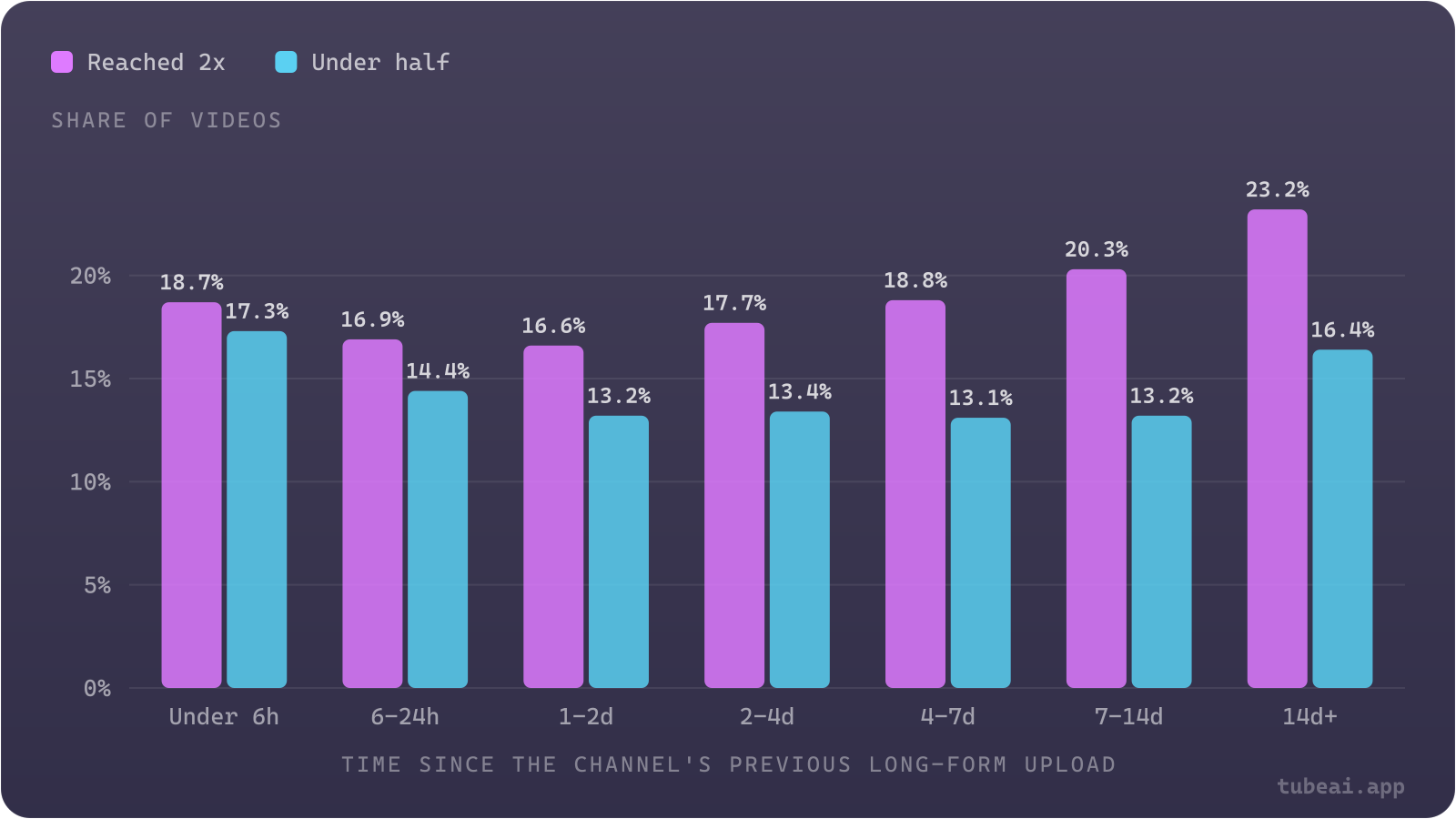
Chart data
| Time since the channel's previous long-form upload | reached_2x (%) | under_half (%) |
|---|---|---|
| Under 6h | 18.7 | 17.3 |
| 6-24h | 16.9 | 14.4 |
| 1-2d | 16.6 | 13.2 |
| 2-4d | 17.7 | 13.4 |
| 4-7d | 18.8 | 13.1 |
| 7-14d | 20.3 | 13.2 |
| 14d+ | 23.2 | 16.4 |
| Gap before the video | Videos | Channels | Median outlier | Reached 2x | Under half |
|---|---|---|---|---|---|
| Under 6 hours | 131,520 | 13,430 | 0.98x | 18.7% | 17.3% |
| 6-24 hours | 241,718 | 30,611 | 0.99x | 16.9% | 14.4% |
| 1-2 days | 226,120 | 41,714 | 1.02x | 16.6% | 13.2% |
| 2-4 days | 200,930 | 51,837 | 1.02x | 17.7% | 13.4% |
| 4-7 days | 148,832 | 64,950 | 1.03x | 18.8% | 13.1% |
| 7-14 days | 120,446 | 63,927 | 1.06x | 20.3% | 13.2% |
| 14 days or more | 52,314 | 44,628 | 1.09x | 23.2% | 16.4% |
Videos posted within 6 hours of the last one are the exception: they swing both ways, with more breakouts (18.7%) and the most flops (17.3%). Uploads that close together are usually batches, such as a series dropped at once or several episodes on the same day, and some parts of a batch carry it while others get little attention.
Past two weeks the flop rate rises again. That end of the scale is covered in our study of whether taking a break hurts your channel.
The same-channel test
Channels that post every day are different from channels that post every week: different formats, teams and audiences. To take that out, I compared each channel with itself: the median score of its videos posted 6-24 hours after the previous upload against the median score of its videos posted 3 days or more after. Only channels with at least 3 of each count: 7,185 channels, 47,346 quick follow-ups and 32,521 spaced uploads.
- 0.96xquick follow-up vs spaced uploadmedian, same channel
- 46.3%of channels where quick follow-ups did better53.7% where they did worse
- 18.0% vs 20.1%reached 2x6-24h vs 3+ days, average per channel
On the same channel, the gap shrinks but does not disappear. A quick follow-up scored a median 4% below the channel's spaced-out uploads, and did worse on a small majority of channels. That is a real but modest cost: a channel that posts daily is not punished, it just gives each video a slightly smaller chance to break out.
The bigger cost: the video you posted before
A new upload may compete with the one before it for the same subscribers' attention. To test that, I took videos that came at least 3 days after their own predecessor, so each started with a clean run, and grouped them by how soon the channel posted again.
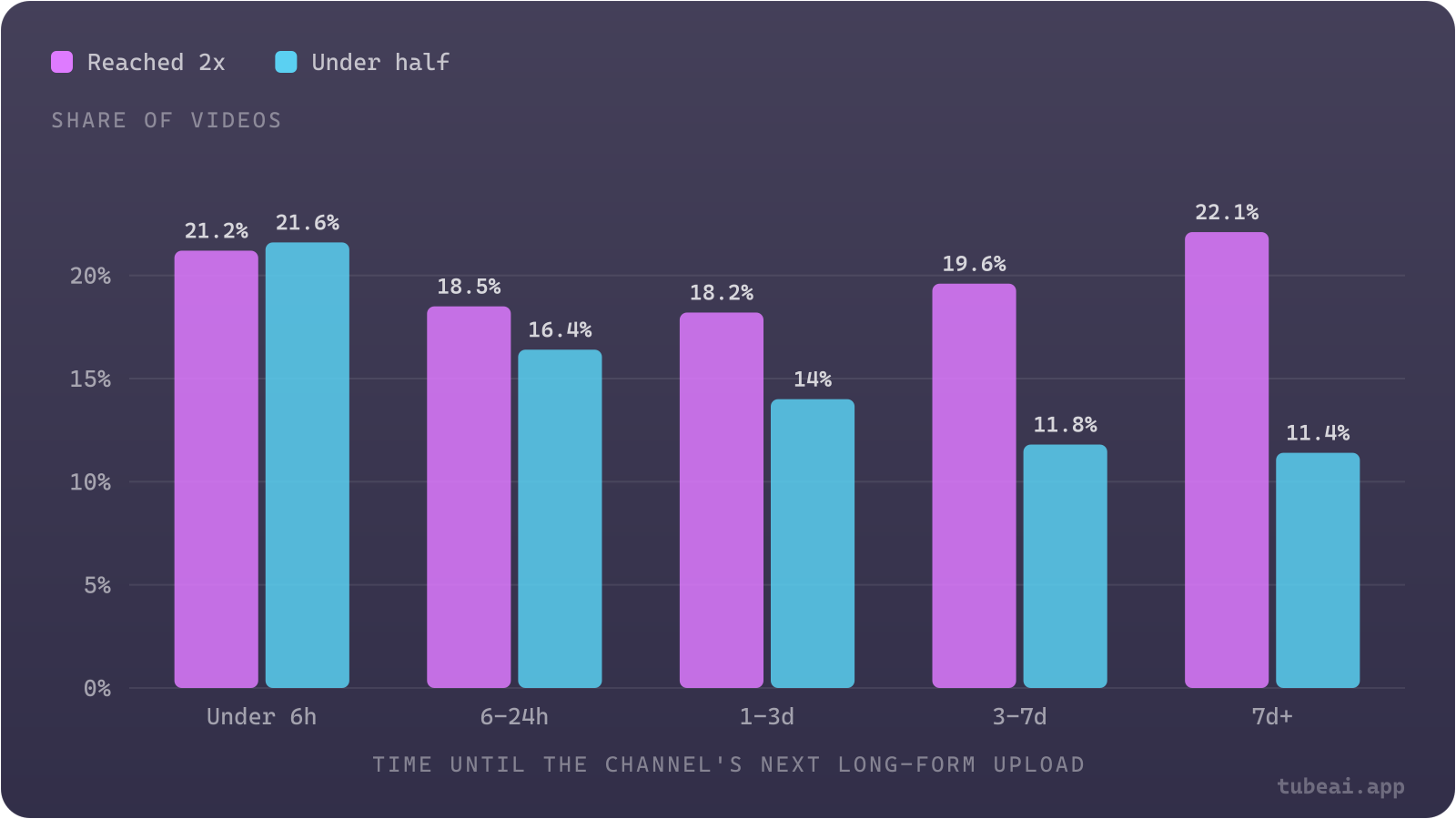
Chart data
| Time until the channel's next long-form upload | reached_2x (%) | under_half (%) |
|---|---|---|
| Under 6h | 21.2 | 21.6 |
| 6-24h | 18.5 | 16.4 |
| 1-3d | 18.2 | 14 |
| 3-7d | 19.6 | 11.8 |
| 7d+ | 22.1 | 11.4 |
| Next upload came | Videos | Median outlier | Reached 2x | Under half |
|---|---|---|---|---|
| Within 6 hours | 5,540 | 0.94x | 21.2% | 21.6% |
| 6-24 hours later | 14,707 | 0.98x | 18.5% | 16.4% |
| 1-3 days later | 62,243 | 1.01x | 18.2% | 14.0% |
| 3-7 days later | 104,184 | 1.08x | 19.6% | 11.8% |
| 7 days or more later | 94,380 | 1.12x | 22.1% | 11.4% |
The sooner the next upload came, the worse the earlier video did. Followed within 6 hours, it scored a median 0.94x and got under half its usual views 21.6% of the time. Left alone for a week or more, it scored 1.12x and flopped 11.4% of the time. Part of this likely runs the other way round: a creator whose video is struggling is more likely to post again quickly. Either way, a video that is still finding its audience has the most to lose from being followed too soon.
Does channel size change it?
The breakout gap shows at every size. It is widest for 10K-100K channels and narrowest for 1M+ channels, which have audiences large enough to absorb two videos close together.
| Channel size | Under 1 day | 1-3 days | 3-7 days | 7+ days |
|---|---|---|---|---|
| Under 10K | 19.4% | 18.9% | 19.9% | 22.0% |
| 10K-100K | 17.7% | 17.3% | 18.9% | 21.9% |
| 100K-1M | 16.5% | 15.2% | 16.4% | 19.3% |
| 1M+ | 15.7% | 14.0% | 15.8% | 17.4% |
Small channels show a second cost: under 10K subscribers, 17.9% of videos posted within a day of the last one got under half their usual views, against 15.5% at 1-3 days. With a small audience, two videos in one day split very few viewers.
None of this means uploading more is a mistake. Our study of how often to upload found that total reach keeps rising with volume even as each video earns less. The question here is narrower: how close together to place the uploads you make.
How to space your uploads
Leave at least a day between long-form videos
Videos posted 6 hours to 2 days apart broke out least often (16.6-16.9%). Spacing them out costs nothing in output.
Don't bury a video that's still climbing
A video followed within 6 hours flopped 21.6% of the time, against 11.4% when left alone for a week. Check how the last upload is doing before scheduling the next.
Batch on purpose, not by accident
Same-day drops swing both ways. If you release a series at once, put your strongest episode first.
Pre-schedule instead of publishing when ready
If you finish two videos the same day, schedule the second a few days out rather than posting both.
Judge your pace by per-video views
Track your median views per video. If they fall as you post more often, spread uploads further apart.
For related questions, read why your YouTube views are dropping and how long it takes a YouTube video to get views.
Frequently asked questions
Does YouTube penalize you for uploading too often?
Not in this data. Across 1.1 million long-form uploads, the typical video scored about the same whatever the gap. Videos posted within a day or two of the previous one broke out a little less often: 16.6-16.9% reached 2x, against 20.3% at 7-14 days.
Is it bad to upload two videos in one day?
It carries a cost for the first video. Videos followed by another upload within 6 hours got under half their usual views 21.6% of the time, against 11.4% when the next upload came a week or more later.
How long should I wait between YouTube uploads?
In this data, the breakout rate rose steadily with the gap, from 16.6% at 1-2 days to 20.3% at 7-14 days. Leaving at least a day, and ideally a few days, between long-form videos avoids most of the cost.
Does a new upload hurt my last video?
It is linked with more flops. Videos followed by a new upload within 6 hours scored a median 0.94x, against 1.12x when the next upload came 7 or more days later. Some of that is creators posting again because a video is struggling.
Does this apply to Shorts?
No. This study measured long-form videos over 3 minutes only. Shorts are distributed differently and were not counted.