
YouTube's new view count: what changed, and what it did to the numbers
On Aug 24 2026 YouTube started counting a view the moment any video starts playing. Here is what changed, what did not, and what it did to the numbers across 3.3 million videos.

Since Aug 24, 2026, YouTube counts a public view the moment a video starts playing, from the very first frame, for long-form videos, Shorts, live streams and podcasts alike. Before, a long-form view only counted once someone had watched for a while. YouTube did not recalculate old totals, and monetization still runs on engaged views, the stricter measure. The result is that videos published after the change look stronger than the ones before them: in the TubeAI research database, long-form videos published after Aug 24 got 53% more views per subscriber at the median, and more of them scored as breakouts.
Below: what changed, what did not, what it means for your channel, and what I measured across 3.3 million long-form videos, including why the change quietly inflates outlier scores.
- +53%views per subscribermedian, 0.077 before vs 0.117 after
- 21.3%reached 2x their channel's normup from 18.1% before
- 1.07xmedian outlier score afterup from 0.97x before
- +76%views per subscriber, 1K-10K channelsthe largest lift of any size band
What YouTube changed
The change came in two stages.
Stage 1: Shorts, March 2025
From March 31, 2025, a Short counted as a view as soon as it started playing or replayed. The old, stricter measure was kept under a new name, engaged views, in YouTube Studio's advanced analytics.
Stage 2: every format, August 2026
On Aug 17, 2026, YouTube announced through its Creator Insider account that the same exposure-based model would apply to everything: long-form videos, Shorts, live streams and podcasts. It took effect on Aug 24. A view now counts from the first frame, whatever the format. YouTube's stated reason was that different counting rules for each format confused creators, and that other platforms already count a view when playback starts.
What did not change
- Old totals. Views a video collected before Aug 24 stay as they were. Only views after that date are counted the new way.
- Earnings. The Partner Program still pays on engaged views and engaged watch hours. The public view count no longer has any link to earnings.
- Other metrics. Click-through rate, average view duration and retention are not being redefined, according to YouTube.
- Recommendations. YouTube says the change does not affect how videos are recommended.
What it means for creators
The public view count is now a reach number: how many times your video started playing in front of someone. It says less than it used to about how many people actually watched. Four practical consequences:
- Aug 24 is a break in your history. A video published in September and one published in July were counted by different rules. Comparing their view counts compares two different measures.
- Your recent videos will look better than your older ones. That is partly real growth and partly the new count. You cannot separate the two from the public number alone.
- Engaged views are the number to track. They are what views used to mean, and they are what YouTube pays on.
- Sponsors will ask. Brands that price deals per view are paying for less attention per view than before. Expect more requests for engaged views, watch time and retention instead of public views.
What the data shows
How I measured it
Our hourly and daily view readings start on Sep 7, 2026, two weeks after the change, so I cannot compare a video's views at the same age before and after. Instead I compared videos by the week they were published, using two measures that are relative to the channel rather than raw view counts:
- Views per subscriber: a video's views divided by its channel's subscriber count.
- Outlier score: a video's views divided by the typical views of the channel's neighbouring uploads.
I looked at 3,309,225 long-form videos (over 60 seconds) from creator channels we serve, published from Jun 1 to Sep 20, 2026. One thing makes the result easier to trust: newer videos have had less time to collect views, so without any change in counting, the most recent weeks should score lower than older ones. They score higher.
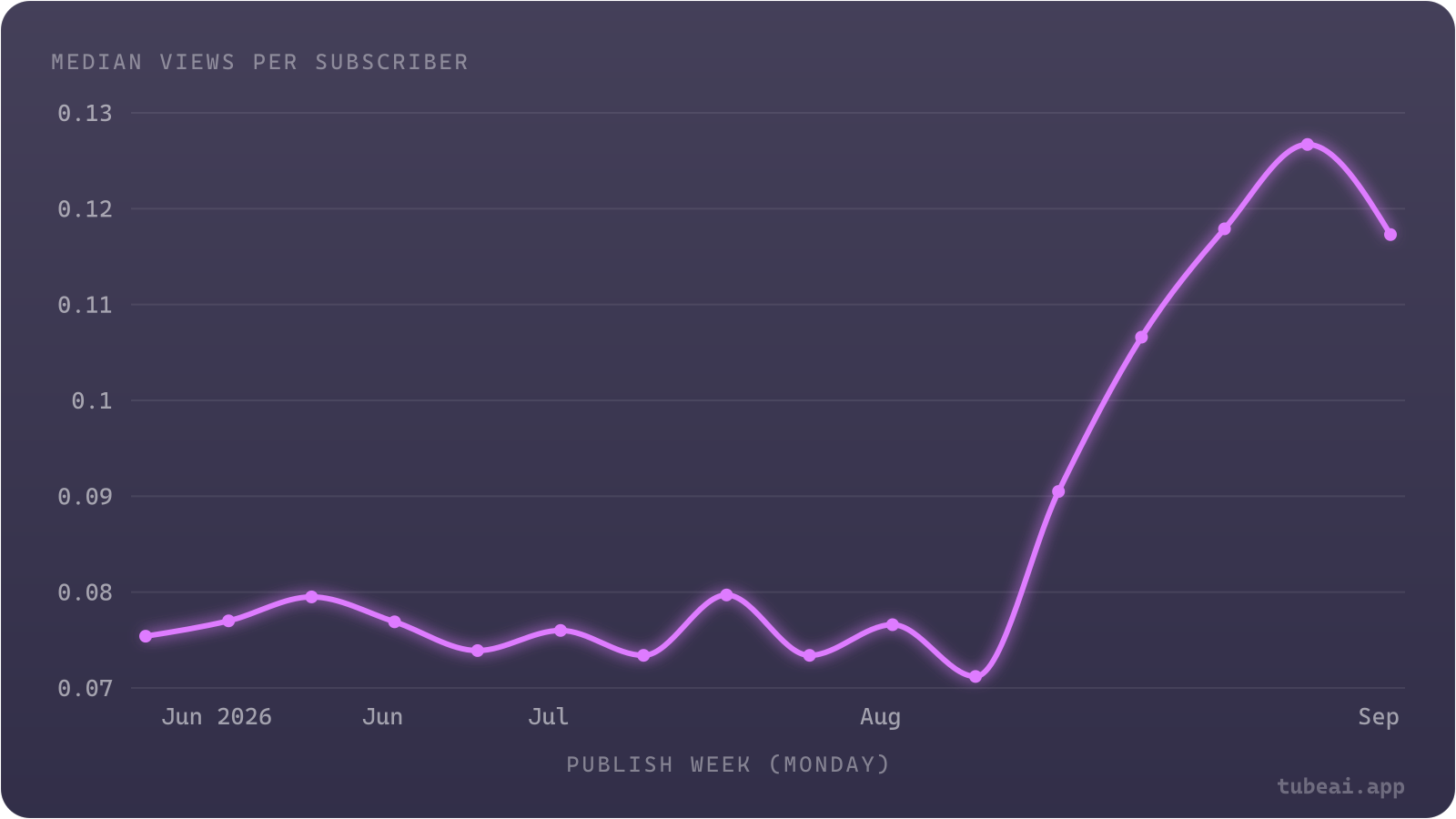
Chart data
| Publish week (Monday) | Median views per subscriber |
|---|---|
| 2026-06-01 | 0.075 |
| 2026-06-08 | 0.077 |
| 2026-06-15 | 0.08 |
| 2026-06-22 | 0.077 |
| 2026-06-29 | 0.074 |
| 2026-07-06 | 0.076 |
| 2026-07-13 | 0.073 |
| 2026-07-20 | 0.08 |
| 2026-07-27 | 0.073 |
| 2026-08-03 | 0.077 |
| 2026-08-10 | 0.071 |
| 2026-08-17 | 0.091 |
| 2026-08-24 | 0.107 |
| 2026-08-31 | 0.118 |
| 2026-09-07 | 0.127 |
| 2026-09-14 | 0.117 |
For eleven straight weeks, from June to mid-August, the median video got between 0.071 and 0.080 views per subscriber. Videos published the week the change was announced (Aug 17) jumped to 0.091: most of their first week of views fell after Aug 24, so they were partly counted the new way. From Aug 24 on, every week sits between 0.107 and 0.127.
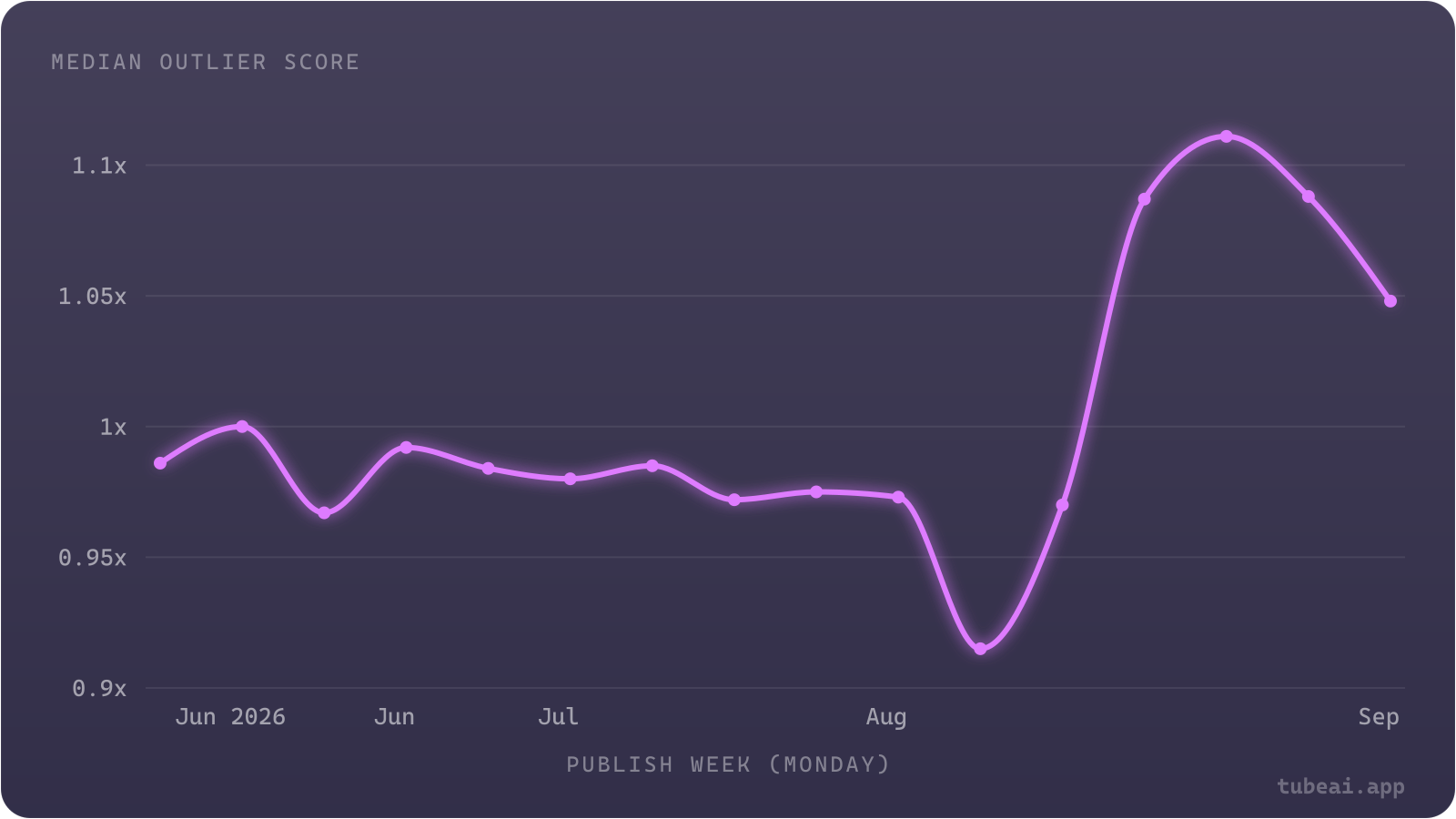
Chart data
| Publish week (Monday) | Median outlier score (x) |
|---|---|
| 2026-06-01 | 0.986 |
| 2026-06-08 | 1 |
| 2026-06-15 | 0.967 |
| 2026-06-22 | 0.992 |
| 2026-06-29 | 0.984 |
| 2026-07-06 | 0.98 |
| 2026-07-13 | 0.985 |
| 2026-07-20 | 0.972 |
| 2026-07-27 | 0.975 |
| 2026-08-03 | 0.973 |
| 2026-08-10 | 0.915 |
| 2026-08-17 | 0.97 |
| 2026-08-24 | 1.087 |
| 2026-08-31 | 1.111 |
| 2026-09-07 | 1.088 |
| 2026-09-14 | 1.048 |
The outlier score tells the same story. Before the change, the typical video scored just under 1x, which is what you would expect: half of a channel's videos beat its norm and half do not. From Aug 24, the typical video scores between 1.05x and 1.11x.
Small channels saw the biggest jump
Splitting by channel size shows the lift is not evenly spread. The smaller the channel, the bigger the change. Channels with 1M+ subscribers show no lift at all.
| Channel size | Videos after | Views per sub, before | Views per sub, after | Change | At 2x+, before | At 2x+, after |
|---|---|---|---|---|---|---|
| 1K-10K | 164,650 | 0.111 | 0.196 | +76% | 19.5% | 24.9% |
| 10K-100K | 412,763 | 0.088 | 0.148 | +68% | 18.3% | 21.8% |
| 100K-1M | 200,189 | 0.052 | 0.074 | +42% | 17.0% | 18.5% |
| 1M+ | 43,497 | 0.031 | 0.029 | -7% | 16.7% | 16.2% |
| All 1K+ | 821,099 | 0.077 | 0.117 | +53% | 18.1% | 21.3% |
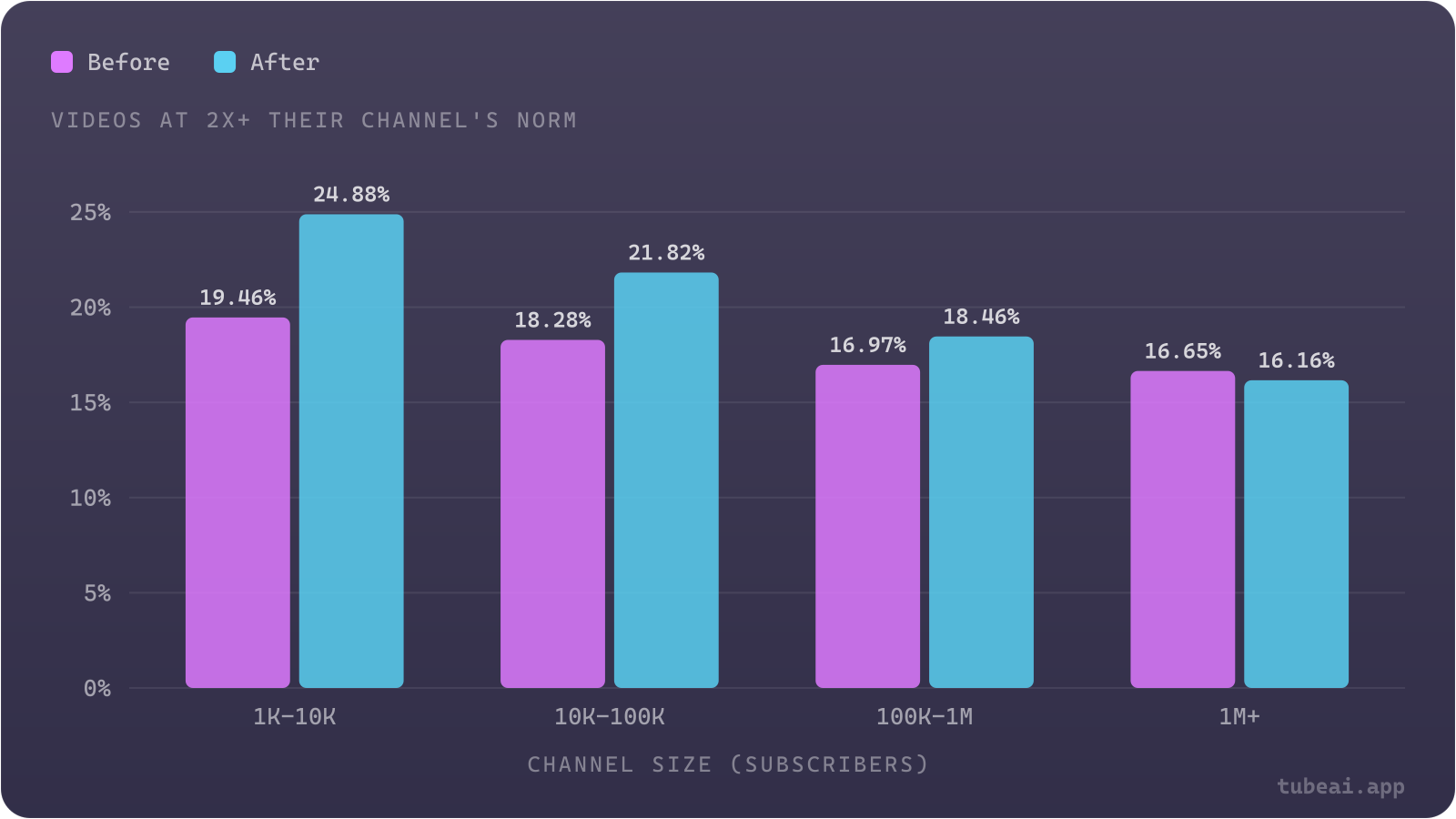
Chart data
| Channel size (subscribers) | before (%) | after (%) |
|---|---|---|
| 1K-10K | 19.46 | 24.88 |
| 10K-100K | 18.28 | 21.82 |
| 100K-1M | 16.97 | 18.46 |
| 1M+ | 16.65 | 16.16 |
Why would the biggest channels see nothing? The data cannot say. One possible reason, which I cannot test here: if more of a large channel's plays already lasted long enough to count under the old rule, counting from the first frame adds less. Whatever the cause, it means the new count does not inflate every channel equally, which matters when you compare yourself with bigger creators.
Why the change inflates outlier scores
An outlier score compares a video with the channel's typical performance, measured on the uploads published around it. That comparison assumes every video was counted the same way. For about two months after Aug 24, it was not.
Take a channel that uploads weekly. Its first video after Aug 24 is counted the new way, but the uploads around it, the ones that set its baseline, were mostly counted the old way. The new video looks like it beat the channel's norm, even if viewers treated it exactly like the others.
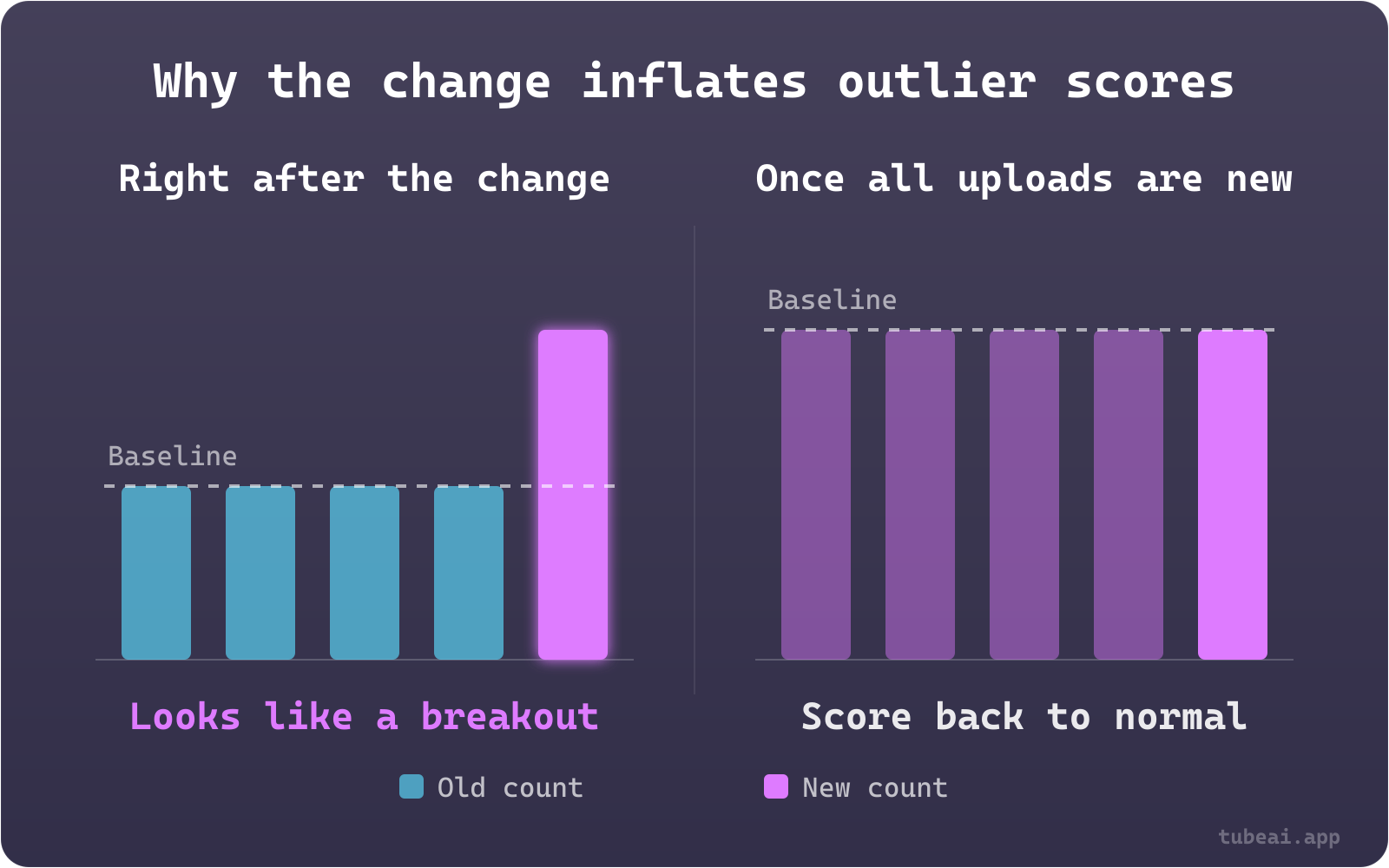
The effect should fade on its own. As a channel keeps uploading, its baseline is built more and more from videos counted the new way, and scores drift back towards normal. There is an early hint of that in the data: the median score peaked at 1.11x for videos published the week of Aug 31 and was down to 1.05x by the week of Sep 14. It is too early to call, though, because those recent videos are also the youngest.
In practice: treat breakouts published from late August through the autumn with some caution, on YouTube and in any tool that measures breakouts, including ours. A 2x video from September is a weaker signal than a 2x video from July.
What to do now
Mark Aug 24 in your reporting
Add a note to any spreadsheet or dashboard that tracks views. Anything published after that date was counted by a looser rule.
Switch your main number to engaged views
Find them in YouTube Studio's advanced analytics. They are what views used to mean, and what YouTube pays on.
Judge videos by retention and watch time
Average view duration and retention were not redefined, so they are still comparable across the change.
Discount recent breakouts
When a September video looks like a 2x hit, check whether it also beat your older videos on watch time before copying its topic or format.
Give sponsors the stricter numbers
Offer engaged views and watch time alongside public views. It protects the relationship when brands notice the difference.
Frequently asked questions
When did YouTube change how views are counted?
For Shorts, on March 31, 2025. For every format, including long-form videos, live streams and podcasts, on Aug 24, 2026, after an announcement on Aug 17, 2026.
Does the new view count change how much I earn?
No, according to YouTube. The Partner Program still pays on engaged views and engaged watch hours, which use the stricter definition. The public view count is no longer tied to earnings.
Were old view counts recalculated?
No. Views a video collected before Aug 24, 2026 keep their old count. Only views after that date are counted from the first frame, which is why older and newer videos are hard to compare.
Why do my recent videos have more views than usual?
Partly because of the new count. In the TubeAI research database, long-form videos published after Aug 24 got 53% more views per subscriber at the median than videos published in June to mid-August. Check engaged views and watch time to see whether viewers really watched more.
Does the change affect the YouTube algorithm?
YouTube says recommendations are not affected. The change is to the public number, not to how videos are chosen for viewers.
Sources
- Update to How Public Views Are Counted on YouTube — YouTube Creator Insider (X)
- YouTube is making a major change to how long-form video views are counted — Dexerto
- YouTube's new 'exposure-based' model counts hovering over video as a view — Euronews
- YouTube to count views from the first frame starting August 24 — Sharp Daily
- YouTube is changing how YouTube Shorts views are counted — TechCrunch
- YouTube changes how Shorts views are counted from March 31 — ppc.land