
Should you change your YouTube title after uploading? What 43,602 retitled videos show
Retitling a video feels like a cheap fix. Across 43,602 retitled videos, a changed title did not speed views up, and creators who kept rewriting the same title ended up with far more flops.

Usually not, unless the title is wrong. I tracked 572,365 videos published September 7-25, 2026 on 117,465 creator channels, and 43,602 of them (7.6%) had their title changed in the first week. In the six hours after a title-only change, the typical video's views came in 6.3% slower than unchanged videos of the same age, and only 45.7% did better than their unchanged peers. The later the change, the worse it looked: -3.4% on day one, -10.8% after day three. And videos that were retitled three or more times flopped more than twice as often as videos left alone.
A new title is not a reliable rescue. Below is what creators actually change, when, and what follows.
- 7.6%of videos retitled43,602 of 572,365 tracked videos
- ~15hmedian time to the first title change
- -6.3%median view pace after a title changevs unchanged videos at the same age
- 45.7%of title changes beat unchanged peers
How often creators change a title
Our tracker checks every new video on the channels TubeAI serves once an hour for its first week and records each title and thumbnail change. Of the 572,365 videos published September 7-25, 2026, 43,602 got at least one new title, on 24,807 different channels. That is one channel in five.
Most stop after one edit. 83.7% of retitled videos were changed once, 11.2% twice and 5.1% three times or more. Fewer than 1 in 100 (286 videos) ended the week back on their original title.
Creators also move fast. The median first title change came about 15 hours after publishing, and 61% landed inside the first day.
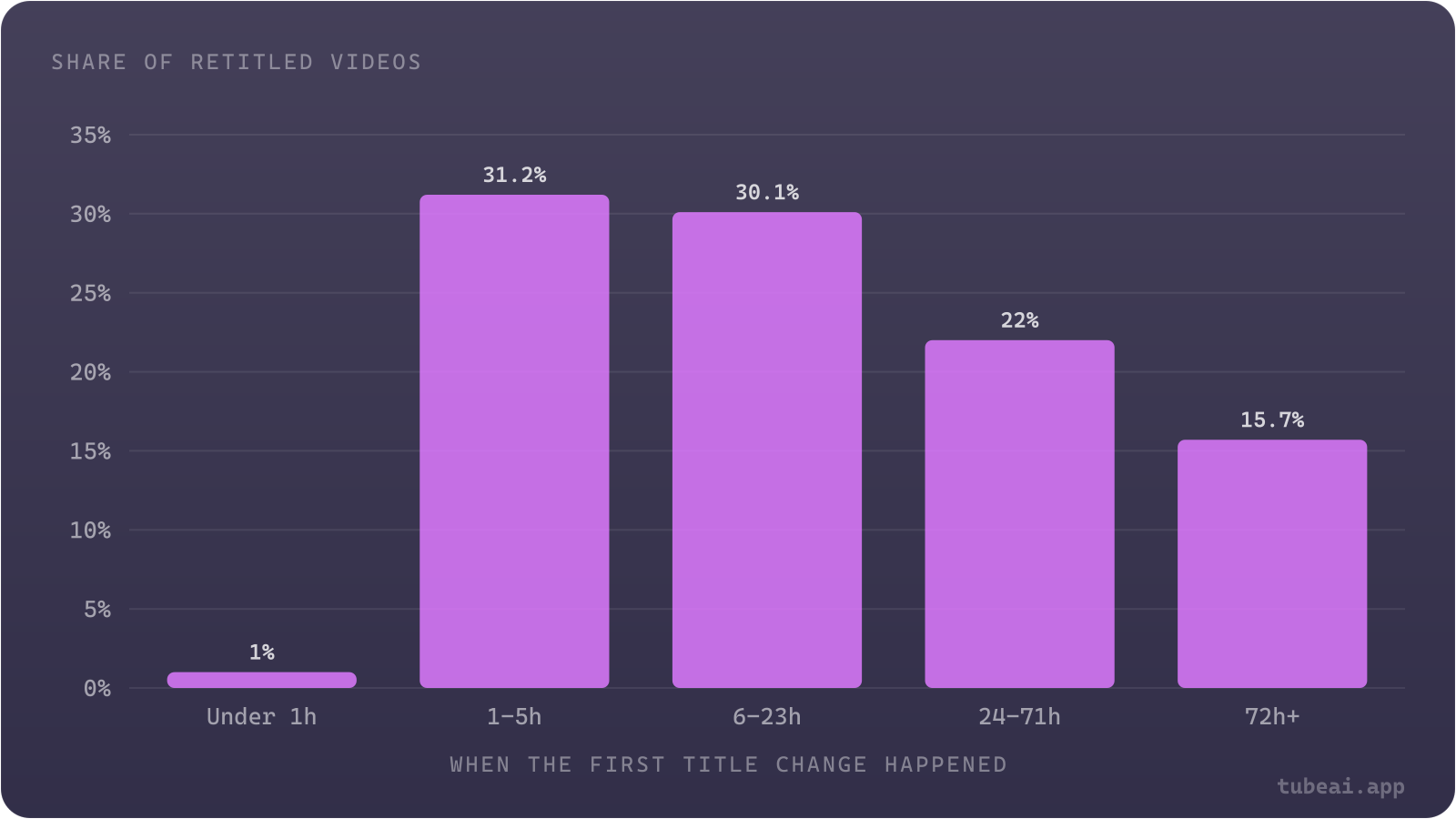
Chart data
| When the first title change happened | Share of retitled videos (%) |
|---|---|
| Under 1h | 1 |
| 1-5h | 31.2 |
| 6-23h | 30.1 |
| 24-71h | 22 |
| 72h+ | 15.7 |
What creators change
I compared the old and new title on every first edit (43,539 with both titles on record). There is no shared playbook. For every common rule of thumb, about as many creators did the opposite:
| Change | Share of edits | Opposite change | Share of edits |
|---|---|---|---|
| Made 10+ characters longer | 20.6% | Made 10+ characters shorter | 18.0% |
| Added a number | 6.3% | Removed a number | 6.4% |
| Added a question mark | 5.1% | Removed a question mark | 5.2% |
| Added ALL-CAPS words | 15.9% | Removed ALL-CAPS words | 15.0% |
The median title went from 53 to 54 characters. Two kinds of edit stand out: 30.1% were near-complete rewrites that kept less than a third of the original words, and 10.0% were tiny fixes of three characters or fewer, the size of a typo or a missing letter.
What a new title does to views
Views always slow down as a video ages, so a before-and-after comparison makes almost every change look bad. Instead I compared each retitled video with unchanged videos at the same hour after publish, the same method I used in the thumbnail swap study:
- I took the views gained in the six hours before the change and the six hours after it.
- I did the same for a 2.5% sample of unchanged videos at that exact age (at least 1,125 of them for every hour).
- A video scores above zero when it kept more of its pace than the typical unchanged video did.
To keep it clean I used only videos whose single change in the week was a title change (no thumbnail edit, no repeat edits), made 7 to 156 hours after publishing, with at least 100 views at the time and hourly readings on both sides. That left 4,680 videos.
The typical one ran 6.3% behind its unchanged peers, and 45.7% did better than them. By construction, unchanged videos beat the typical unchanged video half the time, so a title change came out slightly worse than doing nothing.
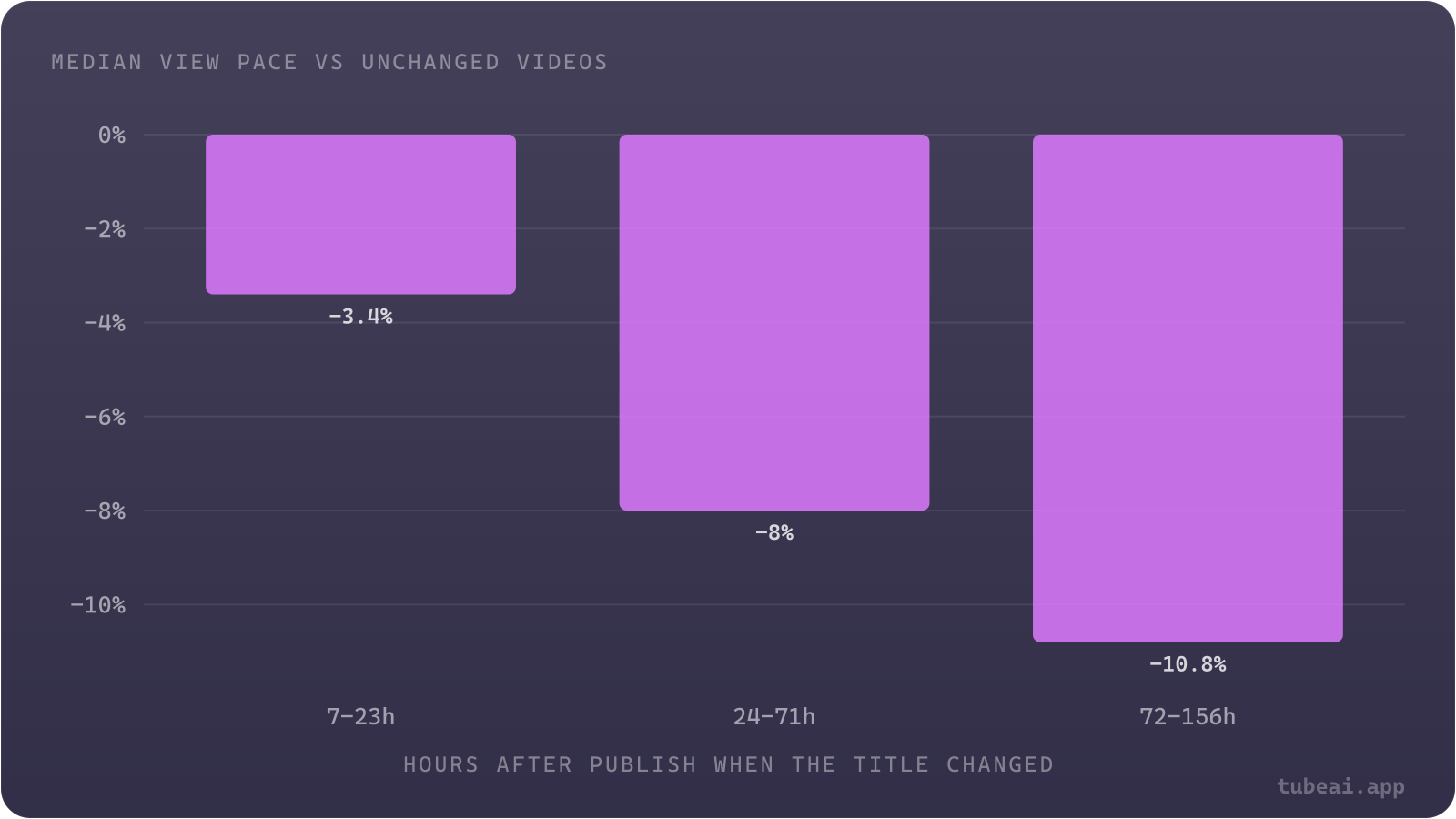
Chart data
| Hours after publish when the title changed | Median view pace vs unchanged videos (%) |
|---|---|
| 7-23h | -3.4 |
| 24-71h | -8 |
| 72-156h | -10.8 |
Day-one changes came closest to break-even. Changes made on days two and three ran 8.0% behind, and changes after day three 10.8% behind. Late retitles were also the least likely to beat unchanged peers: 48.0% on day one, 45.2% on days two and three, 42.8% after that.
The kind of edit barely matters
If the new words were doing the work, a full rewrite should look very different from a typo fix. It doesn't. Every kind of edit landed in the same band, and the tiny fixes, which no viewer would notice, did no better than the rest:
| Kind of edit | Videos measured | Median pace vs unchanged | Beat unchanged peers |
|---|---|---|---|
| Full rewrite (under a third of words kept) | 1,166 | -5.8% | 45.5% |
| Reworded | 1,744 | -6.0% | 46.2% |
| Lengthened (10+ characters) | 714 | -6.1% | 46.1% |
| Shortened (10+ characters) | 476 | -8.7% | 43.3% |
| Small fix (3 characters or fewer) | 580 | -10.2% | 46.4% |
| All title changes | 4,680 | -6.3% | 45.7% |
That is the most useful finding here. A typo fix works almost like a placebo: it changes nothing a viewer would react to, yet those videos slowed just as much. So most of the dip after a retitle is about which videos creators touch and when, not about the new words. A clever rewrite did not beat it in any meaningful way.
One more check points the same way. For 1,377 retitled videos we also had readings from twelve hours before the change. They were not slipping beforehand: in the six hours before the edit they ran 6.1% ahead of unchanged peers, and in the six hours after it 9.9% behind. Creators seem to retitle during a burst of activity, and the pace then settles back. This data can't say whether the new title caused that.
Retitling again and again is a warning sign
Looking at where videos stood at the time of the query, measured against their own channel's normal views, a single title change is nearly harmless. Videos changed once ended about where unchanged videos did. Videos changed two or three times did much worse:
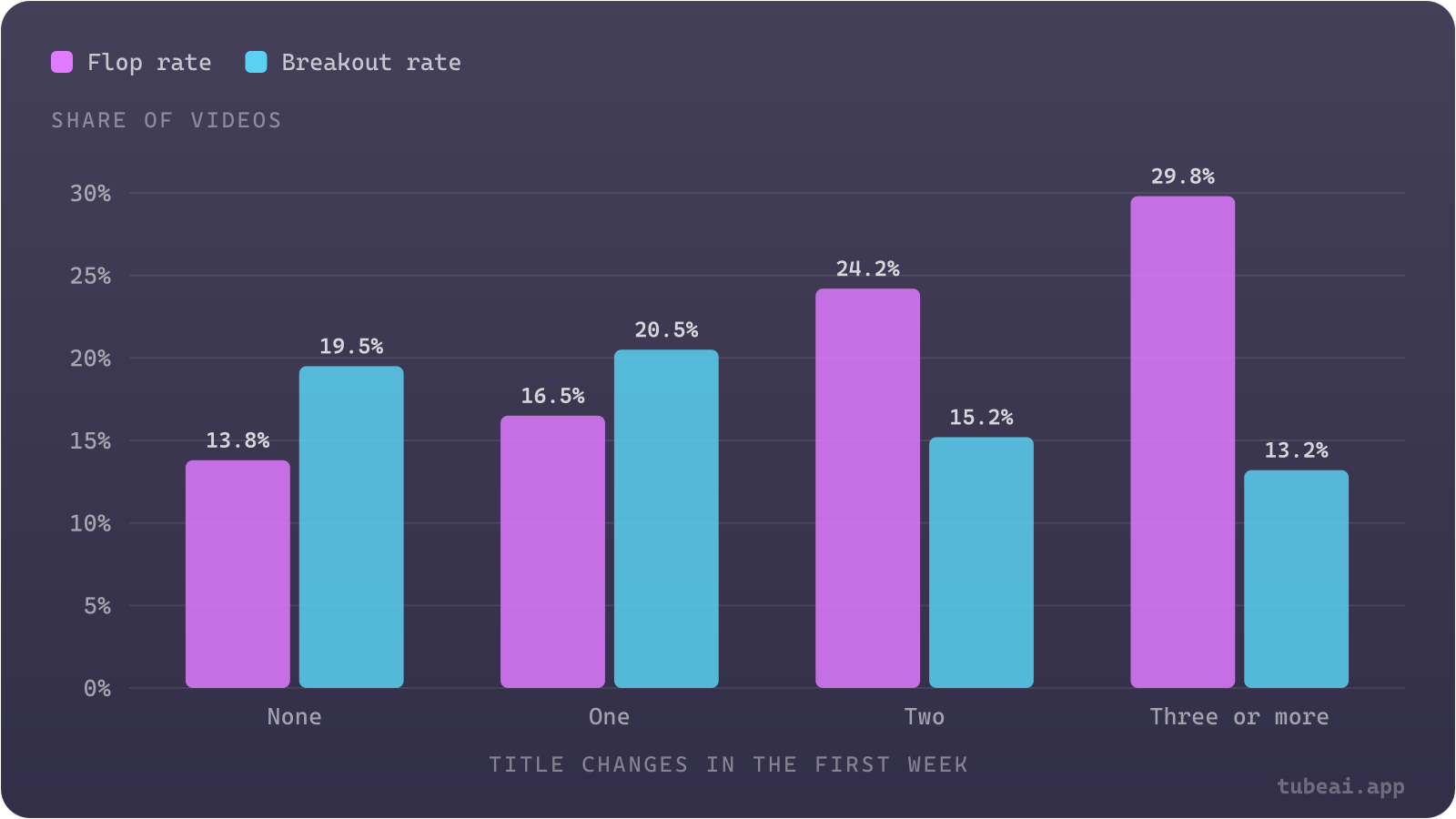
Chart data
| Title changes in the first week | flop_rate (%) | breakout_rate (%) |
|---|---|---|
| None | 13.8 | 19.5 |
| One | 16.5 | 20.5 |
| Two | 24.2 | 15.2 |
| Three or more | 29.8 | 13.2 |
Video by video:
- Unchanged: 1.05x their channel's normal views, 13.8% flops.
- One title change: 1.02x, 16.5% flops.
- Two: 0.86x, 24.2% flops.
- Three or more new titles: 0.77x, 29.8% flops.
The direction of cause is clear enough: creators keep rewriting videos that are not working. Repeated rewrites did not turn those videos around. A small group (307 videos) rotated back and forth between the same two or three titles, which is what YouTube's own title tests look like from outside; they sat between the two groups at 0.95x. For what real tests show, see our analysis of 460 Test & Compare runs.
When to change a title
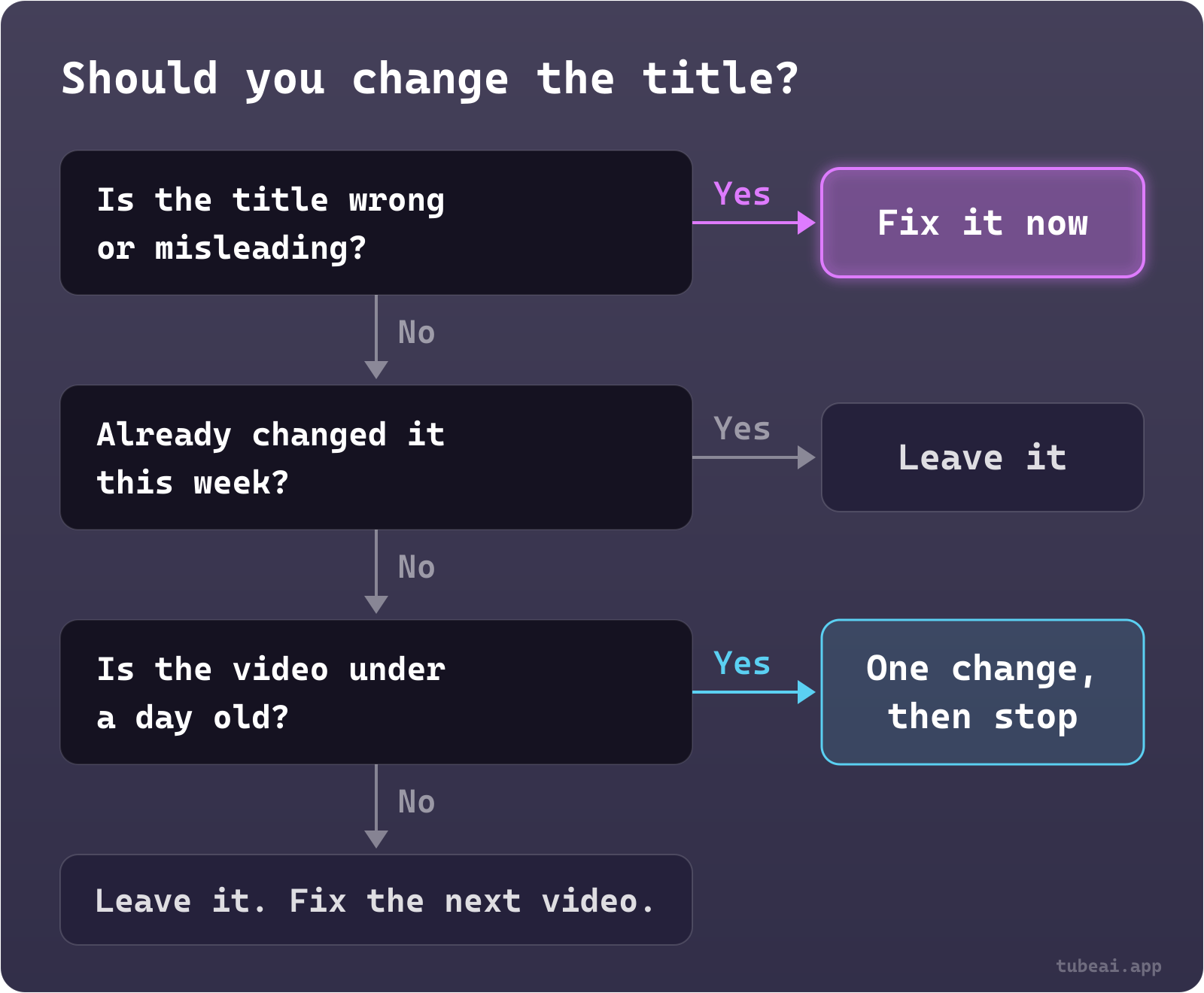
The numbers support a short rule: fix real mistakes right away, make any judgment call early and only once, and put the rest of the effort into the next upload.
A title routine that matches the data
Write several titles before you publish
Draft a handful of options and pick the strongest. Our study of title length found the sweet spot most creators already use, and a list of proven formats is a faster start than editing later.
Fix errors immediately
A typo, a wrong number or a title that promises something the video does not deliver should be fixed the moment you notice. Accuracy beats the small dip that follows any edit.
If you retitle by choice, do it on day one
Day-one changes came closest to even with leaving the video alone. Changes after day three ran 10.8% behind unchanged videos.
Change it once
One change was nearly harmless. Videos rewritten three or more times flopped more than twice as often as videos left alone.
Judge it against your own normal curve
Views always slow down as a video ages. Compare the hours after a change with how your other videos behave at the same age, not with the hours just before.
For the packaging decisions that happen before upload, see how long a YouTube title should be and the title formats that perform best.
Frequently asked questions
Should I change my YouTube title after uploading?
Only if it is wrong or misleading, or if you do it once on the first day. Across 4,680 measured title changes, the typical video's view pace in the six hours after the change ran 6.3% behind unchanged videos of the same age, and only 45.7% beat their unchanged peers.
Does changing a YouTube title reset the video or hurt it?
We saw no sign of a reset. A single title change was close to harmless: videos changed once ended at 1.02x their channel's normal views against 1.05x for unchanged videos. Videos retitled three or more times did much worse, at 0.77x, but those were mostly videos that were already struggling.
When is the best time to change a YouTube title?
Early. Changes made 7-23 hours after publishing ran 3.4% behind unchanged videos, while changes after day three ran 10.8% behind.
How many creators change their titles after publishing?
On the creator channels TubeAI tracks, 7.6% of videos published September 7-25, 2026 had their title changed in the first week, on one channel in five. 61% of first title changes happened within a day of publishing.
Is a full rewrite better than a small tweak?
Not by much. Full rewrites ran 5.8% behind unchanged videos and rewordings 6.0% behind. Even tiny fixes of three characters or fewer ran 10.2% behind, which suggests most of the dip comes from which videos get edited, not from the new words.