
Do emojis in YouTube titles help? What 10.3 million videos show
Emojis barely move a YouTube title. On the same channel, emoji titles beat emoji-free ones on 51% of 22,741 channels: a coin flip, with a small edge for two or more.

Barely. I compared 10,280,371 long-form videos published between July 2025 and June 2026, and 1,050,243 of them (10.2%) had at least one emoji in the title. When a channel uses emojis on some titles and not on others, its emoji titles come out ahead on 51.1% of channels, out of 22,741 that did both. That is a coin flip. The typical channel's emoji titles did about 1% better than its own emoji-free titles.
So an emoji is not a growth tactic, and it is not a penalty either. It is a style choice. The small edge that does exist shows up when a channel uses two or more, and it depends heavily on the niche.
How I measured it
Every video comes from a creator channel that TubeAI serves in its research database. I kept long-form uploads (over 60 seconds) published from July 1, 2025 to June 30, 2026, and dropped removed videos.
A title counts as having an emoji if it contains a character from the standard emoji and pictograph ranges, including symbols like the star and the fire icon, and country flags. The main measure is the outlier multiplier: a video's views divided by what that channel's videos published around the same time usually get. 1.0x is a normal video for the channel; 2.0x doubled it.
Raw comparisons across channels mislead here, because some kinds of channel use emojis far more than others. So the core test compares each channel only with itself: for every channel with at least five emoji titles and five emoji-free titles, I compared the median multiplier of the two groups.
Emoji titles vs emoji-free titles
Across the whole set, emoji titles look slightly worse than titles without one.
| Title | Videos | Channels | Median multiplier | Reached 2x+ | Median views |
|---|---|---|---|---|---|
| No emoji | 9,230,128 | 163,927 | 1.00x | 19.5% | 3,600 |
| 1 emoji | 555,692 | 47,772 | 0.99x | 17.5% | 3,400 |
| 2 emojis | 310,564 | 32,285 | 1.00x | 18.0% | 3,300 |
| 3+ emojis | 183,987 | 18,579 | 1.00x | 16.3% | 2,800 |
Read on its own, this table says emojis cost you: titles with three or more reach 2x their channel's norm 16.3% of the time, against 19.5% for titles with none. But it pools very different channels. Emoji use clusters in ASMR, lifestyle, kids and spirituality channels, and those niches have their own baselines. To know what the emoji itself does, a channel has to be compared with itself.
The same channel, with and without emojis
22,741 channels published at least five emoji titles and five emoji-free titles in the window. For each, I checked whether the emoji titles had the higher median multiplier.
- 51.1%Channels where emoji titles wonof 22,741 channels
- ~1.01xTypical lift from any emojimedian channel
- 54.8%Channels where 3+ emojis wonof 4,170 channels
- 10.2%Titles with an emoji1,050,243 videos
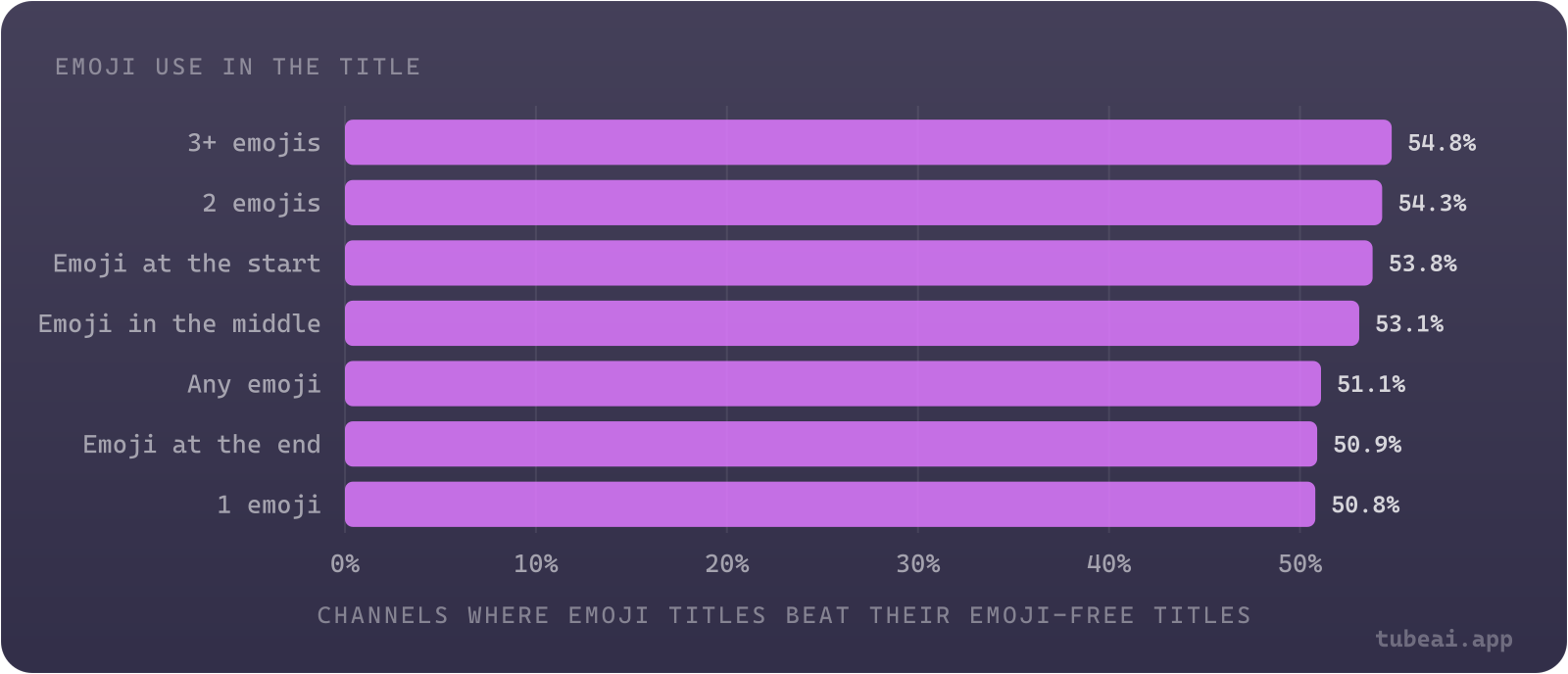
Chart data
| Emoji use in the title | Channels where emoji titles beat their emoji-free titles (%) |
|---|---|
| 3+ emojis | 54.8 |
| 2 emojis | 54.3 |
| Emoji at the start | 53.8 |
| Emoji in the middle | 53.1 |
| Any emoji | 51.1 |
| Emoji at the end | 50.9 |
| 1 emoji | 50.8 |
Once the channel is held constant, the penalty in the pooled table disappears. A single emoji is a pure coin flip: 50.8% of 17,095 channels saw a lift, and the typical one did about 1% better. Two emojis (9,334 channels) and three or more (4,170 channels) do a little better, with emoji titles ahead on 54.3% and 54.8% of channels and a typical lift of about 3%.
Position matters less than count. An emoji at the start of the title won on 53.8% of 3,606 channels and one in the middle on 53.1% of 12,865. An emoji tacked onto the end, the most common habit, was a coin flip at 50.9% of 12,307 channels.
For scale: a 3% edge is small next to what the words in a title do. If you are deciding where to spend your effort on a title, the wording and structure matter far more than the decoration.
Which niches use emojis
Emoji use is a niche habit before it is anything else. In some niches it is close to the default; in others almost nobody does it.
| Niche | Long-form videos | Titles with an emoji |
|---|---|---|
| Religion & Spirituality | 136,916 | 48.3% |
| ASMR | 204,811 | 36.0% |
| Lifestyle & Personal | 409,643 | 25.9% |
| Kids Content | 43,352 | 22.3% |
| Beauty & Makeup | 96,576 | 21.6% |
| Travel & Adventure | 331,556 | 20.2% |
| Crafts & Handmade | 219,317 | 18.9% |
| Gaming | 2,601,556 | 6.3% |
| Automotive | 389,108 | 4.4% |
| Tech | 186,350 | 3.9% |
| Business | 160,722 | 3.1% |
| AI & Machine Learning | 77,438 | 3.1% |
| Science | 49,279 | 2.6% |
| History & Society | 100,935 | 2.6% |
| Photography & Videography | 52,317 | 2.1% |
Nearly half of spirituality titles and over a third of ASMR titles carry an emoji. In science, history, business and photography it is under 4%. Those numbers alone are a useful signal: an emoji in an ASMR title reads as normal, while the same emoji on a history channel stands out, for better or worse.
Where emojis help and where they don't
Running the same-channel test inside each niche shows a spread around the coin flip. These are the 15 niches with at least 400 channels that used both kinds of title.
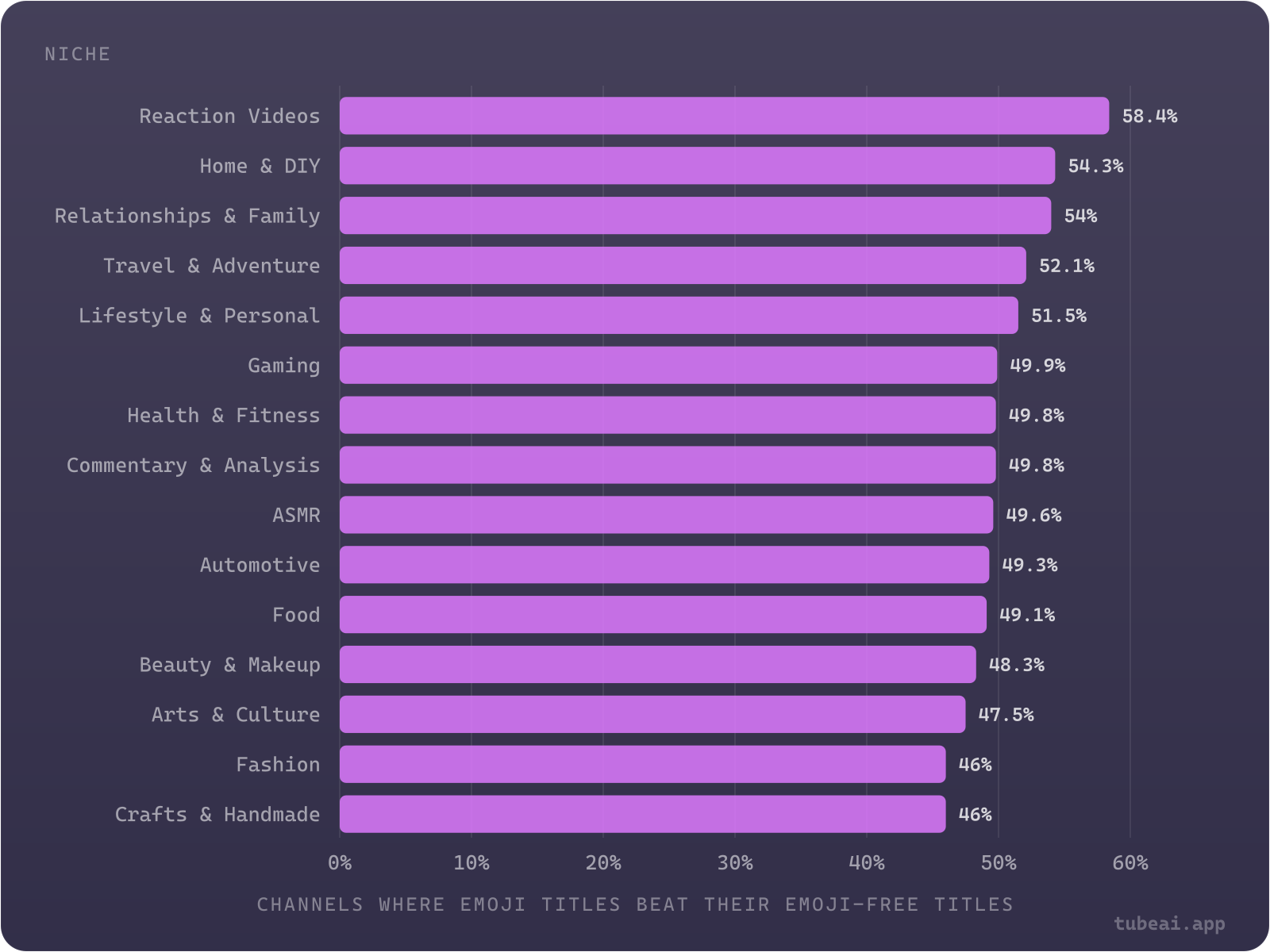
Chart data
| Niche | Channels where emoji titles beat their emoji-free titles (%) |
|---|---|
| Reaction Videos | 58.4 |
| Home & DIY | 54.3 |
| Relationships & Family | 54 |
| Travel & Adventure | 52.1 |
| Lifestyle & Personal | 51.5 |
| Gaming | 49.9 |
| Health & Fitness | 49.8 |
| Commentary & Analysis | 49.8 |
| ASMR | 49.6 |
| Automotive | 49.3 |
| Food | 49.1 |
| Beauty & Makeup | 48.3 |
| Arts & Culture | 47.5 |
| Fashion | 46 |
| Crafts & Handmade | 46 |
Reaction Videos is the one clear winner: emoji titles beat the channel's own emoji-free titles on 58.4% of 741 channels. Reaction titles live on emotion, and a shocked or crying face does some of that work in very few characters. Home & DIY (54.3% of 462 channels) and Relationships & Family (54.0% of 498) lean positive too.
Crafts & Handmade (46.0% of 949 channels) and Fashion (46.0% of 437) lean the other way. Both are niches where viewers search for specific projects and items, and an emoji may take space a descriptive word would use better. Gaming, the largest niche, is a dead even 49.9% across 3,274 channels.
The most used emojis
Creators reach for a small set of emojis, and most of them signal intensity or surprise.
| Emoji | Titles using it | Channels using it |
|---|---|---|
| 🔥 | 105,163 | 13,276 |
| ✨ | 64,623 | 10,372 |
| 😱 | 40,930 | 7,436 |
| 😳 | 40,004 | 7,360 |
| 🚨 | 31,114 | 3,351 |
| ❤ | 29,850 | 6,364 |
| 👀 | 25,532 | 5,946 |
| 😭 | 22,361 | 5,771 |
| 😂 | 22,092 | 5,440 |
| 🤯 | 20,935 | 5,257 |
| 😍 | 19,618 | 3,768 |
| 💥 | 17,755 | 3,297 |
| 🎄 | 14,822 | 5,557 |
The fire emoji alone appears in 105,163 titles from 13,276 channels, about one in ten emoji titles. The siren is worth a note: it is used by far fewer channels (3,351) than its title count suggests, which means a small number of channels put it on nearly everything, typically for breaking-news style content. Flags are left out of this ranking because they are built from two letter symbols and do not count cleanly as single emojis.
What this does and does not show
These are correlations across channels in the TubeAI database, not a controlled test. The same-channel comparison removes channel size and niche, but it cannot remove the reason a creator picked an emoji for one video and not another. A creator may save the fire emoji for the video they already think is strongest.
Two more limits. The typical-lift figures were computed in two random halves of the channels (the full set was too large to process in one pass); the halves agreed to within 0.01, and the channel and win counts are exact. And the study covers long-form videos only; Shorts titles behave differently.
The practical reading: emojis are cheap, rarely hurt, and rarely help. The title's words and structure do the real work. For those, see the best YouTube title formats, the best words for YouTube titles and whether to put numbers in your titles. And since an emoji takes room, how long a YouTube title should be is worth keeping in mind.
How to use emojis in your titles
- Get the words right first. An emoji will not rescue a weak title.
- Match your niche. In ASMR, lifestyle or reaction content emojis are expected; in science, history or business they are rare and stand out.
- If you use them, one alone at the end does nothing measurable. Two, or one at the start, has a small edge.
- Test on your own channel before making it a habit.
Questions about emojis in YouTube titles
Do emojis in YouTube titles increase views?
Not by much. Across 22,741 channels that used both, emoji titles beat the same channel's emoji-free titles on 51.1% of channels, essentially a coin flip. The typical channel saw about a 1% lift.
Do emojis in YouTube titles hurt views?
No. Emoji titles look slightly worse when all channels are pooled, but that is because emoji-heavy channels sit in different niches. Compared with the same channel's emoji-free titles, emojis show no penalty.
How many emojis should I put in a YouTube title?
Two or more did slightly better than one: emoji titles won on 54.3% of channels with two and 54.8% with three or more, against 50.8% with a single emoji. The edge is about 3% for the typical channel.
Where should the emoji go in a YouTube title?
An emoji at the start won on 53.8% of channels and one in the middle on 53.1%. An emoji at the end, the most common placement, was a coin flip at 50.9%.
What is the most popular emoji in YouTube titles?
The fire emoji, found in 105,163 long-form titles from 13,276 channels between July 2025 and June 2026. Sparkles, the screaming face and the flushed face come next.