
How long should a YouTube title be? What 7.9 million videos show
Short titles break out least often. Across 7.9 million long-form videos, titles of 60 to 79 characters reached 2x their channel's typical views most often.

A YouTube title works best at around 60 to 79 characters, roughly 9 to 12 words. I pulled 7,941,694 long-form videos from 126,907 creator channels in the TubeAI database, published between September 2025 and August 2026. In that range, 19.5% to 19.6% of videos reached at least twice their channel's typical views. Titles under 30 characters did that only 15.5% of the time. Going longer than 80 characters didn't help further.
The effect is real but modest. Length changes how often a video breaks out, not what an ordinary video does: the median video performs close to its channel's normal level at every length. So treat length as a floor to clear, not a trick.
- 57Median title lengthcharacters, across all 7.9M videos
- 19.6%Breakout rate at 60-69 charactersshare of videos at 2x+ typical views
- 15.5%Breakout rate under 30 charactersthe lowest of any length band
- +22%Longer than your usual title20+ characters longer vs 20+ shorter, same channel
How I measured it
For each video I used its outlier multiplier: its views divided by the typical views of nearby uploads on the same channel. A score of 2x means the video doubled what that channel normally gets. Because every video is compared with its own channel, a 5-million-subscriber channel and a 20,000-subscriber channel are judged on the same scale.
I counted a video as a breakout when it reached 2x or more. Across the whole set, 18.6% of videos did. I kept only long-form videos over 3 minutes, from creator channels with at least 10,000 subscribers that TubeAI serves in its research tools.
Breakout rate by title length
The rate climbs steadily from the shortest titles up to 60 to 69 characters, stays flat through 79, then eases off slightly.
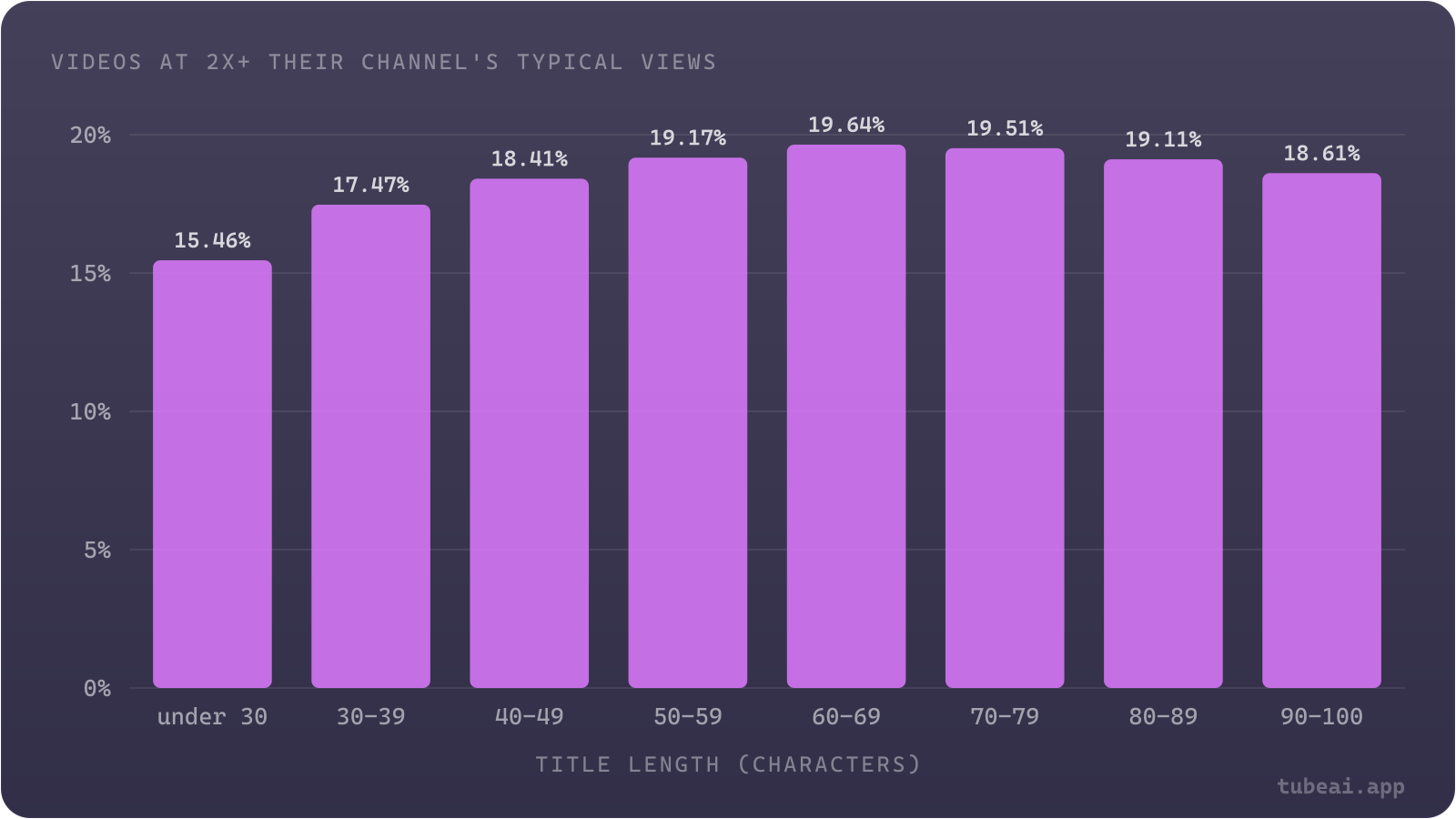
Chart data
| Title length (characters) | Videos at 2x+ their channel's typical views (%) |
|---|---|
| under 30 | 15.46 |
| 30-39 | 17.47 |
| 40-49 | 18.41 |
| 50-59 | 19.17 |
| 60-69 | 19.64 |
| 70-79 | 19.51 |
| 80-89 | 19.11 |
| 90-100 | 18.61 |
A title under 30 characters gives a viewer very little to go on: often a topic and nothing else. From 60 characters there is room for the topic, the promise and a reason to click now. The gap between the shortest band and the best one is 4.2 percentage points, which means titles of 60 to 69 characters broke out about 27% more often.
Is it the title, or the channel?
A fair objection: maybe channels that write longer titles are simply better at packaging. To check, I compared each video with the median title length of its own channel. I kept the 78,116 channels with at least 20 long-form uploads in the period.
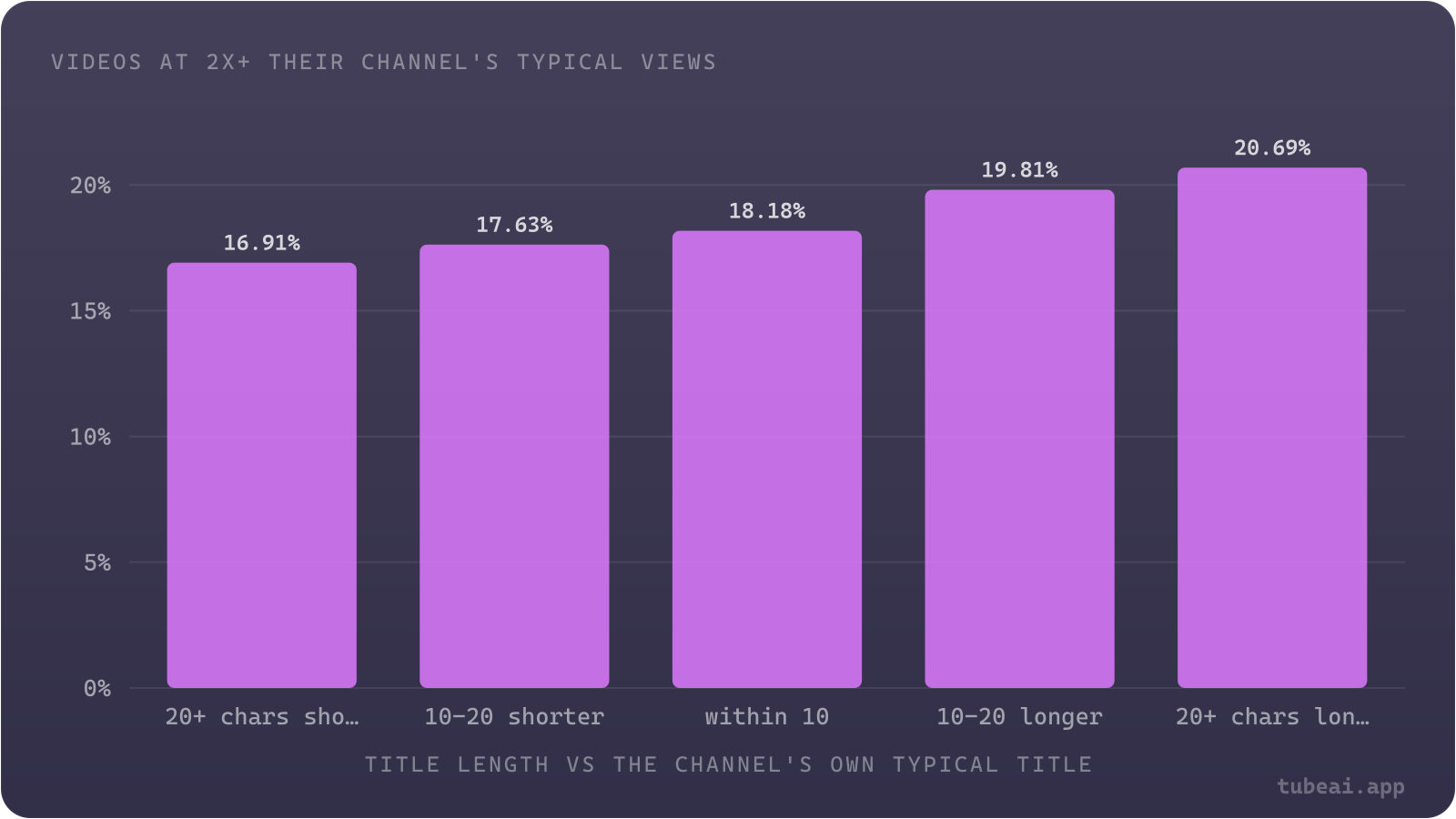
Chart data
| Title length vs the channel's own typical title | Videos at 2x+ their channel's typical views (%) |
|---|---|
| 20+ chars shorter | 16.91 |
| 10-20 shorter | 17.63 |
| within 10 | 18.18 |
| 10-20 longer | 19.81 |
| 20+ chars longer | 20.69 |
The pattern survives. When a creator wrote a title 20+ characters longer than their usual, the video broke out 20.7% of the time. When they wrote one 20+ characters shorter, 16.9%. The median video also moved, from 0.92x to 1.04x of the channel's typical views.
This is still a correlation, not proof. A longer title often means the creator had a more specific idea to sell, and the specific idea may be doing the work. But it points the same way as the first chart: short titles are the weakest bet.
Characters or words?
Counting words gives the same picture. Titles of 1 to 4 words broke out 15.3% of the time. The rate peaked at 11 to 12 words (19.5%) and dipped slightly at 13 words or more (19.0%). Characters are the more practical unit, because that is what gets cut off on screen, but if you count words, aim for about 9 to 12.
| Words in title | Videos | Breakout rate |
|---|---|---|
| 1-4 | 345,789 | 15.3% |
| 5-6 | 903,329 | 17.2% |
| 7-8 | 1,500,460 | 18.4% |
| 9-10 | 1,666,481 | 19.1% |
| 11-12 | 1,392,387 | 19.5% |
| 13+ | 2,133,248 | 19.0% |
Does channel size change it?
No. In all three size groups, titles under 40 characters had the lowest breakout rate. Small and mid-size channels did best at 60 to 79 characters. Channels with 1M+ subscribers were the one group where 80+ characters edged ahead, by less than half a point.
| Channel size | Under 40 | 40-59 | 60-79 | 80+ |
|---|---|---|---|---|
| 10k-100k | 17.2% | 19.3% | 20.0% | 19.3% |
| 100k-1M | 16.2% | 18.1% | 18.7% | 17.8% |
| 1M+ | 15.6% | 17.5% | 19.0% | 19.4% |
By niche
I repeated the analysis for the 10 niches with the most channels. Six peaked at 60 to 79 characters, three at 80 or more, and one (Lifestyle & Personal) at 40 to 59. In every one of them, titles under 40 characters did worse than the best band.
| Niche | Best length band | Breakout rate, best band | Breakout rate, under 40 |
|---|---|---|---|
| Gaming | 80+ | 18.6% | 16.7% |
| Commentary & Analysis | 60-79 | 20.1% | 17.2% |
| Lifestyle & Personal | 40-59 | 15.3% | 13.7% |
| Automotive | 60-79 | 21.8% | 17.7% |
| Travel & Adventure | 60-79 | 20.2% | 16.5% |
| Health & Fitness | 60-79 | 20.4% | 17.4% |
| Food | 80+ | 20.4% | 15.7% |
| Crafts & Handmade | 80+ | 18.7% | 15.2% |
| Home & DIY | 60-79 | 19.8% | 15.4% |
| Animation & VFX | 60-79 | 28.0% | 23.9% |
Longer only works if the first words carry the promise
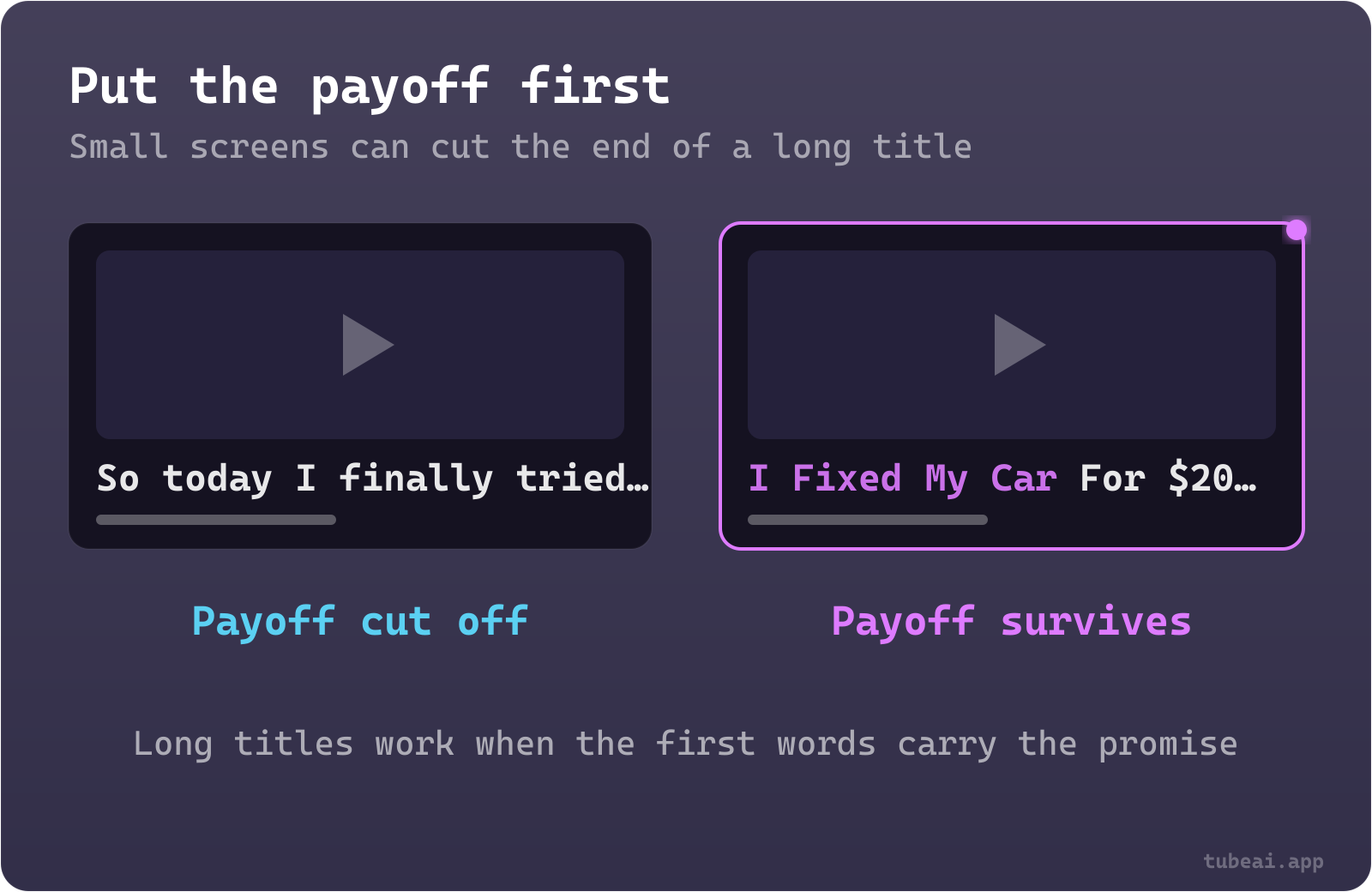
A longer title gives you more room, but not every screen shows all of it. On phones and in the side column, the end of a long title can be cut off. So the extra characters should go after the part that makes someone click.
How to use this on your next title
Write the core promise first
Start with the subject and the outcome, for example the result, the number or the twist. This part should make sense on its own if everything after it is cut off.
Add the detail that sharpens it
Use the remaining space for context that makes the promise specific: a timeframe, a cost, a comparison or who it is for.
Check the length
Aim for about 60 to 79 characters. If you are under 40, you are probably leaving out something a viewer would want to know.
Cut filler, not information
Past 80 characters there is no extra gain. If a long title is padded with words like 'today' or 'so', remove those first.
Length is only one part of a title. The structure matters more. For the templates that break out most often, see the best YouTube title formats, ranked by data. If you're also deciding how long the video itself should be, read how long a YouTube video should be. And if a title isn't working after you publish, what 7,418 thumbnail swaps show covers what changing your packaging can do.
Frequently asked questions
Are shorter YouTube titles better?
Not in our data. Titles under 30 characters had the lowest breakout rate of any length: 15.5% reached twice their channel's typical views, against 19.6% for titles of 60 to 69 characters.
How many words should a YouTube title have?
About 9 to 12 words. Titles of 11 to 12 words broke out 19.5% of the time, and titles of 1 to 4 words 15.3%.
Is there a point where a title is too long?
Past 80 characters the breakout rate stops rising and eases slightly, to 18.6% for titles of 90 to 100 characters. Long titles also risk having their end cut off on small screens, so keep the key promise at the start.
Does title length matter for small channels?
Yes, in the same way. Channels with 10k to 100k subscribers broke out most often with titles of 60 to 79 characters (20.0%) and least often under 40 characters (17.2%).
Will a longer title make my video go viral?
No. Length shifts the odds of a breakout by a few percentage points; it does not change what an average video does. The idea, the title structure and the thumbnail matter more.