
Should you put the year in your YouTube title? What 8 million videos show
Yes, if it is the right year. On the same channel, titles with the current year beat titles with no year by 12.5%, and next year's date beats them by 37%.

Yes, but only the right year, and only on the right kind of video. I compared 7,980,401 long-form videos published between October 2025 and September 2026. On the same channel, titles carrying the current year typically did 12.5% better than that channel's titles with no year. Titles carrying next year ("2026" on a video published in December 2025) did 37% better. Titles with last year's date did no better than having no year at all.
So a year is not a magic word. It is a promise that the video is current. It pays when the topic goes stale and the viewer knows it: rankings, reviews, tutorials, buying guides. It does nothing, or a little harm, on news and commentary, where every video is already current.
How I measured it
Every video comes from a creator channel that TubeAI serves in its research database: 137,726 channels in all. I kept long-form uploads only (over 60 seconds) published from October 1, 2025 to September 14, 2026.
A title counts as having a year if it contains a standalone four-digit number from 1900 to 2099. I then compared that year with the year the video was published: the same year, the next year, the previous year, or something further away.
Big and small channels title differently, so raw views are a poor comparison. The main measure is the outlier multiplier: a video's views divided by what that channel's videos published around the same time usually get. 1.0x is a normal video for that channel; 2.0x doubled it. I report the median multiplier and the share of videos that reached 2x or more.
Which year works
Only 6.9% of titles name a year at all. How they perform depends almost entirely on which year it is.
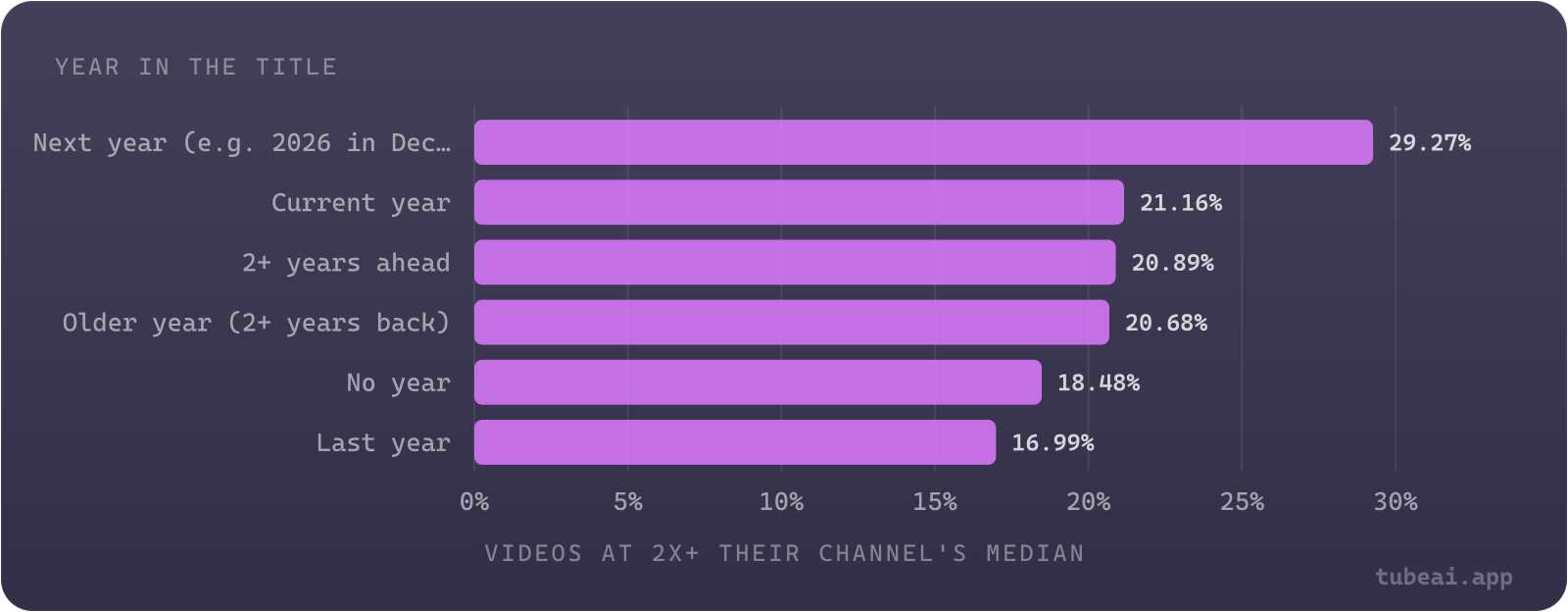
Chart data
| Year in the title | Videos at 2x+ their channel's median (%) |
|---|---|
| Next year (e.g. 2026 in Dec 2025) | 29.27 |
| Current year | 21.16 |
| 2+ years ahead | 20.89 |
| Older year (2+ years back) | 20.68 |
| No year | 18.48 |
| Last year | 16.99 |
| Year in the title | Videos | Channels | Median multiplier | Reached 2x+ | Median views |
|---|---|---|---|---|---|
| No year | 7,426,210 | 136,938 | 1.00x | 18.5% | 4,900 |
| Current year | 369,253 | 49,420 | 1.06x | 21.2% | 3,298 |
| Older year (2+ back) | 104,912 | 19,125 | 1.00x | 20.7% | 2,300 |
| Last year | 48,373 | 17,763 | 0.96x | 17.0% | 2,600 |
| Next year | 24,721 | 8,172 | 1.18x | 29.3% | 7,300 |
| 2+ years ahead | 6,932 | 2,424 | 1.00x | 20.9% | 4,100 |
Three things stand out.
- Next year wins clearly. 29.3% of those videos reached 2x their channel's norm, and their median multiplier was 1.18x. Almost all of them were published from October to December, as creators got ahead of the new year.
- The current year helps, modestly. 1.06x at the median and 21.2% at 2x, against 18.5% for titles with no year.
- Last year is the one to avoid. 0.96x at the median and 17.0% at 2x, the weakest group in the study. A title that says "2025" in 2026 tells the viewer the video is already out of date.
Note the median views column. Current-year titles get fewer raw views (3,298) than titles with no year (4,900). That is because smaller channels use the year more often, not because the year costs views. Against their own channel's norm, the same videos do better.
Older years (2+ years back) are mostly history and anniversary videos ("The 1998 season..."), where the date is the subject, not a freshness signal. Years 2+ ahead are predictions ("by 2030"). Neither group differs much from having no year.
The same channel, with and without the year
Channels that use years are not a random sample. Tech reviewers and car channels use them constantly; vloggers rarely do. The cleaner test compares a channel only with itself.
- 1.37xNext yearmedian across 1,638 channels
- 1.13xCurrent yearmedian across 13,453 channels
- 62.7%Channels where the current year wonof 13,453 channels
- 1.03xLast yearmedian across 3,569 channels
I took every channel with at least five long-form titles without a year and at least five with the current year: 13,453 channels. Their current-year titles ran at a median of 1.13x their no-year titles, and came out ahead on 62.7% of them.
Next year's date is stronger again. On the 1,638 channels that used it at least three times, those titles ran at 1.37x the channel's no-year titles and won on 72.6% of channels.
Last year's date is close to neutral on the same channel: 1.03x, winning on 52.3% of 3,569 channels, which is barely better than a coin flip. The penalty in the overall table mostly comes from what those videos are, not the digits. The fair conclusion: last year's date does not hurt much, but it never helps.
When the year works best
A year is a freshness promise, and freshness wears off. The month a video goes out changes what the same year is worth.
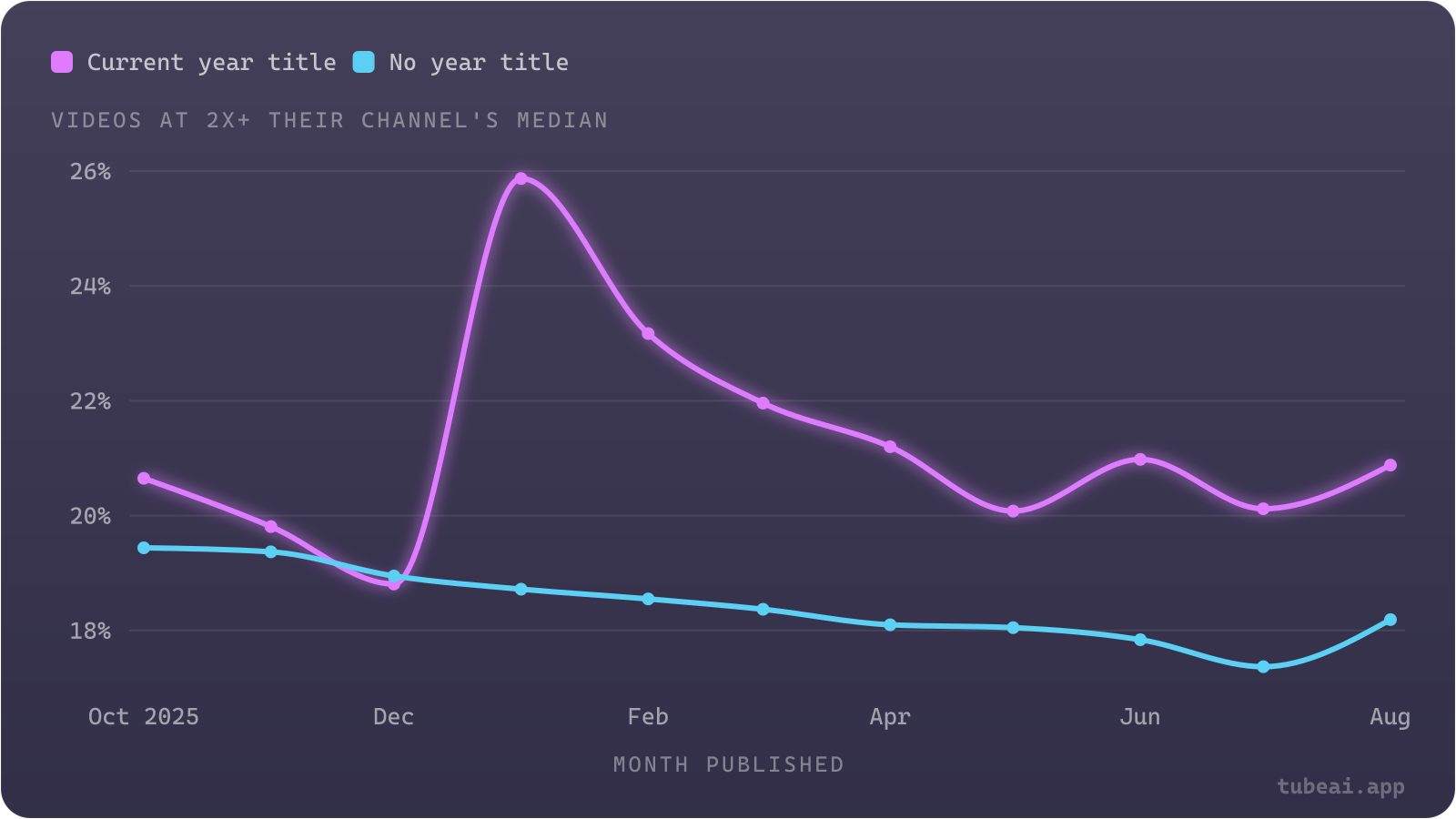
Chart data
| Month published | current_year_title (%) | no_year_title (%) |
|---|---|---|
| 2025-10 | 20.65 | 19.44 |
| 2025-11 | 19.81 | 19.37 |
| 2025-12 | 18.81 | 18.95 |
| 2026-01 | 25.87 | 18.72 |
| 2026-02 | 23.17 | 18.55 |
| 2026-03 | 21.96 | 18.37 |
| 2026-04 | 21.2 | 18.1 |
| 2026-05 | 20.08 | 18.05 |
| 2026-06 | 20.98 | 17.84 |
| 2026-07 | 20.12 | 17.37 |
| 2026-08 | 20.88 | 18.19 |
Current-year titles peak in January: 25.9% of those published in January 2026 reached 2x, against 18.7% for that month's titles with no year. The edge narrows through the spring, holds at 2 to 3 points over the summer, and is gone by December (18.8% against 19.0% in December 2025).
That December dip is where next year takes over. Titles naming the coming year reached 2x 30.3% of the time in October, 30.8% in November and 29.2% in December, on 4,057, 5,282 and 9,015 videos. Creators who titled their buying guides and "best of" videos for the new year in late autumn got there before the January searches did.
January also shows the trap. It brought a wave of 31,372 titles naming last year, mostly recaps and "best of 2025" lists, and only 16.5% of them reached 2x.
Which niches benefit
The year helps most where viewers actively look for current information, and least where the content is current by default.
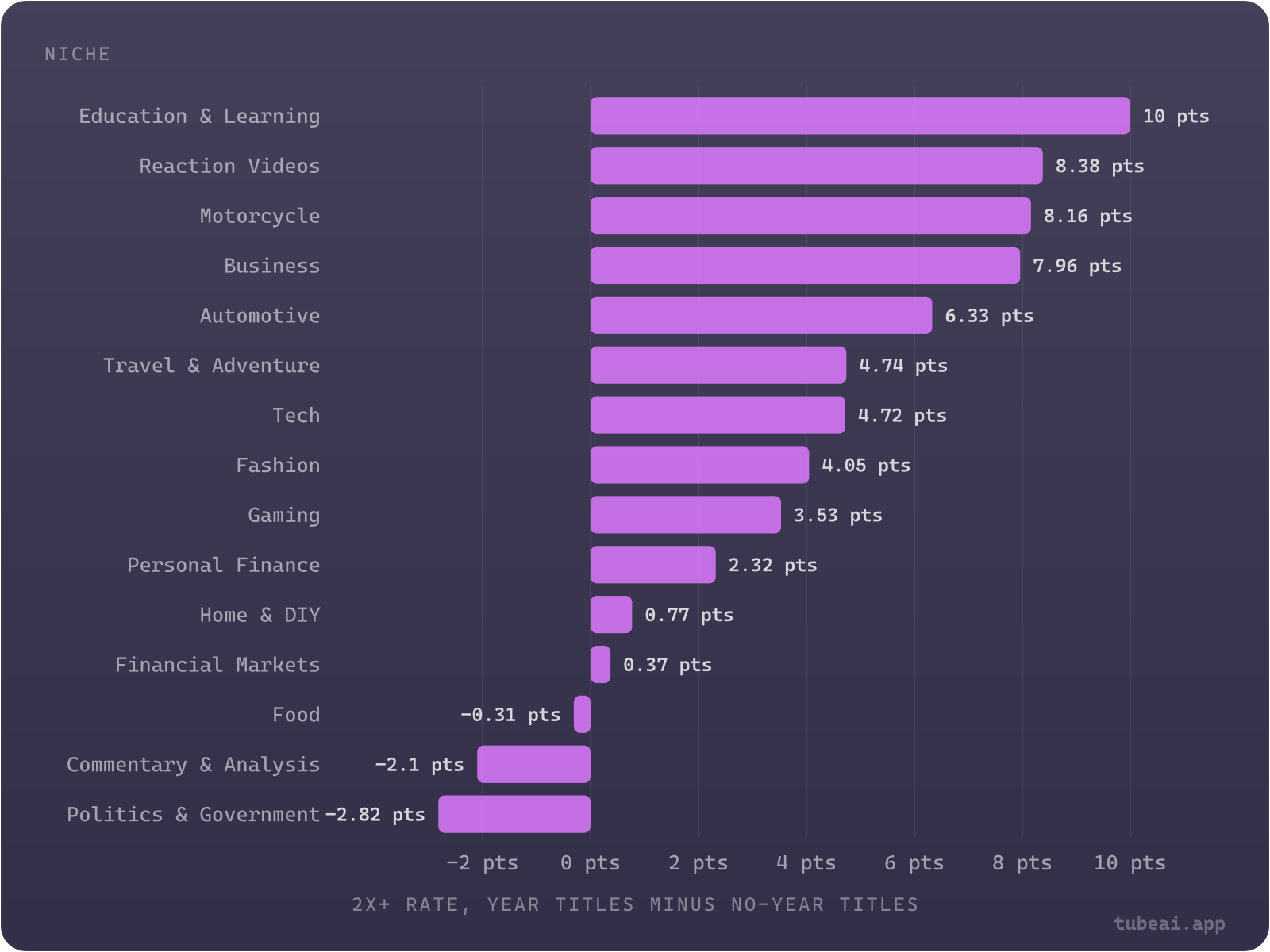
Chart data
| Niche | 2x+ rate, year titles minus no-year titles (pts) |
|---|---|
| Education & Learning | 10 |
| Reaction Videos | 8.38 |
| Motorcycle | 8.16 |
| Business | 7.96 |
| Automotive | 6.33 |
| Travel & Adventure | 4.74 |
| Tech | 4.72 |
| Fashion | 4.05 |
| Gaming | 3.53 |
| Personal Finance | 2.32 |
| Home & DIY | 0.77 |
| Financial Markets | 0.37 |
| Food | -0.31 |
| Commentary & Analysis | -2.1 |
| Politics & Government | -2.82 |
- Education & Learning: 28.6% of year titles reached 2x, against 18.6% without, a 10-point gap. Courses, exam guides and "how to learn X" go out of date, and learners check.
- Business (+8.0 points) and Automotive (+6.3): strategies and model years change every year. Car channels put a year in 13.6% of their titles, more than almost any other niche.
- Tech (+4.7) and Gaming (+3.5): solid but smaller gains, because reviews of new devices and games are already obviously current.
- Food (-0.3), Financial Markets (+0.4) and Home & DIY (+0.8): no real difference. A recipe does not expire, and a market update is about today whatever the title says.
- Commentary (-2.1) and Politics (-2.8): the year slightly hurts. A political video with a year in the title often reads as a recap of something viewers already lived through.
Where to put the year
Among titles with the current or next year, position matters more than I expected.
| Position | Videos | Median multiplier | Reached 2x+ |
|---|---|---|---|
| In brackets, e.g. (2026) | 38,385 | 1.10x | 25.7% |
| At the start | 26,736 | 1.10x | 24.6% |
| In the middle | 203,988 | 1.07x | 21.7% |
| At the end, no brackets | 124,865 | 1.02x | 19.8% |
A bare year tacked onto the end of a title ("Best budget phones 2026") is the weakest placement: 19.8% at 2x, barely above no year at all. Putting it in brackets lifts that to 25.7%. Brackets mark the year as a label rather than part of the sentence, and they keep it visible when the title is cut off on mobile. Leading with the year ("2026 buyer's guide...") works almost as well, at 24.6%.
What this does and does not show
These are correlations across channels in the TubeAI database, not a controlled test. Videos that carry a year tend to be a certain kind of video: rankings, guides and reviews that viewers search for. Part of the lift belongs to that format. The same-channel comparison removes channel size and niche, but not topic choice.
Two limits on the data. View counts are a snapshot, so videos from the last weeks of the window have had less time to grow than older ones. And the next-year group is small (24,721 videos) and concentrated in October to December, so it describes late-year publishing, not a trick that works all year.
The practical reading: the year works when it is true and when it matters to the viewer. Putting "2026" on a video that will be just as useful in 2028 does not borrow anything, and it puts an expiry date on the title.
The year is one of several kinds of number covered in whether to put numbers in YouTube titles. It also costs characters, which matters under the limits in how long a YouTube title should be. To refresh an old video whose title still names last year, see what changing a title after upload tends to do, and for the structures a year usually sits inside, the best YouTube title formats.
How to use the year in your next title
- Add the year only to videos that can go out of date: rankings, reviews, buying guides, tutorials, strategies.
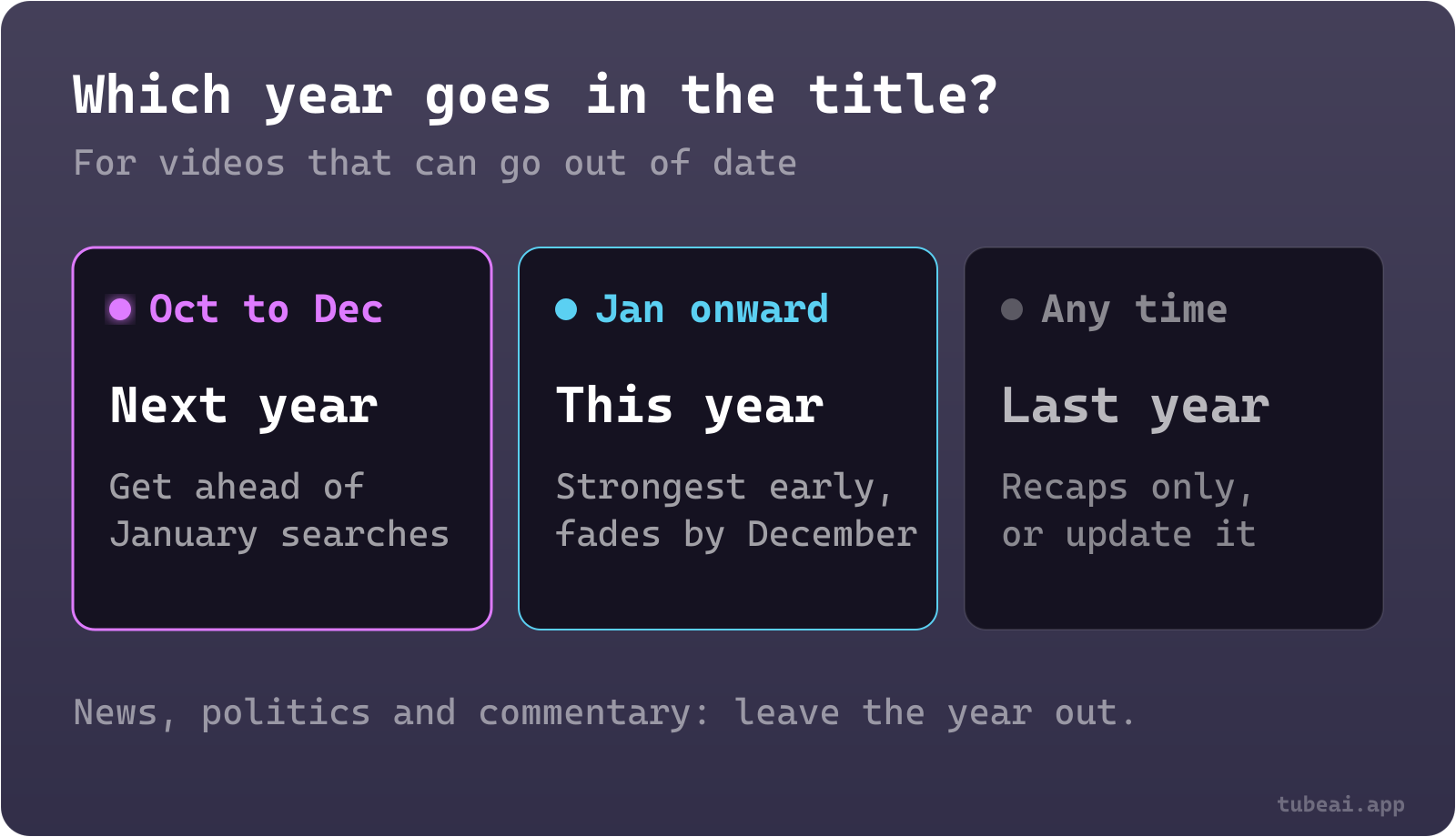
- From October, title those videos with next year. From January, use the current year.
- Never publish a new video with last year's date, unless it is a recap where the year is the subject.
- Put the year in brackets or at the start, not loose at the end.
- Leave it out of news, politics and commentary.
- Each January, update the year on evergreen videos that still get search traffic.
Questions about the year in YouTube titles
Should I put the year in my YouTube title?
For videos that can go out of date, yes. Across 8 million long-form videos, titles with the current year reached 2x their channel's typical views 21.2% of the time, against 18.5% for titles with no year. On the same channel, current-year titles did 12.5% better at the median. For news, commentary and recipes it makes little or no difference.
Should I use this year or next year in my title?
From October onward, next year. Titles naming the coming year reached 2x their channel's norm 29% to 31% of the time in October, November and December, the best result in the study. From January, switch to the current year, which peaks that month at 25.9%.
Does an old year in the title hurt views?
It does not help. Titles naming last year reached 2x only 17.0% of the time, the lowest of any group, and on the same channel they did about as well as titles with no year. Update the year on evergreen videos each January.
Where should the year go in a YouTube title?
In brackets or at the start. Among titles with the current or next year, a bracketed year reached 2x 25.7% of the time and a leading year 24.6%, against 19.8% for a bare year at the end.
Which YouTube niches benefit most from a year in the title?
Education, Business, Automotive, Motorcycle and Tech showed the biggest gains, from about 5 to 10 percentage points in the share of videos reaching 2x. Food and Financial Markets showed no difference, and Commentary and Politics did slightly worse with a year.