
Should your YouTube title be a question? What 10.3 million videos show
A question mark on its own does nothing for a YouTube title. Yes/no questions cost the same channel about 5%, while "is it worth it?" and "X vs Y?" titles beat everything else.

Usually not, and a question mark on its own does nothing. I compared 10,280,370 long-form videos published between July 2025 and June 2026. On the same channel, titles with a question mark perform almost exactly like the titles without one: 0.997x across 43,458 channels. The kind of question is what matters. Yes/no questions ("Is it over?", "Should you buy this?") cost the same channel about 5%. Buying-decision questions ("Is it worth it?", "X vs Y?") do the opposite: 25.2% of "worth it?" titles reached 2x their channel's typical views, against 19.0% for titles with no question at all.
So the useful question is not "should my title be a question?" It is "does the viewer already want this question answered?" A question the viewer is asking themselves before they click is a strong title. A question you made up to sound curious is not.
How I measured it
Every video here comes from a creator channel that TubeAI serves in its research database. I kept long-form uploads only (over 60 seconds) published from July 1, 2025 to June 30, 2026, and dropped removed videos. That leaves 10,280,370 videos.
The main measure is the outlier multiplier: a video's views divided by what that channel's videos published around the same time usually get. 1.0x is a normal video for that channel; 2.0x doubled the channel's norm. I report the median multiplier and the share of videos that reached 2x or more, because raw views mostly measure channel size.
A title counts as a question if it contains a question mark. I also sorted titles by their first word (why, what, how, is, can, do, should and so on), so a title like "Why Nobody Buys Sedans Anymore" counts as a question opener even without the mark. The opener check works on English titles only.
Question titles vs everything else
Across the whole set, about one title in eleven contains a question mark. Those titles perform slightly under their channel's norm, whether the mark sits at the end or in the middle.
| Title | Videos | Channels | Median multiplier | Reached 2x+ |
|---|---|---|---|---|
| No question | 8,730,784 | 165,336 | 1.00x | 19.0% |
| Starts with a question word, no ? | 613,028 | 89,118 | 1.02x | 23.5% |
| Ends with ? | 405,470 | 71,846 | 0.97x | 19.5% |
| ? in the middle | 531,088 | 79,677 | 0.98x | 18.3% |
The best row in that table is not really a question group. Most of it (272,409 videos) is "How to ..." titles, which promise a result rather than ask anything. I split those out below.
A cross-channel table can mislead, because some kinds of channel use questions far more than others. The cleaner test compares each channel only with itself.
The same channel, with and without a question
For every channel with at least five titles in a group and at least five titles with no question, I compared the median multiplier of the two. The baseline is always the same channel's titles with no question mark and no question opener.
- 0.997xAny question mark43,458 channels, won on 48.5%
- 0.95xYes/no questions10,170 channels, won on 43.6%
- 1.02xWhy / What / How questions7,050 channels, won on 51.7%
- 1.16x"How to" titles10,739 channels, won on 63.4%
Adding a question mark does not move the needle on its own: question titles win on fewer than half of the channels that use them. The split by question type is where the difference shows up. Yes/no questions run at 0.95x of the same channel's plain titles. Open questions (why, what, how) come out about level at 1.02x. And "How to" titles, which are not questions at all, beat the same channel's other titles by 16%.
Yes/no questions are the weakest kind
Sorting question titles by their first word shows a clear line between open questions and yes/no questions.
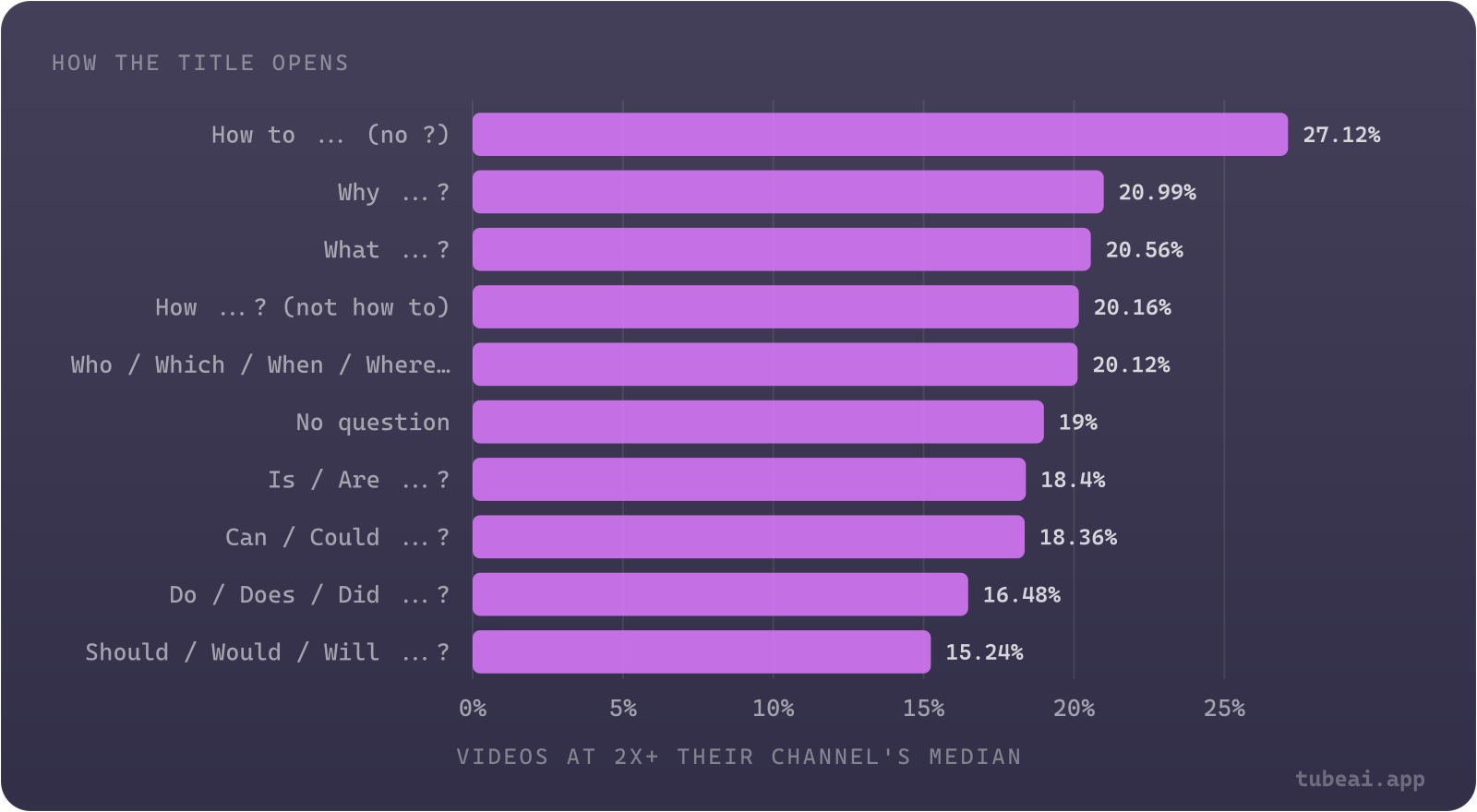
Chart data
| How the title opens | Videos at 2x+ their channel's median (%) |
|---|---|
| How to ... (no ?) | 27.12 |
| Why ...? | 20.99 |
| What ...? | 20.56 |
| How ...? (not how to) | 20.16 |
| Who / Which / When / Where ...? | 20.12 |
| No question | 19 |
| Is / Are ...? | 18.4 |
| Can / Could ...? | 18.36 |
| Do / Does / Did ...? | 16.48 |
| Should / Would / Will ...? | 15.24 |
- Should / Would / Will ...? (23,692 videos): 0.91x median, 15.2% at 2x. The weakest group in the study.
- Do / Does / Did ...? (31,373 videos): 0.92x median, 16.5% at 2x.
- Is / Are ...? (86,643 videos) and Can / Could ...? (50,755 videos): both about 0.95x and 18.4% at 2x, just under titles with no question.
- Why, What, How and Who/Which/When/Where questions: 20.1% to 21.0% at 2x, with medians at about 1.0x.
A yes/no question hands the viewer a one-word answer. If they already think they know it ("Is the economy collapsing?" "Probably not"), there is nothing left to click for. An open question cannot be answered in a word, so the video still has something to offer.
One more detail: the question mark is not what makes open questions work. "Why ..." titles without a question mark reached 2x 21.5% of the time, a little better than "Why ...?" titles at 21.0%. "How ..." without the mark did 21.7%, against 20.2% with it. Written as a statement ("Why Nobody Buys Sedans Anymore"), the title reads like the video already has the answer.
The questions that win: buying decisions
There is one kind of yes/no question that beats almost everything: the question a viewer types into search before they spend money or time. I sorted all 936,558 question-mark titles by what they ask.
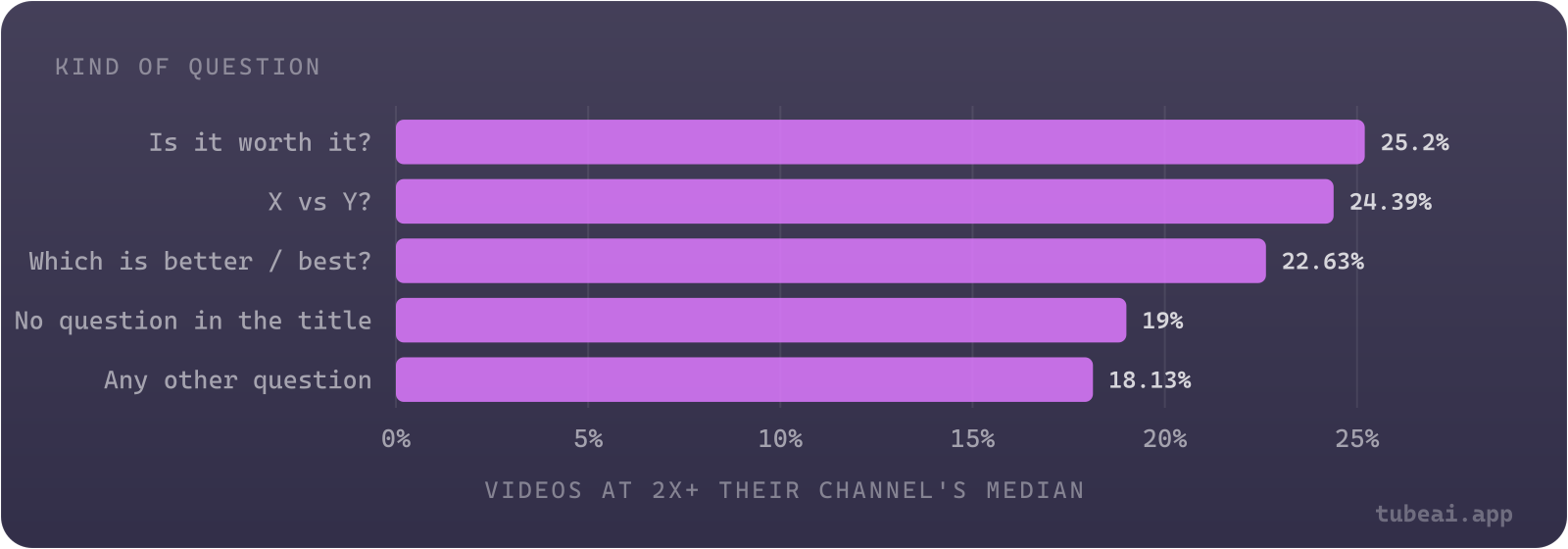
Chart data
| Kind of question | Videos at 2x+ their channel's median (%) |
|---|---|
| Is it worth it? | 25.2 |
| X vs Y? | 24.39 |
| Which is better / best? | 22.63 |
| No question in the title | 19 |
| Any other question | 18.13 |
- "Worth it?" (26,231 videos on 13,244 channels): 1.05x median, 25.2% at 2x.
- "X vs Y?" (34,231 videos on 14,795 channels): 1.03x median, 24.4% at 2x.
- "Better" or "best" questions (51,522 videos on 22,912 channels): 1.03x median, 22.6% at 2x.
- Every other question (824,574 videos): 0.97x median, 18.1% at 2x.
These questions differ from the weak ones in one way: the viewer already has them. Someone deciding between two cameras does not need to be talked into caring about the answer. The title just has to show that this video settles it. That is also why decision questions sit near the top of the best YouTube title formats.
Where question titles work, and where they do not
The niche results follow the same logic. I compared question-mark titles with titles that have no question, niche by niche, for every niche with at least 3,000 question titles in the window. These are the six largest gaps in each direction.
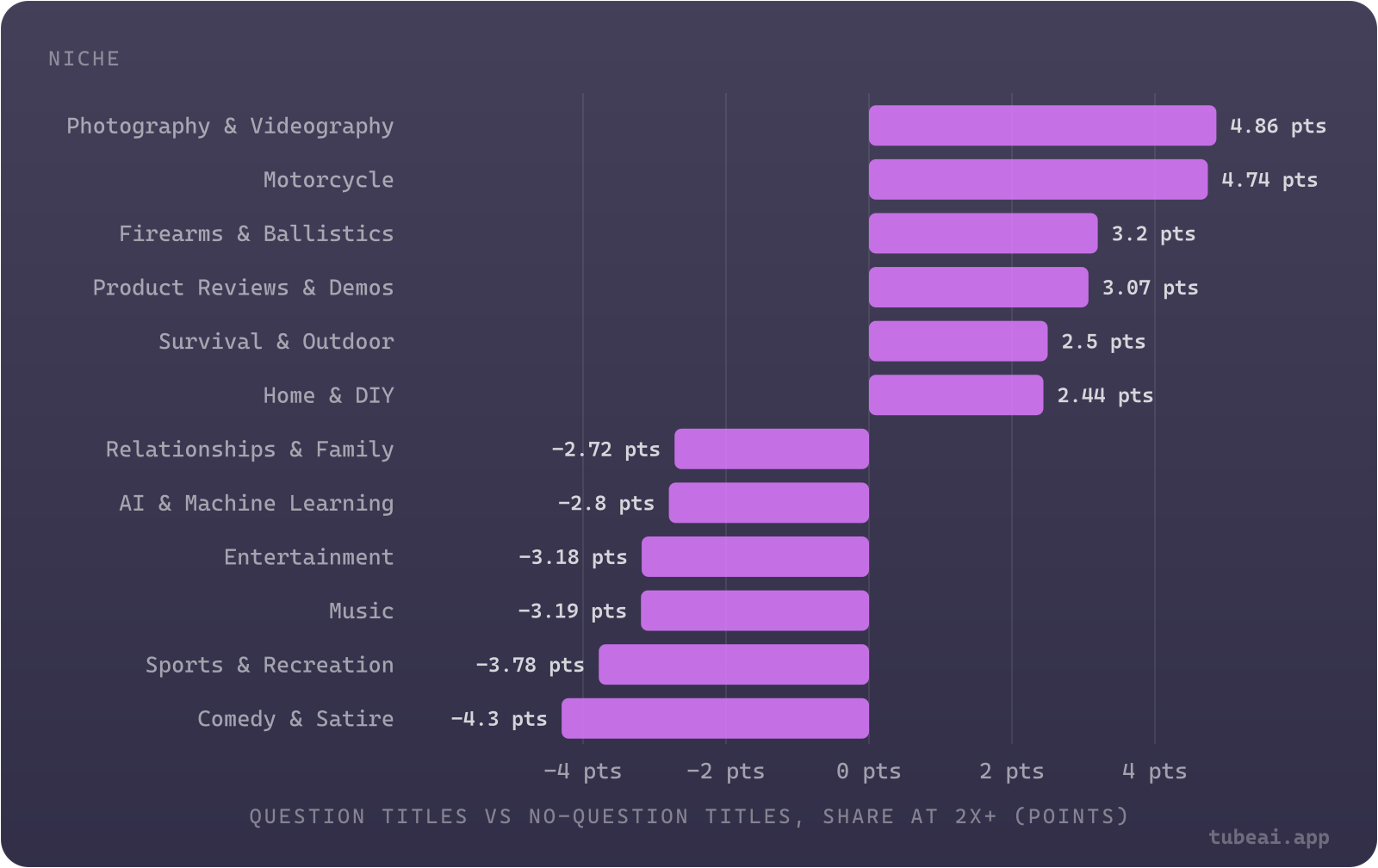
Chart data
| Niche | Question titles vs no-question titles, share at 2x+ (points) (pts) |
|---|---|
| Photography & Videography | 4.86 |
| Motorcycle | 4.74 |
| Firearms & Ballistics | 3.2 |
| Product Reviews & Demos | 3.07 |
| Survival & Outdoor | 2.5 |
| Home & DIY | 2.44 |
| Relationships & Family | -2.72 |
| AI & Machine Learning | -2.8 |
| Entertainment | -3.18 |
| Music | -3.19 |
| Sports & Recreation | -3.78 |
| Comedy & Satire | -4.3 |
Questions help in Photography & Videography (28.2% of question titles at 2x, against 23.3% without), Motorcycle (26.0% against 21.2%), Firearms, Product Reviews, Survival and Home & DIY. These are gear and how-to niches, where viewers arrive with a decision or a problem to solve.
Questions hurt in Comedy & Satire (15.0% against 19.3%), Sports & Recreation (13.2% against 16.9%), Music, Entertainment, AI & Machine Learning and Relationships. In those niches a question usually works as a teaser or a hot take, and viewers who browse for entertainment respond better to a clear statement of what happens in the video. Commentary, Politics and Legal channels lean the same way, at 2 to 2.5 points worse with a question.
Gaming, the biggest niche in the set, sits slightly negative: 17.8% of its 218,140 question titles reached 2x, against 18.7% without a question.
What this does and does not show
These are correlations across channels in the TubeAI database, not a controlled test. A question mark does not cause a video to do worse or better. The same-channel comparison removes channel size and niche from the picture, but it cannot remove topic choice: a creator who titles a video "Is it over?" may be making a different kind of video from the one they title as a statement.
The practical reading still holds. A question works when it matches something the viewer already wants to know. Questions also cost characters: a statement often says the same thing more tightly, which matters under the limits in how long a YouTube title should be. For the words that tend to sit around a strong question, see the best words for YouTube titles. If a question title is already live and stalling, changing the title after upload covers what that usually does.
How to use questions in your next title
- Use a question when the viewer is already asking it: "Is X worth it?", "X vs Y?", "Which X is best?"
- Avoid yes/no questions the viewer thinks they can answer without clicking. Rewrite them as the answer or as a "why" statement.
- For why, what and how, the question mark adds nothing. Writing the title as a statement works at least as well.
- If you teach something, "How to ..." beats any question: it did 16% better than the same channel's other titles.
- In comedy, sports, entertainment and commentary, default to a statement of what happens in the video.
Questions about question titles on YouTube
Do question titles get more views on YouTube?
Not on their own. Across 10.3 million long-form videos, titles with a question mark ran at 0.997x of the same channel's other titles and won on only 48.5% of 43,458 channels. Buying-decision questions were the exception: 25.2% of "worth it?" titles reached 2x their channel's typical views, against 19.0% for titles with no question.
Are yes/no questions bad for YouTube titles?
They are the weakest kind of question in this data. Titles opening with is, can, do or should and ending in a question mark ran at 0.95x of the same channel's other titles. Should/would/will questions reached 2x only 15.2% of the time. The exception is a buying-decision question like "Is it worth it?".
Should I end my YouTube title with a question mark?
It makes little difference. Titles ending in a question mark reached 2x 19.5% of the time, against 19.0% for titles with no question. Why and how titles did slightly better without the question mark than with it.
What kind of question works best in a YouTube title?
Questions viewers already ask before a decision. "Is it worth it?" titles reached 2x their channel's norm 25.2% of the time, "X vs Y?" titles 24.4%, and "which is better or best?" titles 22.6%. Every other question averaged 18.1%.
Are "How to" titles questions?
No, and they behave differently. "How to" titles promise a result rather than ask something. They were the strongest group in the study: 27.1% reached 2x their channel's norm, and on the same channel they did 16% better than titles with no question.