
Should you use ALL CAPS in YouTube titles? What 11.8 million videos show
A few capitalized words lift a title; a whole title in caps does not. On the same channel, 1-3 caps words beat no caps by 6-7%.

Use them, but sparingly. I compared 11,759,403 long-form videos published between October 2025 and September 2026. On the same channel, titles with one to three words in capital letters typically do 6-7% better than that channel's titles with no caps. A title written entirely in caps is a different story: it almost never breaks out. Only 16.1% of all-caps titles reached 2x their channel's usual views, against 19.2% for titles with no caps and 20.2% for titles with a single caps word.
So capital letters work as emphasis, not as volume. One word in caps tells the viewer what matters in the title. A whole title in caps says everything matters, which is the same as saying nothing does.
How I measured it
Every video comes from a creator channel that TubeAI serves in its research database. I kept long-form uploads (over 60 seconds) published from October 1, 2025 to September 30, 2026, dropped removed videos, and kept titles written in the Latin alphabet with at least two words, since titles in Arabic, Hindi, Japanese and other scripts have no capital letters to test. That leaves 11,759,403 videos from more than 179,000 channels.
A caps word is a word of three or more letters written entirely in capitals, such as NEW, BEST or INSANE. I skipped two-letter words so that AI, TV and the like do not count as shouting. Some three-letter acronyms (GTA, USA, DIY) still count; they turn out to be a small share of caps words, as the word list below shows.
The main measure is the outlier multiplier: a video's views divided by what that channel's videos published around the same time usually get. 1.0x is a normal video for that channel; 2.0x doubled the norm. I report the median multiplier and the share of videos that reached 2x or more.
Caps words vs no caps
Titles with no caps word are the majority, and they run slightly under their channel's norm. Adding one caps word moves the needle up. Adding more stops helping, and writing the whole title in caps pulls the share of breakout videos down hard.
| Title | Videos | Channels | Median multiplier | Reached 2x+ |
|---|---|---|---|---|
| No caps word | 6,277,094 | 179,185 | 0.98x | 19.2% |
| One caps word | 2,232,990 | 149,443 | 1.00x | 20.2% |
| Two to three caps words | 1,591,842 | 117,537 | 1.01x | 20.0% |
| Four or more caps words | 884,008 | 61,419 | 1.01x | 18.8% |
| Whole title in caps | 773,469 | 42,178 | 1.00x | 16.1% |
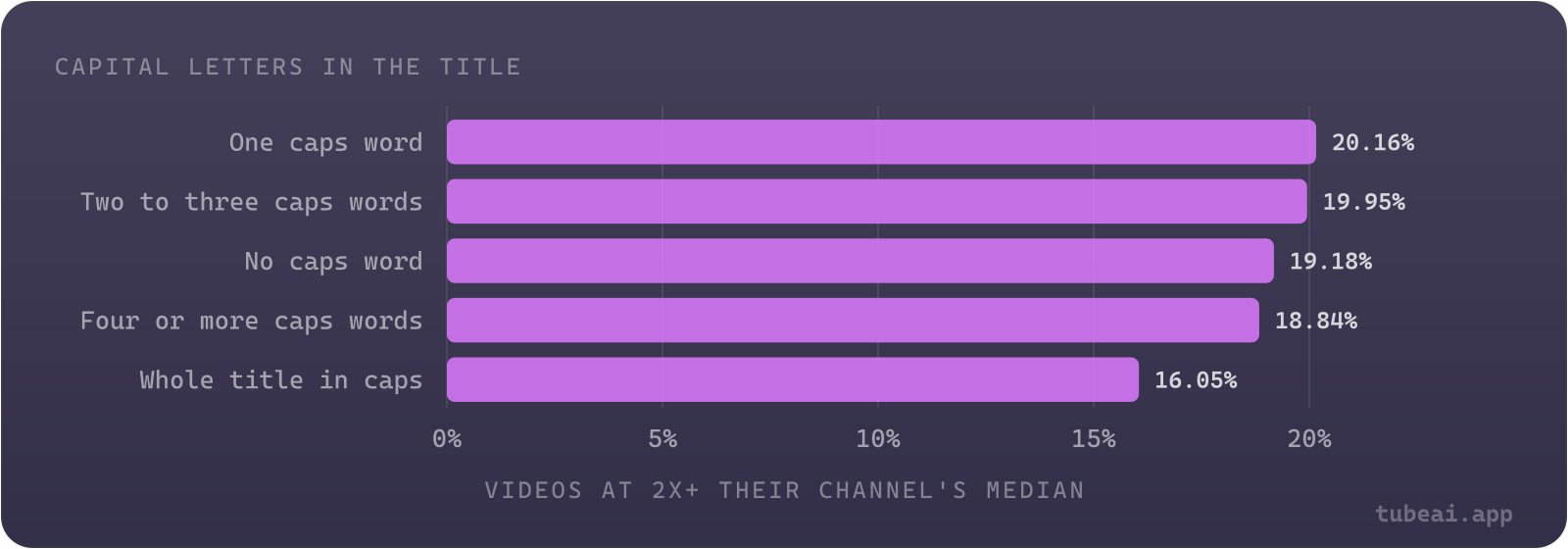
Chart data
| Capital letters in the title | Videos at 2x+ their channel's median (%) |
|---|---|
| One caps word | 20.16 |
| Two to three caps words | 19.95 |
| No caps word | 19.18 |
| Four or more caps words | 18.84 |
| Whole title in caps | 16.05 |
The medians are close together, which is expected: a capital letter is a small change. The tail is where the difference shows. A video with a single caps word is about 5% more likely to reach 2x than a video with none (20.2% against 19.2%). A video whose whole title is in caps is about 16% less likely to (16.1%).
The all-caps result has a simple reading. When every word is shouting, the viewer cannot tell which word is the hook, and on a phone screen a block of capitals is harder to read at a glance than mixed case. Many all-caps titles also come from channels that write every title that way, so their titles never stand out from each other either.
The same channel, with and without caps
A cross-channel comparison mixes very different creators. The cleaner test compares each channel with itself: its titles with caps against its own titles with none. I took every channel that published at least five titles of each kind, and ran the test separately on each half of the year to check that the result was not a one-off.
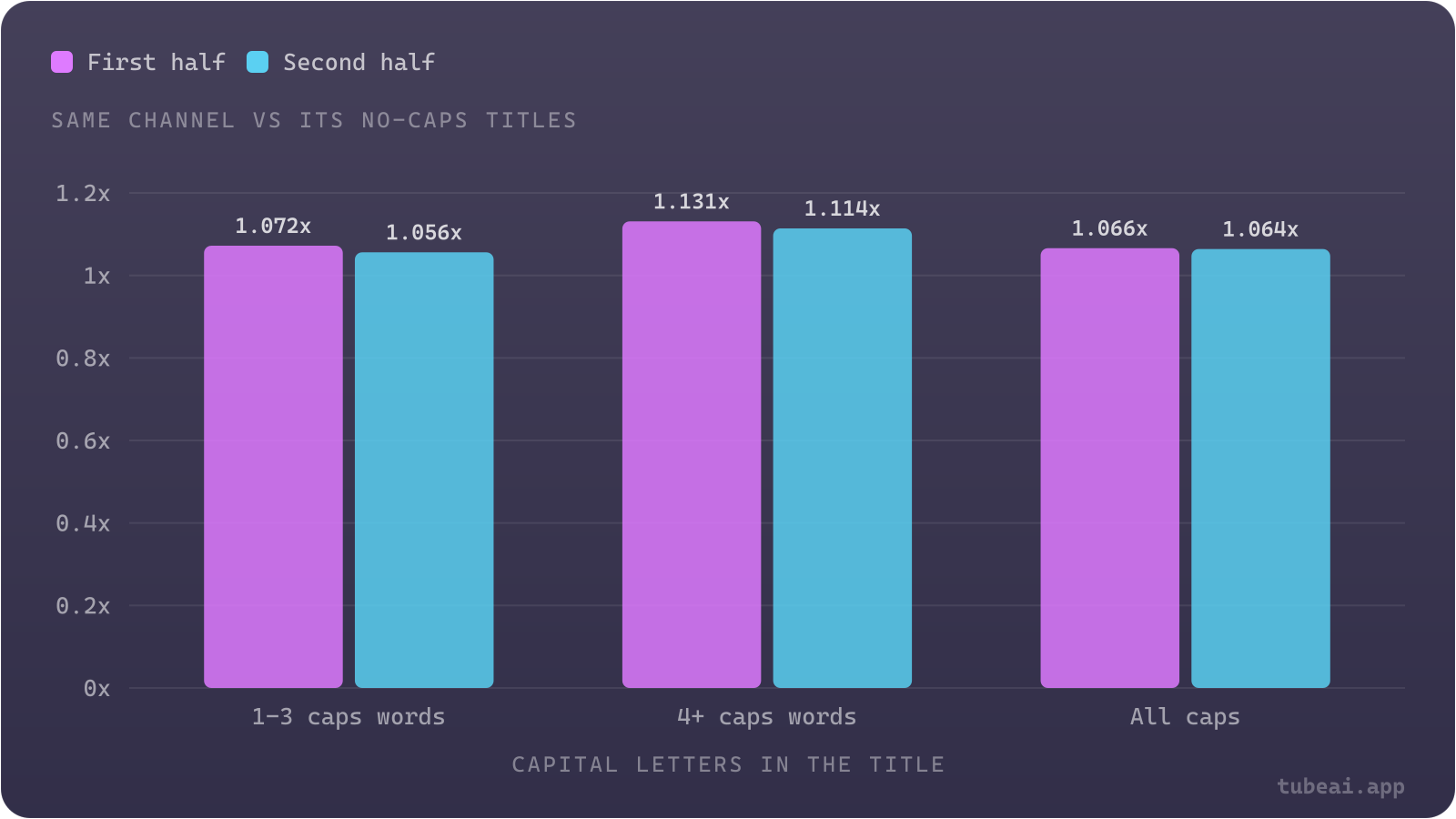
Chart data
| Capital letters in the title | first_half (x) | second_half (x) |
|---|---|---|
| 1-3 caps words | 1.072 | 1.056 |
| 4+ caps words | 1.131 | 1.114 |
| All caps | 1.066 | 1.064 |
- 1.06x1-3 caps wordsmedian across 52,910 channels
- 56.9%Channels where caps wonof those 52,910 channels
- 1.11x4+ caps wordsmedian across 8,008 channels
- 1.06xWhole title in capsmedian across 4,968 channels
Inside a channel, caps help. With one to three caps words, the median channel did 7.2% better than its own no-caps titles in the first half of the year and 5.6% better in the second, and caps came out ahead on 57-58% of channels both times. Four or more caps words did better still (1.11x to 1.13x, winning on 62-63% of channels), and even fully capitalized titles beat the same channel's no-caps titles by about 6%.
That looks like it contradicts the first table. It does not. The same-channel test only includes channels that mix styles: they write most titles in normal case and save caps for some videos. Those are usually the videos the creator thinks are the big ones, a launch, a reveal, a strong opinion, so part of the lift belongs to the video, not to the capital letters. The channels that put every title in caps are not in this test at all (they have no no-caps titles to compare against), and in the cross-channel numbers they are the group that rarely breaks out.
Which words creators put in caps
To see what the caps are doing, I listed the words creators write in capitals inside otherwise normal-case titles, for videos published from April to September 2026. The most common, by number of channels using them, are NEW (22,677 channels), THE, THIS, BEST and NOT. Almost all of the top 80 are emphasis words, not acronyms: INSANE, FINALLY, NEVER, HUGE, FREE, WRONG. The exceptions are labels like ASMR, DIY, GTA, POV and VLOG.
Among words used in caps by at least 3,000 channels, the gap between the best and the worst is far larger than the gap between caps and no caps.
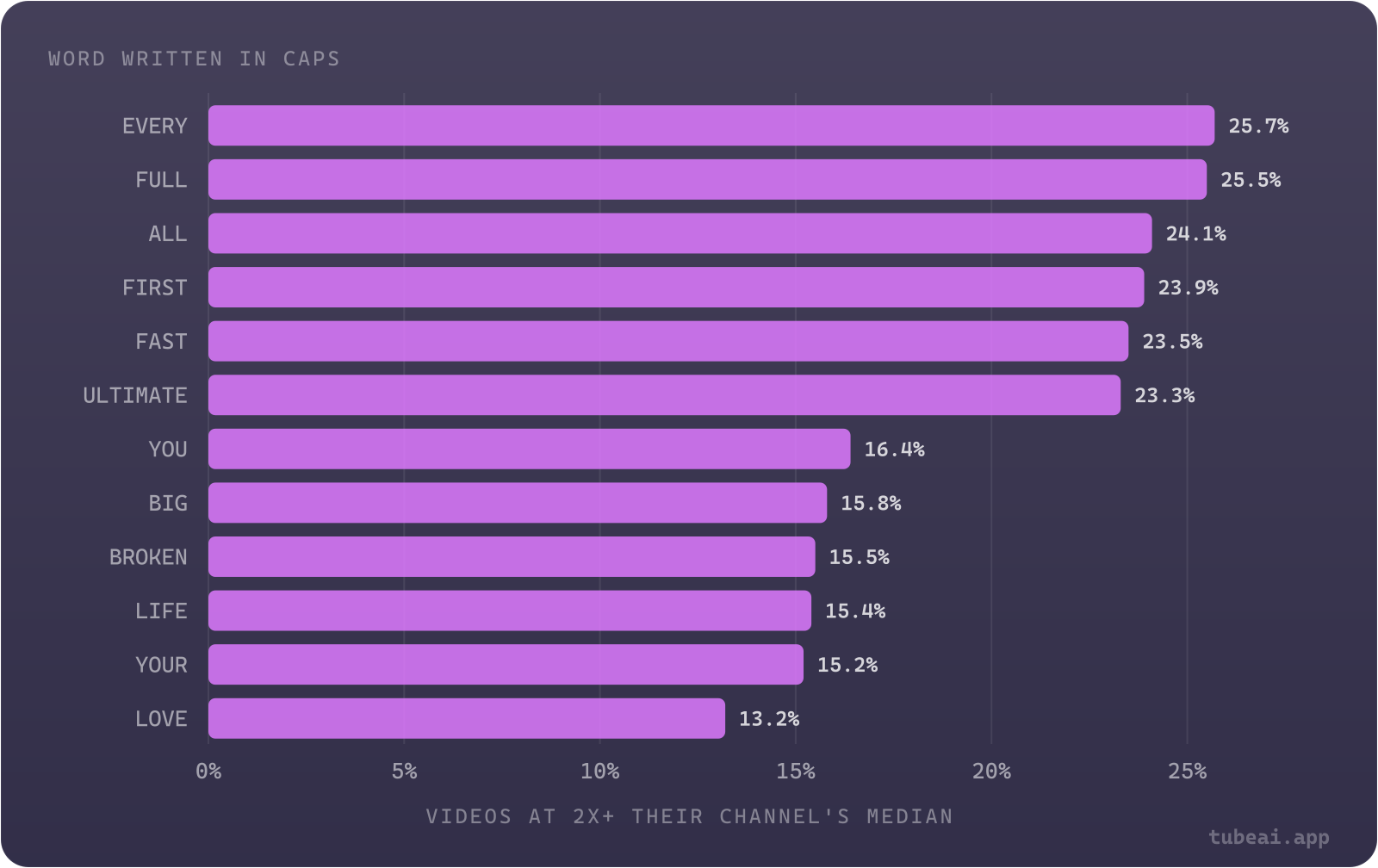
Chart data
| Word written in caps | Videos at 2x+ their channel's median (%) |
|---|---|
| EVERY | 25.7 |
| FULL | 25.5 |
| ALL | 24.1 |
| FIRST | 23.9 |
| FAST | 23.5 |
| ULTIMATE | 23.3 |
| YOU | 16.4 |
| BIG | 15.8 |
| BROKEN | 15.5 |
| LIFE | 15.4 |
| YOUR | 15.2 |
| LOVE | 13.2 |
The strongest caps words share a theme: they promise scope or a first. EVERY (25.7% of videos at 2x, 1.09x median), FULL (25.5%, 1.09x), ALL (24.1%, 1.08x), FIRST (23.9%) and ULTIMATE (23.3%, 1.10x) tell the viewer the video is complete or new. BEST (22.2%, 1.08x) belongs in the same family.
The weakest are words that describe a feeling or address the viewer directly: LOVE (13.2%), YOUR (15.2%), LIFE (15.4%) and YOU (16.4%). Shouting at the viewer does not read as a promise. The popular hype words sit in the middle: INSANE (20.4%), CRAZY (17.8%) and HUGE (17.6%) are used by thousands of channels and mostly do no better than titles without caps.
So capitalizing a word only amplifies what the word already says. If the word is a concrete promise, caps make it louder. If it is filler, caps make the filler louder.
What this does and does not show
These are correlations across channels in the TubeAI database, not a controlled test. Creators choose which videos get caps, and they tend to choose the videos they already expect to do well. The same-channel comparison removes channel size and niche from the picture, but it cannot remove that choice. The honest reading is that caps on the right word are worth using, not that capital letters make a video perform.
Capitals are one of several cheap ways to add weight to a title. For the others, see numbers in YouTube titles, emojis in YouTube titles and the best words for YouTube titles. The same lesson shows up with whole phrases: in our study on whether clickbait works on YouTube, phrases that promise specific information beat pure hype. Caps also take more width than lowercase on most screens, so keep an eye on how long your title is.
How to use caps in your next title
- Capitalize one word, two at most: the one that carries the promise.
- Pick a concrete word. EVERY, FULL, ALL, FIRST and BEST did best; LOVE, YOUR and LIFE did worst.
- Do not write the whole title in caps. It was the weakest group in the study.
- Keep normal case as your default, so caps still mean something when you use them.
- Do not capitalize the name of a game, show or brand to make it pop; it is already the part viewers recognise.
Questions about ALL CAPS in YouTube titles
Do ALL CAPS words in YouTube titles get more views?
A few do. Across 11.8 million long-form videos, titles with one caps word reached 2x their channel's typical views 20.2% of the time, against 19.2% for titles with no caps. On the same channel, one to three caps words did 6-7% better than that channel's titles without caps.
Should I write my whole YouTube title in capital letters?
No. Titles written entirely in caps were the weakest group: only 16.1% reached 2x their channel's typical views. When every word is capitalized, none of them stands out, and a block of capitals is harder to read quickly on a phone.
How many words should be in caps in a YouTube title?
One or two. A single caps word did best across all channels. More caps did well when a channel used them only on some videos, but channels that put many words in caps on every title rarely had videos break out.
Which words work best in caps?
Words that promise scope or a first. Among words used in caps by at least 3,000 channels, EVERY, FULL and ALL put 24-26% of videos at 2x their channel's norm, while LOVE, YOUR and LIFE fell to 13-15%.
Do acronyms like GTA or DIY count as caps?
In this study, any word of three or more letters written in capitals counted, so GTA, DIY and ASMR did. Two-letter words like AI and TV were skipped. Acronyms are a small share of caps words: almost all of the most common ones are emphasis words like NEW, BEST and INSANE.