
The tai chi walking scam: how hidden-subscription ads took over YouTube, and what they cost creators
The "62 and ripped" tai chi walking ads are not a meme. They are a $195.6M YouTube ad campaign for a subscription app whose parent group is now under an FTC asset freeze. Here is how the funnel works, why the ads look absurd on purpose, and how this money reshapes YouTube's ad auction for everyone else.

The tai chi walking ads are a YouTube ad campaign for MadMuscles, a fitness subscription app, and they are one of the most expensive campaigns on the platform: ad-intelligence tracker Web2App World puts MadMuscles' YouTube spend at $195.6 million over the trailing 12 months. In June 2026 the US Federal Trade Commission froze the assets of the group behind it, alleging that its apps were sold as free or one-off purchases while the auto-renewing subscription was buried. Tai chi itself is a real, gentle practice. The problem is the machine selling it.
You have probably seen one: an AI-generated man in his sixties, shirtless and shredded, telling you that "Doctors hate me. I'm 62, ripped, and I teach menopausal women to melt fat in 9 minutes using Tai Chi." Or: "After 50, the gym breaks you. Tai Chi heals your body." This post follows the money: who runs the ads, how the funnel works, who it is aimed at, and why ad money like this changes YouTube's ad auction for every honest advertiser and every creator who depends on it.
- $195.6MMadMuscles YouTube ad spendTrailing 12 months, Web2App World
- $14.2MSpent on its top tai chi adOne 73-second creative
- 15 + 8Companies and people in the FTC caseFTC v. GM Universeapps, June 2026
- $4.3BFraud losses reported by people 50+FTC Consumer Sentinel, 2025
Who is behind the tai chi walking ads
The ads push MadMuscles, a workout and meal-plan app. According to the YouTube investigation "The $295,000,000 Tai Chi Walking Scam" and independent reporting, MadMuscles sits inside a Ukrainian-founded app group: Genesis at the top, which owns AMO, an app studio of roughly 600 people. AMO's health and fitness arm runs MadMuscles alongside sister apps Harna and Unimeal. The FTC's complaint names AmoMedia Ltd. (doing business as AMO), Amoapps Ltd. and AmoApp Inc. among the defendants.
The scale is hard to overstate. Web2App World ranks MadMuscles as the biggest YouTube spender of any fitness app it tracks, at 38 times the YouTube spend of its nearest named fitness rival. One 73-second, podcast-style tai chi ad had burned $14.2 million on its own, $7.7 million of it in a single 30-day window. The video's own count for one MadMuscles ad on YouTube is 135,893,431 views. And the traffic follows: Semrush data shows about 26% of madmuscles.com's visits in August 2026 came from youtube.com.
What the FTC alleges
On June 17, 2026 the FTC announced it had sued Genesis Tech, a network of 15 companies and 8 individuals behind apps including MadMuscles, Harna, Unimeal, Nebula, Wisey and PDF Guru (FTC v. GM Universeapps Ltd., N.D. Cal., No. 26-cv-05232). The agency's core allegation: the products were advertised as free or available for a low one-time price, often with a money-back guarantee, and the recurring subscription was obscured at sign-up. The FTC says five of the group's product lines alone brought in nearly $250 million between 2023 and mid-2025.
A judge granted a temporary restraining order with an asset freeze on June 4. PayPal froze about $8 million and JPMorgan Chase about $2 million in accounts linked to the defendants. On July 2 the court issued a preliminary injunction keeping the assets of ten Genesis companies frozen until the case is resolved. These are allegations: there is no ruling on the merits and no settlement yet.
How the funnel works, step by step
The video's presenter walked through the MadMuscles sign-up funnel himself. Web2App World counts 48 screens in the quiz. The details from his walkthrough are the clearest picture of how it is built:
- A quiz that always finds a problem. He entered a weight of 50 kg. The quiz calculated a BMI of 19.53 and labelled him "Underweight", then recommended a diet of 1,040 kcal a day and a body-fat goal of 10–12%. A weight-loss plan for someone the app had just called underweight.
- A "study" that cites itself. The pitch that three months of the plan gets "twice as many results" as one month is attributed to "a study by Mad Muscles, 2022".
- Urgency on every screen. A spin-the-wheel "-75%" discount and a countdown timer push you to pay now.
- A cheap door in. Plans shown to him: a 1-week trial at £4.99, 4 weeks at £35.99, 12 weeks at £89.99, with the small print saying the plan renews automatically.
- A hard door out. The money-back guarantee requires completing the workouts on 7 consecutive days within the first 30, with screenshots as proof.
Designer Harry Brignull, who catalogued these tricks at deceptive.design, has a name for the last step: making a product "easy to join and hard to leave... sometimes referred to as a 'roach motel.'"
Who the ads are aimed at
The creative speaks to one audience: people over 50 who feel the gym is no longer for them, and women in menopause. YouTube advertisers can target by age bracket, and older viewers are exactly who fraud already hits hardest. The FTC's 2025 data shows people aged 50 and over reported $4.3 billion lost to fraud, against $2.3 billion for younger adults. Social media was the most reported way scams reached people aged 50–59, 60–69 and 70–79, and total losses to scams that started on social media reached $2.1 billion, eight times the 2020 level.
A hidden subscription is a quieter harm than an investment scam. Nobody's savings disappear overnight. But a monthly renewal someone does not notice, on a card they rarely check, is exactly the kind of loss older viewers are least likely to catch and least likely to report.
How this money breaks YouTube's ad auction
Every YouTube ad slot is sold in a real-time Google Ads auction. Google ranks bids by a mix of bid and ad quality, and most large advertisers no longer set bids by hand. They use automated bidding, such as Target ROAS, which bids on how much a customer is predicted to be worth. The more a signup is worth to you, the more your system will pay for the next viewer who looks like one.
That is where hidden subscriptions win. An honest app earns what the customer meant to pay. A subscription that keeps charging people who forgot about it, or who gave up on a hard cancellation, earns much more per signup. So it can afford a far higher maximum bid for the same viewer, in the same slot.
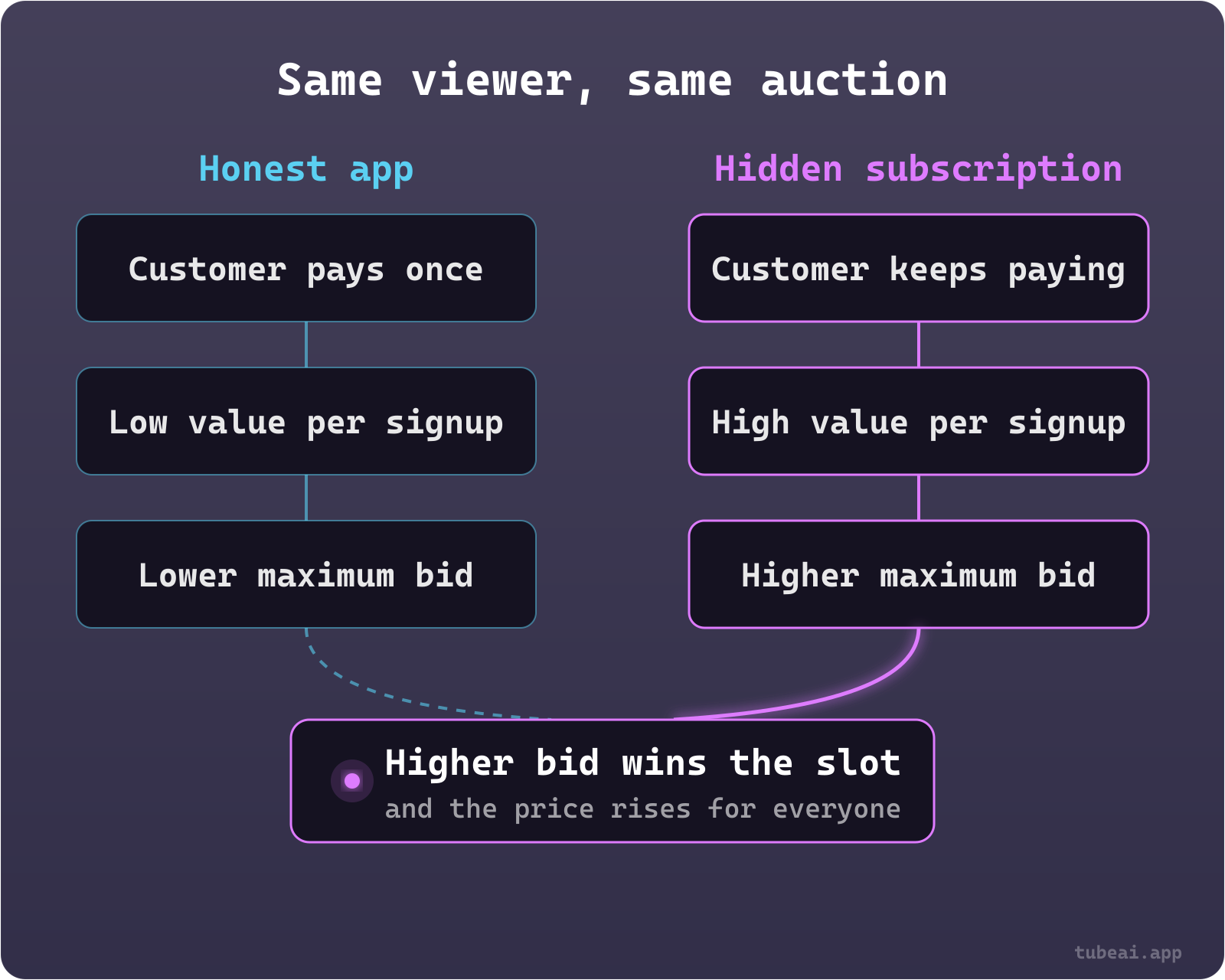
The damage spreads beyond the lost slot. Google's auction charges each winner roughly what it takes to beat the ad below it, so an advertiser bidding far above the market pulls the clearing price up for everyone competing for that audience. A local gym, a physiotherapist's online course or a legitimate fitness app targeting the same over-50 viewers now pays more per view, or loses the impression entirely. In plain terms: the money taken from viewers through renewals they did not expect gets recycled into bids no honest business can match.
Google is not blind to scam ads. Its 2025 Ads Safety Report says it blocked or removed 8.3 billion ads and suspended 24.9 million advertiser accounts, including 602 million scam ads, up from 415 million the year before. But scam enforcement targets obvious fraud: fake giveaways, impersonation, crypto drainers. A real app with a real product, a buried renewal and an absurd AI spokesman sits in a grey zone that automated review does not catch, which is why regulators, not ad review, ended up acting.
What it means for YouTube creators
1. These ads run on your videos
Creators do not choose the individual ads that play on their videos. When a viewer over 50 gets charged by a subscription they found through an ad on your channel, the ad lived next to your content. That erodes the trust your audience places in what they see on your channel, even though you never touched the deal.
2. Higher ad prices are not a free win
Aggressive bidders can lift CPMs in the niches they target, and a creator's revenue share rises with them. But that money depends on a practice regulators are now attacking. If enforcement pulls the biggest bidders out of an audience overnight, the prices they propped up go with them. Meanwhile, every creator who buys ads to promote their own course, product or channel pays the inflated price.
3. The ads created a content wave
Ad campaigns this large create search demand, and YouTube fills it. In TubeAI's data, videos with "tai chi" in the title went from 110 uploads in July 2025 to 629 in August 2026, with the sharpest jump from May 2026 onward.
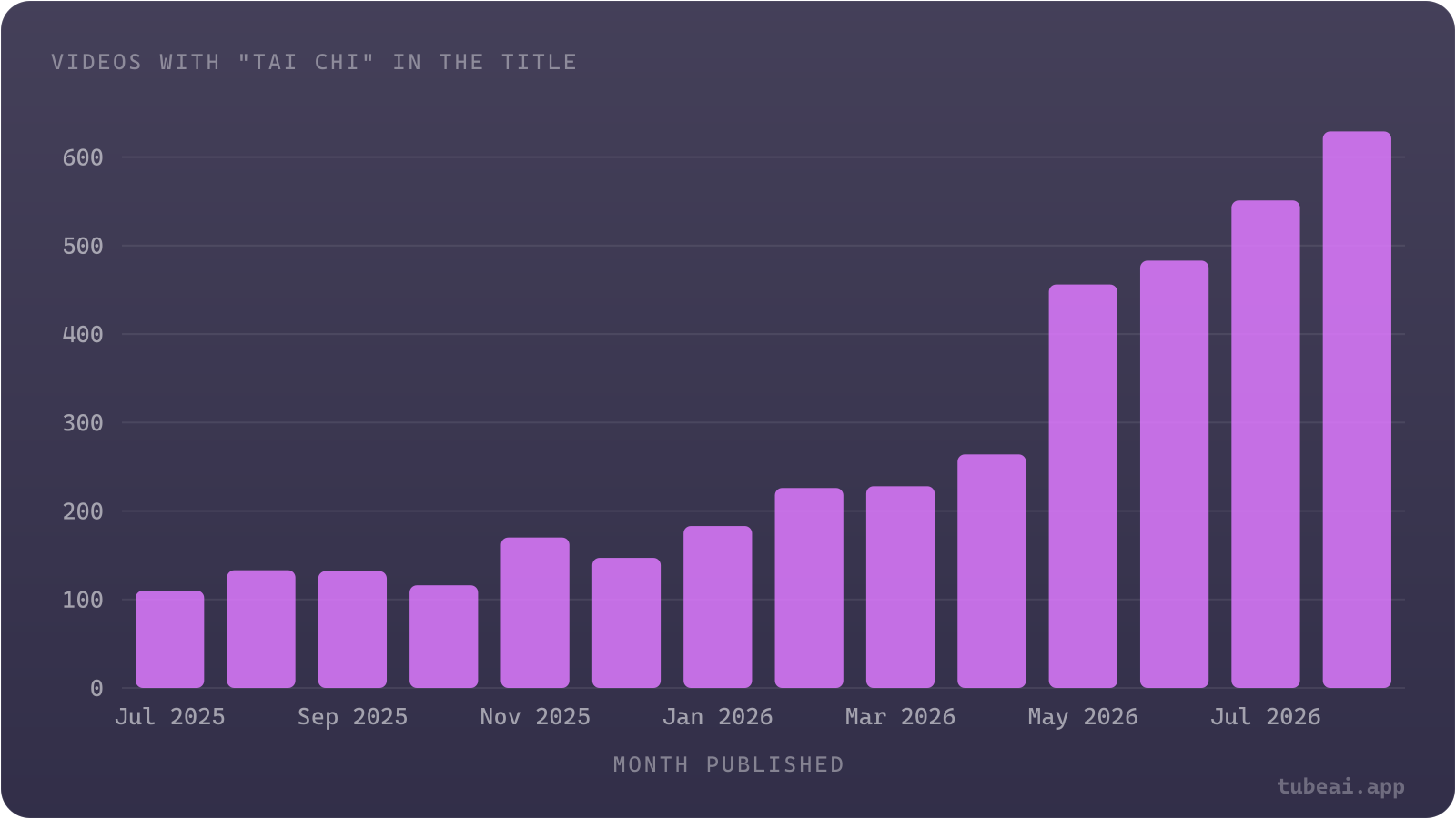
Chart data
| Month published | Videos with "tai chi" in the title |
|---|---|
| 2025-07 | 110 |
| 2025-08 | 133 |
| 2025-09 | 132 |
| 2025-10 | 116 |
| 2025-11 | 170 |
| 2025-12 | 147 |
| 2026-01 | 183 |
| 2026-02 | 226 |
| 2026-03 | 228 |
| 2026-04 | 264 |
| 2026-05 | 456 |
| 2026-06 | 483 |
| 2026-07 | 551 |
| 2026-08 | 629 |
Most of the attention went to newcomers. Of the 3,543 tai chi videos published in 2026 on channels we track, channels created in 2025 or later posted about half, but took two thirds of the views. Their median tai chi video got 7,900 views, against 2,530 for channels that existed before 2025. We cannot tell from this data which of these channels use AI presenters or sell anything. What it shows is how fast a paid ad narrative turns into an organic content niche, and that the established teachers in it were outrun by channels that did not exist two years ago.
| Channel created | Channels | Tai chi videos | Total views | Median views per video | Titles mentioning walking |
|---|---|---|---|---|---|
| 2025 or later | 68 | 1,709 | 70.4M | 7,900 | 319 (19%) |
| Before 2025 | 225 | 1,834 | 34.3M | 2,530 | 241 (13%) |
How to spot a hidden-subscription ad, and get out
- The spokesperson looks too perfect. Unnaturally smooth skin, a physique that does not match the claimed age, lip movements that drift from the words.
- The promise is effortless. Fat loss in minutes a day, no gym, no diet change, "doctors hate me".
- The quiz always ends in a paywall. If a long quiz about your body ends in a countdown timer and a spinning discount wheel, the quiz was the sales pitch.
- The "study" is by the seller. Check who ran it.
- Read the renewal line before paying. A £4.99 or $4.99 trial that turns into a monthly plan is the model.
- To get out: cancel through the app store or the provider's site, keep screenshots, check your card statement for the next two months, and ask your bank to block further charges if cancellation fails. In the US you can report it at reportfraud.ftc.gov.
If you run a channel for viewers over 50, telling your audience what these ads are is a service, and it is content your audience is already searching for.
Related reading
How a new channel can still break in fast: Is it too late to start a YouTube channel in 2026? Which topics are gaining audience right now: The fastest-growing YouTube niches. And how YouTube's own numbers shift under creators' feet: YouTube's new view count.
How we measured
The TubeAI figures count live videos in our research database with "tai chi" anywhere in the title, using the newest recorded version of each video. They cover every channel we track, not only the curated creator channels the app shows. We excluded June 2025 from the chart because a batch of older videos from established tai chi channels entered the database with that month as their estimated publish date, which would have shown a spike that did not happen. September 2026 is left out because the month was not complete. All other figures in this post come from the external sources listed below and are credited in the text.
Frequently asked questions
Is tai chi walking a scam?
Tai chi is a real, low-impact practice. What critics call the tai chi walking scam is the advertising: AI-generated spokesmen promising effortless fat loss to push people into a paid fitness app subscription. The FTC alleges the group behind the MadMuscles app hid auto-renewing subscriptions behind free or one-off offers. Those claims have not yet been decided in court.
Who is behind the tai chi walking ads on YouTube?
The ads promote MadMuscles, an app run by AMO, which is part of the Genesis app group. Ad tracker Web2App World estimates MadMuscles spent $195.6 million on YouTube ads over 12 months. In June 2026 the FTC sued 15 Genesis companies and 8 individuals, and a court froze assets of ten of the companies.
Why do the tai chi ads look so fake?
One explanation comes from a 2012 Microsoft Research paper on email scams: an absurd pitch filters out skeptical people, so the few who respond are the most likely to pay. Outlandish ads may be a feature, not a mistake.
Why does YouTube let these ads run?
Google removed 602 million scam ads in 2025, but its automated review targets clear fraud such as fake giveaways and impersonation. An app with a real product and a buried renewal sits in a grey zone, which is why regulators stepped in.
Do scam ads affect YouTube creators?
Yes, in three ways. They run next to creators' videos and can damage audience trust. Advertisers with inflated customer value can bid up ad prices, which makes promotion more expensive for creators and honest brands. And big campaigns create content waves: tai chi uploads in TubeAI's data grew 5.7x in about a year.
Sources
- FTC Sues to Stop Sprawling Enterprise Operating Unlawful Subscription Schemes — Federal Trade Commission
- Assets of ten Genesis companies will remain frozen until the case is resolved — AIN
- FTC lawsuit reveals how subscription scam networks evade app store enforcement — TechCrunch
- The $295,000,000 Tai Chi Walking Scam — YouTube
- Google's 2025 Ads Safety Report — Google
- How the Google Ads auction works — Google Ads Help
- New FTC Data Show People Have Lost Billions to Social Media Scams — Federal Trade Commission
- Older Adults Hit Hard by Fraud in 2025 — AARP
- Why do Nigerian Scammers Say They are from Nigeria? — Microsoft Research
- Deceptive Patterns — Harry Brignull