
YouTube's bigger thumbnails: fewer slots, more competition, and what the data shows
YouTube's home feed shows fewer, larger video cards, with Shorts shelves in between. Here is what changed and how 319,550 tracked uploads split their first-week views.

YouTube's home feed now shows fewer, larger thumbnails per row on desktop, with Shorts shelves taking whole rows in between, and it is testing the same idea on mobile. YouTube says the change grew long-form viewing overall. For a single creator it means fewer visible slots per screen, so every slot is worth more and the competition for it is sharper. The data shows how uneven that competition already is: in the TubeAI research database, the top 10% of long-form uploads collected 70.6% of all first-week views, and the bottom half shared 3.2%.
Below: what YouTube changed, what it said about it, and what I measured across 319,550 uploads tracked from the hour they went live.
- 70.6%of first-week views went to the top 10% of uploads
- 30.1%went to the top 1%
- 3.2%was shared by the bottom half
- 6,915median first-week views per uploadhalf of uploads got fewer
What YouTube changed
Bigger cards on desktop
Reports of a desktop home page with oversized video cards go back to 2024. The layout spread in April 2025, when Android Authority described it as a test that many viewers disliked. Today most desktop viewers see a handful of large cards per row; how many depends on screen size and zoom, and YouTube offers no setting to change it.
Shorts shelves take whole rows
Between rows of long-form videos, the home page shows a Shorts shelf: a row of vertical cards. The dismiss button hides it only temporarily. In mid-2026 YouTube began testing the opposite emphasis too, a layout that opens with full-width long-form cards and pushes the Shorts shelf further down.
Mobile is next
YouTube is now testing a mobile home feed that changes the size of video cards automatically to make some of them stand out.
What YouTube says
Todd Beaupré, YouTube's senior director of growth and discovery, said on Creator Insider that the bigger thumbnails drove more attention and engagement around long-form, and that the team would not have launched the change if it had reduced viewership. His reasoning: often less is more, and fewer options make it easier for viewers to decide. He was clear that this describes the home page as a whole, not what a bigger thumbnail does for one video.
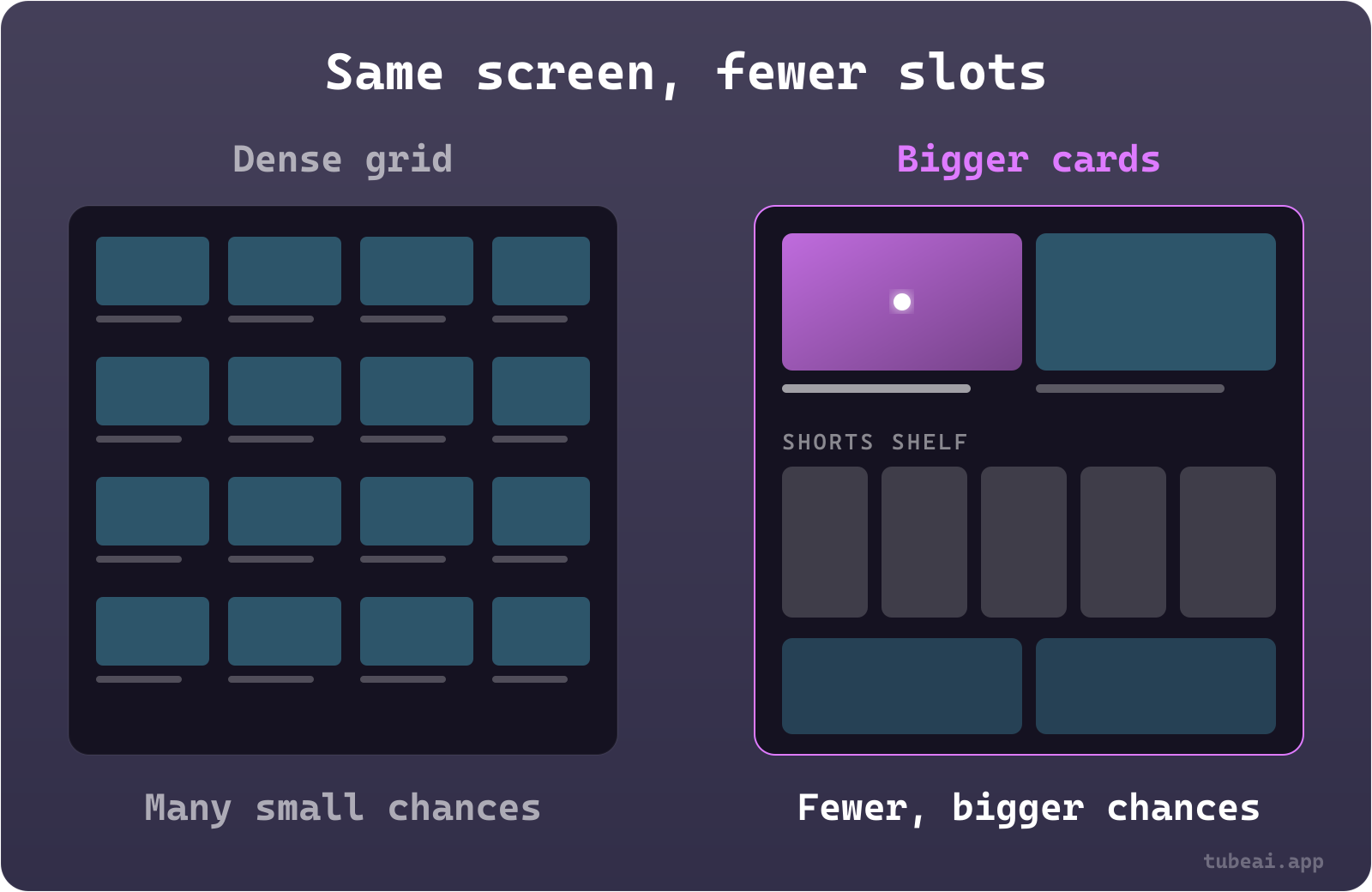
Why each slot is worth more
A home screen is a fixed amount of space. When cards get bigger and a Shorts shelf takes a row, fewer long-form videos fit on the first screen. Meanwhile the supply of videos competing for those slots is large: the creator channels we track published about 12,800 long-form videos a day in September, and 125,057 of them uploaded in the last 30 days.
Three things follow:
- Each impression matters more. A viewer sees fewer options before scrolling, so being one of them is worth more, and missing out costs more.
- The thumbnail carries more of the decision. A bigger card shows more detail, which helps a clear, readable thumbnail and exposes a cluttered one.
- Your own videos compete with each other. Recommendations rarely show several of your videos at once, so your strongest upload tends to take the slot.
What the data shows
How I measured it
I took long-form uploads from creator channels we serve, published Aug 31 to Sep 24, 2026, that we tracked from within 90 minutes of going live. For each one I used its views at day 7, its first week. That gave 319,550 uploads. All of them were published after YouTube's Aug 24 view-count change, so they were counted the same way.
A note on what I could not measure: I wanted a before-and-after comparison around the redesign, but it is not possible with this data. Our exact, hour-by-hour view tracking started in late August 2026, publish dates for older videos are estimates, and older videos have had longer to collect breakout views, which would bias any comparison. So this section describes competition as it is now, not how the redesign changed it.
A small share of uploads takes most of the views
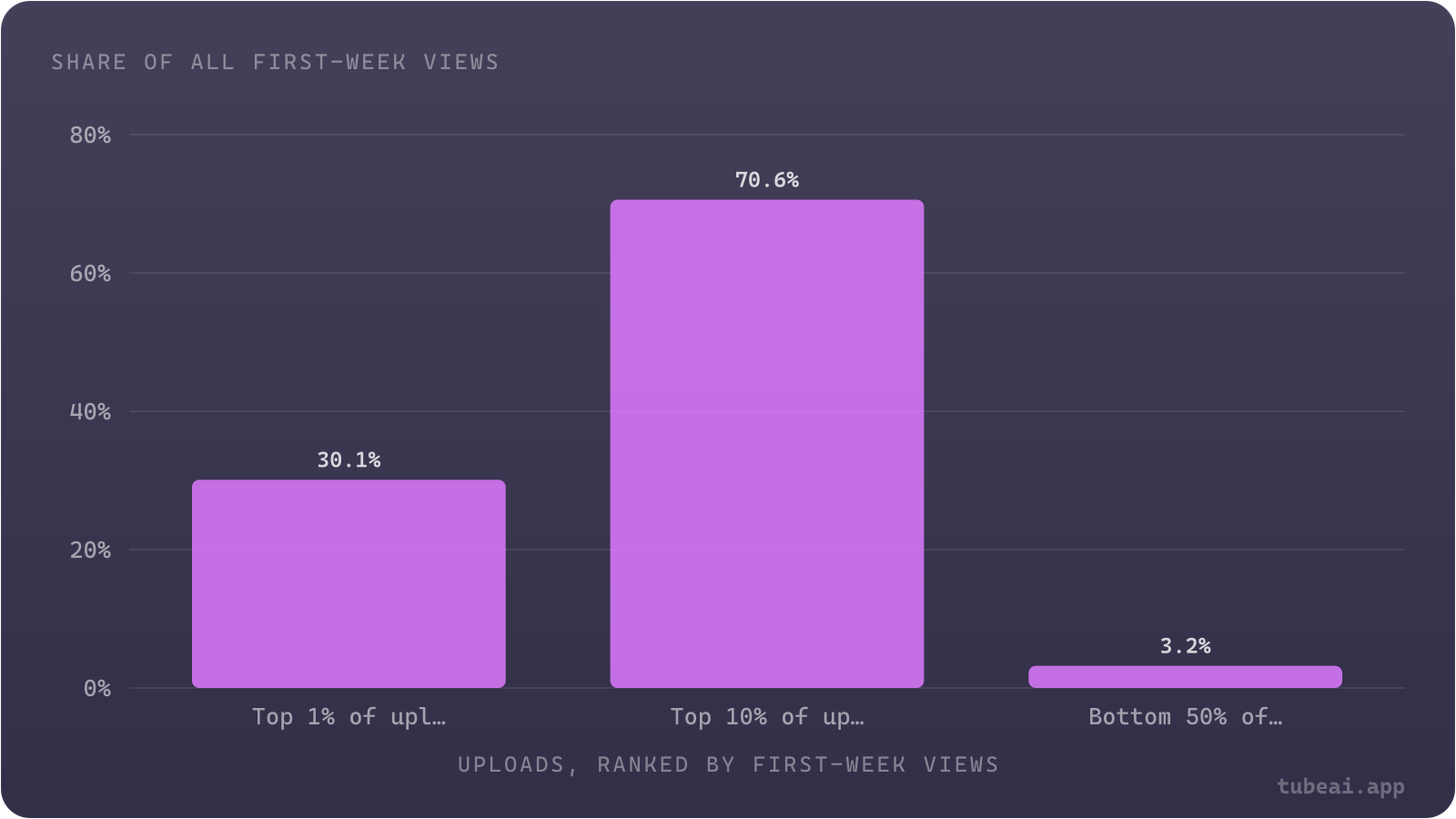
Chart data
| Uploads, ranked by first-week views | Share of all first-week views (%) |
|---|---|
| Top 1% of uploads | 30.1 |
| Top 10% of uploads | 70.6 |
| Bottom 50% of uploads | 3.2 |
The top 1% of uploads, about 3,200 videos, collected 30.1% of all first-week views. The top 10% collected 70.6%. The bottom half of uploads, about 160,000 videos, shared 3.2% between them. The median upload got 6,915 views in its first week.
Big channels take most of the top spots
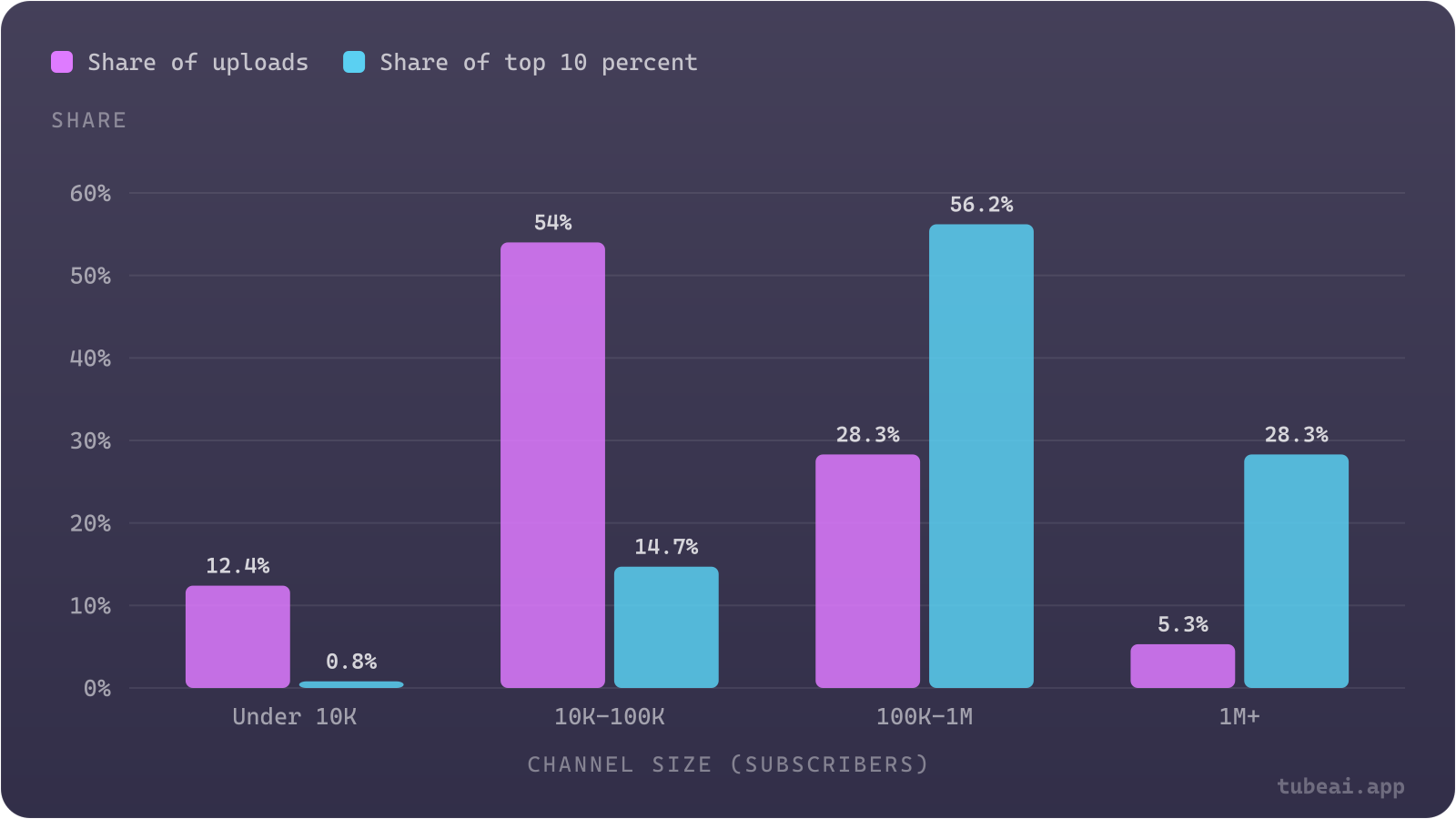
Chart data
| Channel size (subscribers) | share_of_uploads (%) | share_of_top_10_percent (%) |
|---|---|---|
| Under 10K | 12.4 | 0.8 |
| 10K-100K | 54 | 14.7 |
| 100K-1M | 28.3 | 56.2 |
| 1M+ | 5.3 | 28.3 |
| Channel size | Share of uploads | Share of views | Share of top 10% uploads | Share of top 1% uploads | Median first-week views |
|---|---|---|---|---|---|
| Under 10K | 12.4% | 1.9% | 0.8% | 0.3% | 1,523 |
| 10K-100K | 54.0% | 19.6% | 14.7% | 3.8% | 4,773 |
| 100K-1M | 28.3% | 43.6% | 56.2% | 34.4% | 20,425 |
| 1M+ | 5.3% | 35.0% | 28.3% | 61.5% | 75,840 |
Channels with 10K-100K subscribers made more than half of all uploads but only 14.7% of the top 10%. Channels with 100K+ subscribers made a third of uploads and took 84.5% of the top spots. In the top 1%, channels with 1M+ subscribers alone took 61.5%. This is not surprising, since big channels start with big audiences, but it shows who you are competing with for each slot on the home page.
Against their own baseline, small channels break out more often
Raw views favour big channels. A fairer test is whether a video beat its own channel's usual result. I compared each upload with the median first-week views of its channel's uploads in the same window, for channels with at least three tracked uploads.
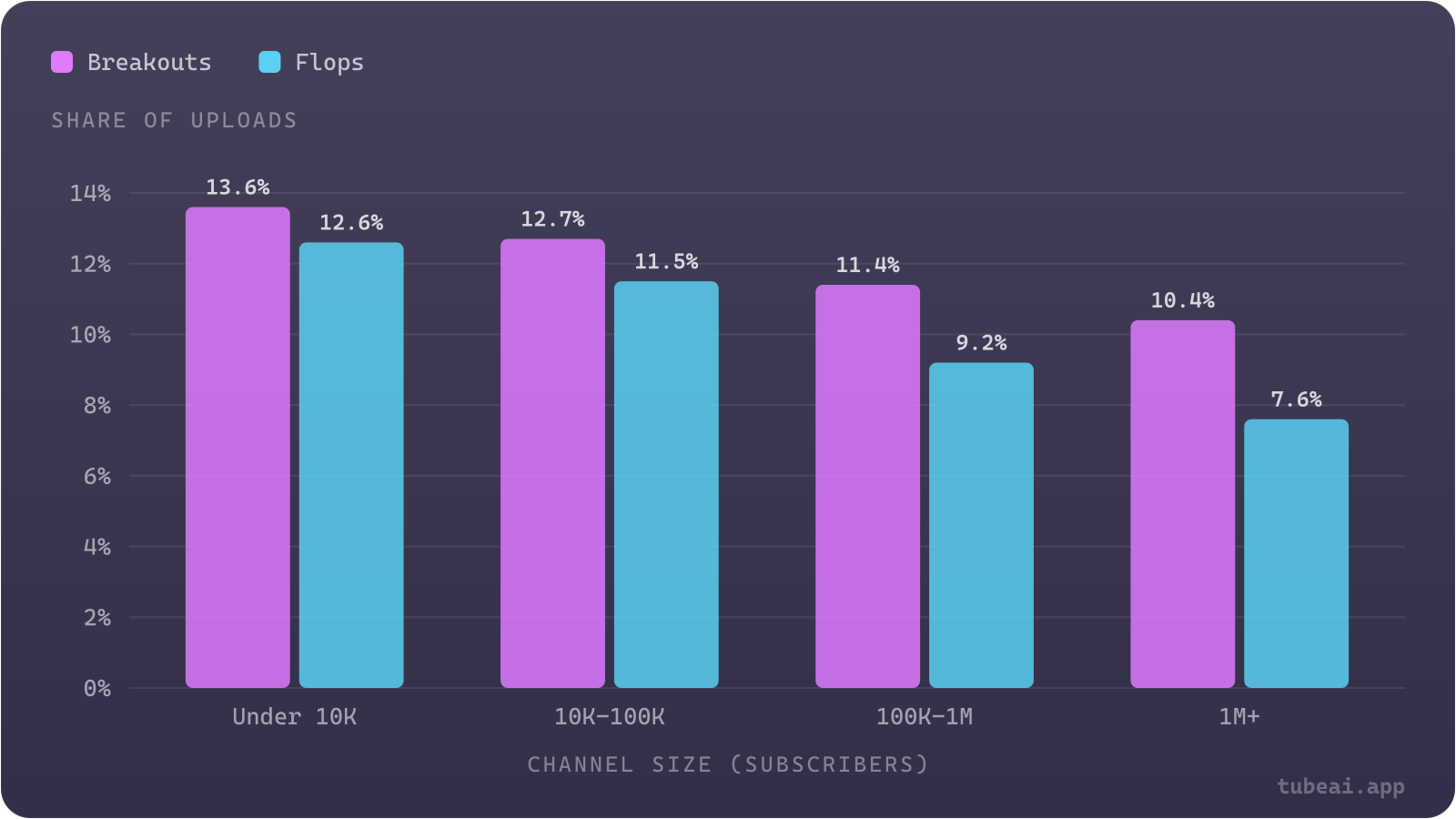
Chart data
| Channel size (subscribers) | breakouts (%) | flops (%) |
|---|---|---|
| Under 10K | 13.6 | 12.6 |
| 10K-100K | 12.7 | 11.5 |
| 100K-1M | 11.4 | 9.2 |
| 1M+ | 10.4 | 7.6 |
Channels under 10K subscribers broke out on 13.6% of uploads, against 10.4% for channels with 1M+. They also flopped more: 12.6% against 7.6%. Small channels' results swing more in both directions. The home page does not reserve its slots for big channels; a small channel's video that wins the click can still travel far beyond its usual audience.
One video often carries a channel's month
The same concentration shows up inside channels. Among 20,596 channels with at least five tracked uploads in the window (a median of 8 each), the best video took 26.6% of the channel's first-week views at the median, about twice its share if views were split evenly. For 9.2% of channels, a single upload took more than half.
- 26.6%of a channel's first-week views from its best uploadmedian channel
- 2xan even splitmedian channel
- 9.2%of channels got over half from one video
How to compete for fewer, bigger slots
Design for the big card first
Check your thumbnail at full home-page size, not just the small sidebar size. Detail that was invisible before is now on show, good or bad.
Keep one clear focal point
With fewer cards on screen, a viewer compares a few options closely. One subject, one idea and a few readable words beat a busy collage.
Fix weak packaging early
Most first-week views arrive in the first day. If a video stalls, a thumbnail swap is cheap to test.
Space out your strongest ideas
Your videos compete with each other for the same viewers. Two strong uploads on the same day can split the attention one would have taken.
Judge by your own baseline
Big channels take most raw views. Track whether each upload beats your channel's usual first week, not whether it beats a bigger creator.
For more on packaging, see what the data shows about changing your thumbnail after publishing, how YouTube's thumbnail A/B tests play out, and how long a YouTube title should be. The views in this study were counted under YouTube's new view count.
Frequently asked questions
Why are YouTube thumbnails so big now?
YouTube redesigned the desktop home feed to show fewer, larger video cards per row, a layout that spread from April 2025. YouTube says fewer options make it easier for viewers to choose, and that the change increased long-form viewing overall.
Can I make YouTube thumbnails smaller on the home page?
Not with a built-in setting. How many cards you see per row depends on your screen size and browser zoom. Zooming out shows more cards; browser extensions also exist, but YouTube does not offer the option itself.
Do bigger thumbnails mean more competition for creators?
Each screen holds fewer long-form slots, so each slot is worth more. In the TubeAI research database, the top 10% of long-form uploads already collected 70.6% of first-week views, so winning the click matters a lot.
Does the Shorts shelf take views from long-form videos?
It takes space on the home page, which leaves fewer slots for long-form cards on the first screen. YouTube says the overall layout grew both long-form and Shorts viewing, and in 2026 it began testing a layout that puts long-form above the Shorts shelf.
Should I redesign my thumbnails for the bigger layout?
Check how they look at full home-page size. Larger cards show more detail, so clear subjects and readable text help, and clutter hurts. Test changes on new uploads or with YouTube's Test and Compare.
Sources
- YouTube Says Bigger Thumbnails Drove More Long-Form Views — Search Engine Journal
- YouTube is testing giant homepage thumbnails, and people hate it — Android Authority
- Your YouTube home feed could soon look very different on mobile — Android Authority
- YouTube Thumbnails Too Big? How to Shrink Home-Page Cards — iTechGuides